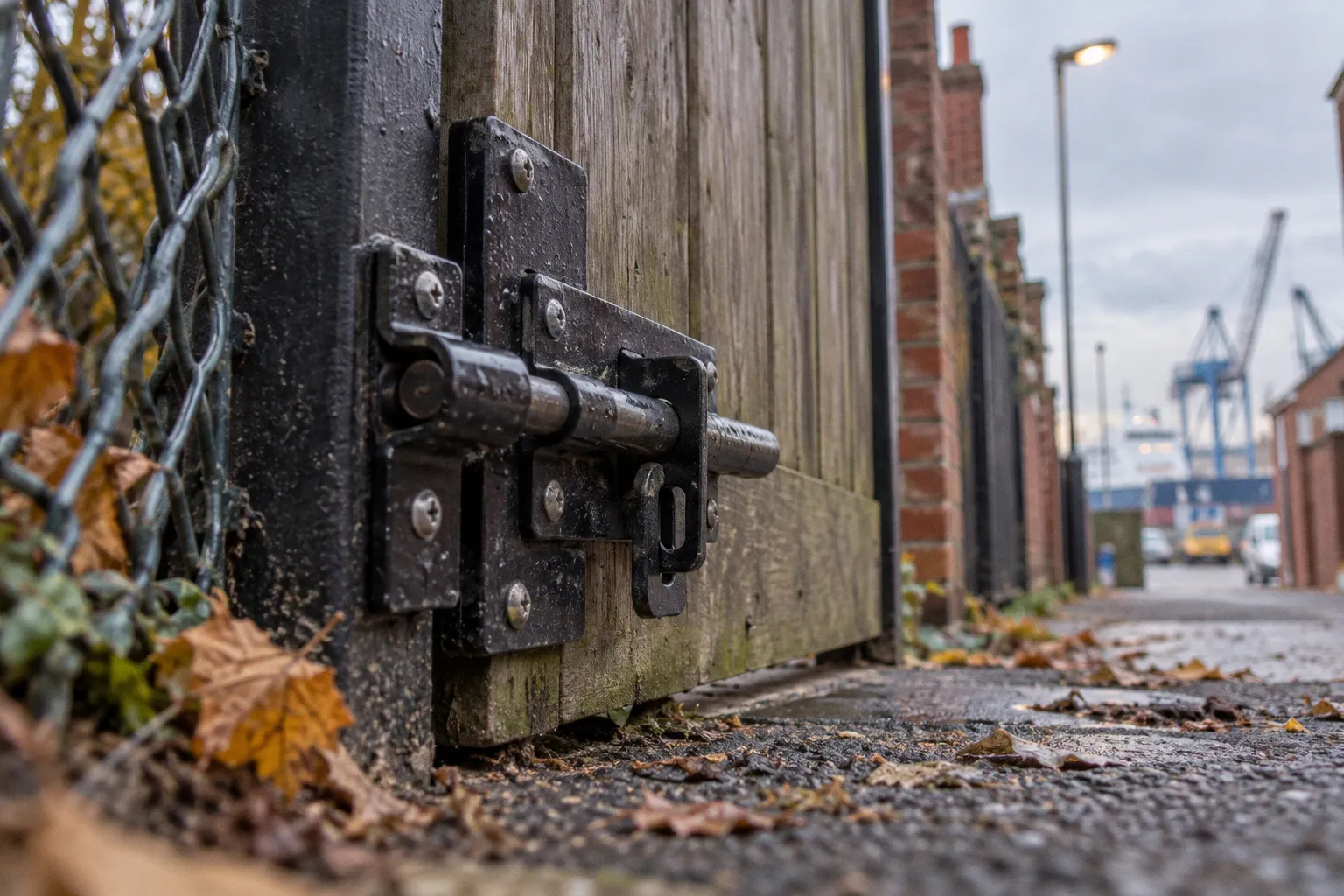
If the gate is open, low, loose, or secured with a single light-duty latch, it can give an intruder a concealed route from the pavement to the rear garden, back door, shed, or garage.
Roughly one in ten burglars gain entry through the side of a property. The figure is not a local ward-by-ward count for North East Lincolnshire, and it should not be read as one. It is a clear warning about the access point itself: the side passage is frequently less visible, less maintained, and less securely locked than the front entrance.
When I assess a property, I do not begin with the alarm. I begin at the pavement and follow the route an opportunist would use. Can the side gate be pushed open? Can a hand reach around it? Is the locking point exposed? Does the gate give cover from the street? Can someone get to the rear door without being seen from a neighbouring window?
That is the practical test. Residential side gate security improvements for burglary prevention start with controlling movement around the perimeter, not adding another device inside the house.
The hidden vulnerability: why side access remains a primary target
The side of a typical terraced or semi-detached property in Grimsby, Cleethorpes, or Immingham presents a familiar combination of weaknesses:
- The gate is positioned close to the front building line, where it can be reached and manipulated from the pavement.
- The gate is lower than the adjoining fence, leaving a person with an easy step-over route.
- A single sliding bolt holds the gate shut at waist height.
- The hinges are visible from the outside and fixed with short screws.
- The passage behind the gate is screened from the street by fencing, planting, bins, or a projecting wall.
- The rear door, shed, or garage is not visible until someone has already crossed the boundary.
None of these flaws is dramatic on its own. Together, they create a protected route through the perimeter.
A front door usually faces a road, has a recognisable entrance, and is more likely to be overlooked. A side gate often offers the opposite: concealment, a narrow approach, and a direct path to less visible access points. Once an intruder reaches the rear garden, the property may have lost its most useful layer of natural surveillance.
This is why preventing unauthorised access to back gardens should be treated as a separate security task. Locking the back door matters, but the gate determines whether someone can approach it unseen and take time examining the frame, glazing, hinges, or nearby tools.
A side gate is not decoration. It is the first door protecting the least visible side of the property.
Start with the gate closed, not with the lock
Stand outside the property and look at the gate as if you have no reason to be there. Do not begin by asking whether the lock is expensive. Ask whether the gate can be bypassed.
Check the following points in sequence:
1. Can it be reached without being seen?
Look from the nearest pavement, road junction, neighbouring front window, and any opposite property. A gate set behind a wall or hedge may be less exposed, but excessive screening can also remove natural surveillance.
2. Can it be opened without the key?
Push and pull the gate firmly. Test the latch side, bottom corner, and top rail. Movement is a vulnerability. A gate that rattles several centimetres may allow the lock or hasp to be attacked without creating much noise.
3. Can someone reach over or around it?
Measure the practical height, not just the nominal height. A low wall beside the gate, a wheelie bin, a trellis, or a raised section of paving can create a climbing aid.
4. Does the gate match the boundary?
A tall fence ending at a short gate signals a weak point. The boundary should operate as one perimeter rather than a series of unrelated pieces.
5. What lies beyond it?
A shed containing ladders or tools, an unsecured rear door, a side window, and a dark passage all increase the value of the route.
This physical audit takes minutes and usually identifies more useful work than a general purchase of smart security equipment.
Structural standards: height, position and boundary compliance
For side and rear gates, UK police crime prevention guidance recommends a minimum height of 1.8 metres, or roughly six feet. The adjoining fencing should be of a similar height. A tall fence with a knee-high gate is not a secure perimeter; it is a tall boundary with an invitation built into it.
The purpose of the height is straightforward. A properly proportioned gate removes the easy step-over route and makes the person attempting to cross it more visible and less stable. It is not an anti-climb system by itself. A determined intruder can still attack a gate, climb a fence, or use nearby objects. The height simply removes the quickest low-effort option.
Planning limits also matter. Rear and side garden fences and gates can generally be up to 2.0 metres high without planning permission. A structure over 2.0 metres beside public access may require approval. Local conditions, listed buildings, shared boundaries, and highway arrangements can change the position, so do not treat the 2.0-metre figure as permission to build anything anywhere.
A secure gate that blocks visibility onto a public footpath can create a different problem. If it is placed too far forward, close to the pavement, the recessed side passage may disappear from view behind the front elevation. Guidance commonly recommends keeping side gates no more than about 60 centimetres behind the front building line where the layout allows. The objective is to avoid creating a deep, concealed pocket at the entrance.
Front boundaries need a different approach
The front and side boundaries do not perform the same job.
A front wall or fence is usually best kept low enough to preserve a line of sight between the house and the street. A recommended maximum height of around 1.0 metre helps residents, neighbours, and passers-by see movement near the front door and windows. A high front boundary may offer privacy, but it can also remove observation from the most exposed part of the property.
The side boundary can be more defensive because its primary role is to stop movement towards the rear. That does not mean adding height without thought. A gate should not create a blind corner, obstruct a public path, or provide an easy support for climbing.
Use this distinction when planning residential side gate security improvements for burglary prevention:
| Area | Main security objective | Practical treatment |
|---|---|---|
| Front boundary | Preserve natural surveillance | Keep walls and fences low, with a clear view of the entrance |
| Side gate | Control movement into the rear garden | Use a secure gate at least 1.8 metres high, matching the adjoining boundary |
| Rear boundary | Delay access and protect the garden | Maintain consistent height, repair gaps, and remove climbable aids |
| Gate recess | Prevent a concealed approach | Avoid setting the gate deep behind the front building line; around 60 cm is a commonly recommended maximum recess |
| Gate hardware | Resist pulling and levering | Use two locking points, robust fixings, and hardware suited to the gate construction |
The perimeter should also be maintained. A gate secured at two points is still undermined by a broken fence panel, a gap under the gate, or a stack of bins placed beside it.
Hardening the perimeter with dual-point locking
The most common weakness I find in a side gate is not the absence of a lock. It is the use of one locking point in the middle of a flexible wooden gate.
A single central latch allows the top and bottom of the gate to move independently. That movement gives an attacker leverage. Pull the gate at the upper corner and the frame twists around the centre fixing. The lock may remain intact while the gate edge moves far enough to expose a gap or strain the hinges.
The practical response is dual-point locking. Position the locking points roughly one-third of the way up and one-third of the way down the gate. This spreads resistance across the gate leaf and reduces flexing.
Suitable arrangements can include:
- Two heavy-duty padbolts, each secured to a strong frame member.
- Two hasp-and-staple assemblies paired with five-lever padlocks.
- Long-throw gate locks installed at upper and lower positions.
- A lock at one-third height combined with a second bolt at the lower third, where the gate design allows it.
The lock is only as strong as its fixing. Short screws driven into a thin gate rail are not a serious defence. Use bolts or long fixings where the construction permits, reinforce the receiving post, and make sure the staple or keep cannot be pulled away from soft timber.
Gate security hardware for residential properties
Select hardware according to the way the gate is built.
A lightweight timber gate may need an internal reinforcement plate or additional horizontal rails before a lock can work properly. A metal gate may accept a long-throw lock but still have weak hinges or a flexible frame. A shared passage may require an arrangement that works for both households rather than a private padlock that prevents legitimate access.
The following faults deserve attention:
- Exposed padlock: An ordinary padlock hanging low on the gate can be attacked with bolt cutters or struck against the paving.
- Thin hasp: A strong padlock cannot compensate for a hasp made from light metal and fixed with small screws.
- Weak staple: If the receiving plate is attached to rotten timber, the lock is only securing a piece of failing wood.
- Loose post: Movement in the post transfers directly into the lock and creates a gap.
- Visible hinge pins: If the gate opens towards the property and the hinge pins are accessible from outside, replace or shield them where practical.
- Large bottom gap: A gap beneath the gate may allow tools or hands to be used against the lower locking point.
- Gate opening outward: An outward-opening gate can place its hinges and hardware on the public side and may interfere with a pavement or shared access route.
A padlock should be kept protected from weather and positioned so it cannot be easily gripped, twisted, or struck. That does not mean burying it behind decorative cladding. Security hardware must remain serviceable. A lock that sticks in winter will eventually be left open.
A stronger gate is not a guarantee
Dual locking is a delay and deterrent measure. It is not an absolute barrier. A side gate can still be defeated if the fence beside it is weak, the post is rotten, or the rear access door has a vulnerable cylinder and poor frame fixing.
Treat the gate as one layer:
1. The gate prevents casual access.
2. The boundary delays climbing and bypass.
3. Lighting exposes movement.
4. Windows and neighbours provide observation.
5. Rear doors and garage doors resist entry if the perimeter is crossed.
6. Alarms or cameras provide detection and evidence.
The order matters. There is little value in a camera aimed at a gate that is permanently left open.
Defensive additions: anti-climb measures and natural surveillance
The best anti-climb measure is often removing the object that makes climbing easy.
Move bins, timber, ladders, plant pots, stacked paving slabs, and garden furniture away from the gate and adjoining fence. Check both sides of the boundary. A resident may remove a bin from their own side while a neighbouring structure remains directly beside the fence.
Anti-climb additions can help, but they must be selected and installed with care. Trellis fixed above a fence may look defensive, yet a rigid trellis can become a ladder. Spiked strips and similar products may create safety, liability, and planning issues, particularly where the boundary borders a public route or a shared passage. The aim is to make climbing difficult without creating a hazard that harms residents, children, pets, or passers-by.
Lighting must reveal the access point
Security lighting is most effective when it covers the gate and the approach to it without creating glare.
A sensor light positioned too high or aimed directly towards the pavement can wash out the camera view and annoy neighbours. A light aimed along the passage should reveal the gate, locking hardware, and ground immediately inside it. Avoid deep shadows beneath the light fitting or behind a projecting wall.
Use lighting to support natural surveillance:
- Illuminate the gate approach rather than only the rear garden.
- Keep the gate visible from at least one occupied room where possible.
- Trim vegetation that blocks the line of sight from windows.
- Avoid dense planting beside the lock and hinge side.
- Check the light after dark, not only in daylight.
- Make sure the sensor does not trigger constantly from passing traffic or movement on a public path.
A permanently bright floodlight is not automatically better. Continuous glare can reduce visibility beyond the illuminated area and may encourage residents to disable the fitting. Controlled, well-aimed lighting is the more useful deterrent.
Cameras should cover the route, not just the property
A camera should show what happens at the gate: approach, manipulation, entry, and movement into the passage. A view that captures only the rear door begins too late.
Mounting height, angle, and lighting determine whether recorded footage is useful. A camera pointed at a bright street may produce silhouettes at night. A camera aimed down at the top of a gate may miss a person working at the lock. If the camera is installed behind glass, infrared reflection can ruin the image.
Privacy also matters. A residential camera should be directed at the property and immediate access route, not casually across neighbouring gardens or inside nearby homes. The equipment should supplement physical security rather than excuse a weak gate.
Secured by Design: what the evidence says about physical vulnerability
The value of target hardening is not limited to one lock or one gate. Secured by Design standards apply a broader approach to the way buildings, boundaries, access routes, doors, windows, lighting, and surveillance work together.
Independent research cited by the College of Policing found burglary rates were 53% lower in properties complying with Secured by Design standards compared with unaccredited homes. The same body of evidence reported a 77% reduction in attempted burglary under the standards. These figures do not mean that a certified or well-designed property is immune. They show that physical design can alter opportunity at scale.
The lesson for an ordinary household is practical: build resistance into the property before relying on detection after an intruder has crossed the boundary.
For a side gate, that means assessing:
- Whether the gate is visible and proportionate to the boundary.
- Whether the locking points resist leverage.
- Whether the hinges and posts are as strong as the lock.
- Whether a person can climb over using nearby objects.
- Whether lighting exposes the approach.
- Whether the rear door and garage door remain secure if the garden is reached.
- Whether the route is shared and needs an agreed access arrangement.
North East Lincolnshire support and local improvements
The Safer Streets initiative in North East Lincolnshire has distributed free home security kits in areas including East Marsh in Grimsby. These kits have included items such as locks, security lighting, alarms, and CCTV. Availability and eligibility can change, so residents should confirm current arrangements through the relevant local programme rather than assume a kit is available everywhere.
Local security work is most effective when it addresses the physical conditions of a street. Alley gating schemes, improved lighting, and better surveillance can reduce access opportunities across several properties. They do not remove the need for each household to secure its own side gate. A gated alley still contains individual weak points: an unlocked garden gate, a damaged fence, or a rear door visible from the passage.
If several properties share a side access route, coordinate the perimeter. One open gate can undermine the security work carried out next door. Agree who holds keys, how the gate is closed, and who reports damage. A shared boundary without a shared operating habit will not remain secure.
A five-minute side gate audit
Carry out this audit in daylight, then repeat it after dark. Use the route from the public side first.
1. Approach the gate from the pavement.
Identify whether the gate is visible, recessed, screened, or hidden by a wall, hedge, bin, or parked vehicle.
2. Test movement at three points.
Push near the top, centre, and bottom of the latch side. Any substantial flexing indicates that the gate, frame, post, or lock needs attention.
3. Inspect the height and continuity.
Compare the gate with the adjoining fence. A gate below 1.8 metres or a boundary with a sudden height change is a clear vulnerability.
4. Examine the hardware.
Look for a single central latch, short screws, exposed hinge pins, corroded padlocks, and a receiving post that moves under pressure.
5. Look for climbable aids.
Remove or relocate bins, ladders, furniture, trellis, and stacked materials beside the gate.
6. Walk the route to the rear door.
Note every window, shed, garage, tool store, and dark corner that can be reached once the gate is open.
7. Check the line of sight.
Stand inside the house and look towards the gate. Then stand outside and look back. Trim only what blocks observation; do not create a new blind screen.
8. Test the lighting.
Trigger the sensor after dark. Confirm that the gate, lock, and approach are visible without glare obscuring the view.
9. Close and lock the gate as a habit.
A sound mechanism that is left open is not a security measure.
10. Move to the next layer.
Check the rear door, garage door, and accessible windows. The gate reduces opportunity, but the secondary access points still need proper locks and secure frames.
The immediate, low-cost fixes
Not every property needs a new gate. Start with the defects that create the easiest route.
- Fit a second locking point at the upper or lower third of the gate.
- Replace a weak hasp, staple, or short fixing rather than simply buying a more expensive padlock.
- Repair a loose gate post and rotten frame sections.
- Raise a low gate to match the adjoining boundary, subject to local planning requirements.
- Reposition bins and garden equipment away from the perimeter.
- Trim vegetation around the gate and the sightline from the house.
- Install a correctly aimed sensor light covering the approach and lock.
- Add a gate stop so the leaf cannot be pushed past its intended closing position.
- Check whether the gate opens in a way that exposes hinges or obstructs public access.
- Secure the rear door and garage door after the perimeter work is complete.
These measures are modest, but they remove the low-effort vulnerabilities that make side access attractive.
Final assessment
Residential side gate security improvements for burglary prevention are not about turning a garden into a fortress. They are about closing the quiet route that allows someone to move from public space to private space without observation.
Use a gate at least 1.8 metres high where suitable, keep it aligned with the boundary, avoid a deep concealed recess, and install locking points that resist leverage rather than merely holding the gate shut. Protect the hardware with sound fixings. Remove climbing aids. Light the approach. Preserve a clear line of sight. Then secure the rear doors and windows as part of the same perimeter.
Tonight, walk to the side gate from the pavement and test it with your hands. If it moves, flexes, hides the approach, or opens with one casual action, you have found the first vulnerability. Fix that before spending money on another device inside the house.