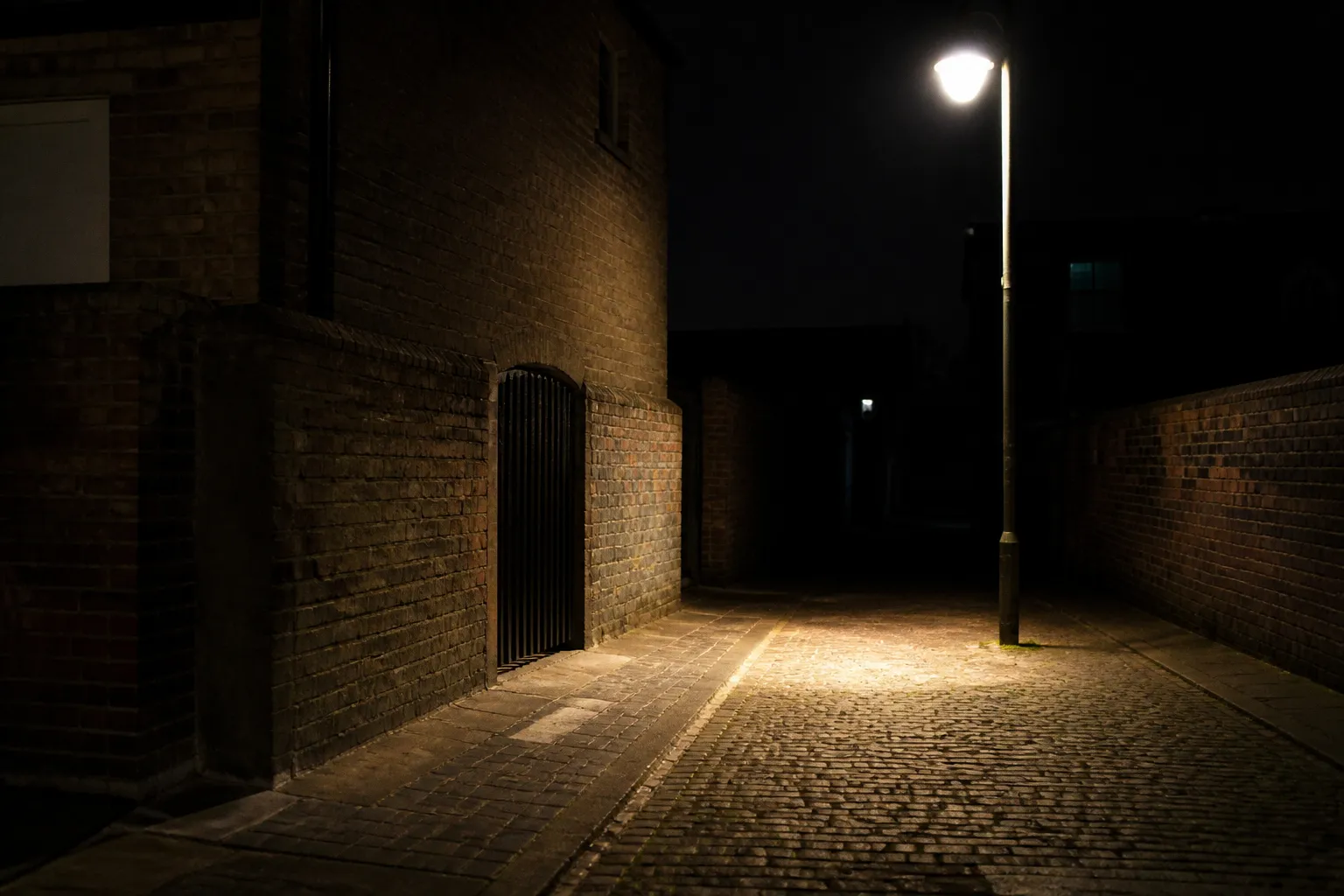
Those figures are significant, but they do not represent the isolated effect of new street lighting.
The intervention combined several measures: upgraded public lighting, expanded CCTV coverage, rapid deployment cameras, repaired alley gates, clearance of accumulated waste, and around 500 home-security upgrades. The available data supports a clear conclusion about the package as a whole. It does not support a narrower claim that street lighting alone caused the reduction.
That distinction matters. Public safety infrastructure is often assessed as if each component operates independently. In practice, residents experience the combined system: a better-lit route, a visible camera, a gated alley, a secured rear door and a cleaner line of sight may all affect the same incident opportunity. The East Marsh results are therefore best read as evidence for a layered preventative framework rather than a single-purpose lighting project.
The £749,500 intervention was designed as a combined system
The East Marsh project was managed by North East Lincolnshire Council in partnership with the Office of the Humberside Police and Crime Commissioner. The funding award was made in July 2022, with home security visits and the rollout of rapid deployment CCTV beginning in November of that year. The project's completion and impact figures were announced in October 2023.
The programme addressed several different points in the local security environment:
- Street-level visibility: lighting improvements were intended to improve visibility in public areas and along routes used by residents.
- Public-space surveillance: 11 new CCTV cameras were connected to the council's wider network.
- Short-term hotspot monitoring: six rapid deployment cameras were installed in locations identified as requiring flexible surveillance, including Rutland Street.
- Access control: alley gates were repaired or replaced across 30 sites.
- Environmental maintenance: nearly 10 tonnes of waste and 12 bulky items were removed from East Marsh alleyways.
- Household protection: around 500 home-security upgrades were installed, including outdoor security lights, window locks and alarms.
This distribution of measures indicates a policy aimed at reducing opportunity across multiple settings. The target was not only the road or footpath where an offence might occur. It also included the boundary between public and private space: rear alleys, entrances, windows, gardens and the external areas around homes.
A lighting upgrade can improve visibility, but it cannot control access to a passageway. A CCTV camera can support detection, but it does not physically secure a window. An alley gate can restrict movement, but it does not address an insecure rear door. The programme's logic was based on overlap between these functions.
The East Marsh data measures the effect of a security package. It does not isolate the effect of street lighting from CCTV, gating, environmental clearance or household upgrades.
That is not a limitation unique to East Marsh. Multi-agency safety projects are generally implemented as packages because crime opportunities are not separated neatly by administrative category. The evaluation challenge is that the same design makes it difficult to assign a precise percentage of the outcome to any one measure.
What the 23% crime reduction actually tells us
The reported 23% reduction in crime is the headline metric. It indicates that overall crime fell across East Marsh after the Safer Streets measures were implemented. The accompanying 27% reduction in anti-social behaviour is also material because anti-social behaviour often reflects repeated use of the same spaces, persistent nuisance activity and localised disorder rather than isolated incidents.
The two figures should not be collapsed into a single claim. Crime and anti-social behaviour are related but distinct measures. A reduction in one does not automatically establish an equivalent reduction in the other. Their simultaneous decline does, however, suggest that the intervention affected more than one category of local harm.
There are several practical interpretations:
1. The physical environment became more difficult to use for opportunistic activity. Better visibility, controlled alley access and the removal of waste can reduce concealment and unmanaged space.
2. The perceived probability of detection increased. Networked CCTV and rapidly deployable cameras can alter the risk calculation in locations where incidents are concentrated.
3. Household vulnerability was reduced. Window locks, alarms and outdoor lights address different stages of a potential burglary or trespass event.
4. The local disorder environment was disrupted. Clearing alleyways and repairing gates can reduce the conditions that allow nuisance activity to become persistent.
5. The interventions reinforced one another. A visible camera is more useful when the area is accessible and observable; a lighting improvement has greater practical value when it supports a secure route and a monitored space.
These are plausible mechanisms within the preventative framework. They are not separate statistical findings. The available evaluation does not provide an isolated incidence rate for streets with new lighting compared with otherwise equivalent streets that did not receive the upgrade. It also does not establish the specific contribution made by each camera, gate, light or household installation.
The correct analytical position is therefore measured: East Marsh experienced a 23% reduction in overall crime after a multi-layered safety intervention. The outcome is consistent with the programme's design, but it cannot be used to claim that lighting alone produced the reduction.
Why street lighting remains central, despite the attribution problem
The inability to isolate lighting's effect does not make the lighting component irrelevant. It means that lighting should be assessed according to its role within the wider system.
Street lighting improvements can affect three operational conditions.
Visibility
Lighting can improve the ability of residents, patrols and camera systems to observe movement and identify changes in the streetscape. This is particularly relevant where routes are narrow, bordered by walls or buildings, or connected to alleyways with limited natural surveillance.
The value is not simply brightness. The location, continuity and maintenance of the lighting network matter. A dark gap between two illuminated sections can remain a concealment point. Obstructed fixtures, damaged units or poor coverage around entrances can weaken the practical result. The available East Marsh data does not specify the lumens, hardware models or precise illumination levels of the upgraded units, so technical claims about performance would be premature.
Route confidence and movement patterns
Residents, workers and visitors make decisions about which streets to use and when. A more consistently visible route may reduce avoidance behaviour and concentrate movement on streets where surveillance and access control are stronger. That can increase natural observation without requiring every movement to be monitored directly.
This should not be confused with a guarantee of safety after dark. Lighting does not eliminate crime, and it does not remove the need for household security, policing or environmental maintenance. Its role is to reduce unmanaged visibility gaps and support the use of public space under more controlled conditions.
Support for surveillance and guardianship
CCTV is not independent of the physical environment. Camera coverage is shaped by sightlines, obstructions, lighting conditions and the ability to identify activity. An illuminated area may provide more usable visual information than an area where movement is obscured. At the same time, camera effectiveness depends on positioning, monitoring arrangements, retention policies and response capacity. A camera installed in a poorly designed location is not equivalent to meaningful surveillance.
The East Marsh programme expanded the council-connected network by 11 cameras and added six rapid deployment units in hotspot areas. This is a more direct surveillance intervention than lighting. The two measures may support one another, but the crime data does not quantify the relationship.
CCTV and alley gates changed the structure of opportunity
The 11 fixed cameras and six rapid deployment cameras increased the surveillance capacity available in East Marsh. The distinction between the two types is operationally important.
Fixed cameras provide consistent coverage at established locations. They are suitable where the risk pattern is sufficiently stable to justify permanent infrastructure. Rapid deployment cameras provide flexibility. They can be positioned in hotspot locations where the pattern of incidents is changing or where a short-term response is required before a permanent solution is considered.
This arrangement recognises that crime concentration is not static. A location may become active because of a temporary dispute, a change in local movement or the displacement of activity from another site. Rapid deployment equipment can respond to that variation more quickly than a permanent construction programme.
Alley gates addressed a different problem: uncontrolled permeability. Across 30 sites, gates were repaired or replaced after the removal of nearly 10 tonnes of waste and 12 bulky items. The combination is important. A gate installed in a neglected or obstructed alley does not create a credible security boundary. Clearance improves access for legitimate users and reduces the physical disorder that can make an alley appear unmanaged.
A secured alley can limit through-movement, reduce escape routes and create a clearer distinction between public access and residential space. It is not a universal solution. Gates require maintenance, correct use and a local arrangement for access. But as part of a wider design, they can reduce the number of uncontrolled connections between streets and rear property boundaries.
| Intervention | Primary security function | Limitation when used alone |
|---|---|---|
| Street lighting improvements | Increase visibility and support safer movement through public space | Cannot control access or prevent entry to a property |
| Networked CCTV | Improve monitoring and provide potential evidential coverage | Effectiveness depends on positioning, operation and response |
| Rapid deployment cameras | Address changing or concentrated hotspot activity | Temporary coverage may not resolve underlying environmental problems |
| Alley gate repairs and replacement | Restrict uncontrolled access through rear routes | Requires maintenance, access management and resident compliance |
| Home-security upgrades | Reduce vulnerability at windows, doors and external areas | Protection is limited if other access points remain weak |
| Waste and bulky-item clearance | Remove concealment, obstruction and signs of unmanaged space | Environmental improvement must be sustained over time |
The table also explains why the East Marsh results should not be assigned to one technology. Each intervention closes a different gap. The programme's value lies in the combined reduction of opportunity across the public realm, semi-private routes and individual properties.
Around 500 home-security upgrades moved prevention inside the boundary
A major feature of the East Marsh project was the installation of around 500 home-security upgrades. These included outdoor security lights, window locks and alarms installed by Empower CIC.
This part of the programme matters because public-space improvements cannot protect a property once an offender reaches its boundary. The transition from street to home often occurs through rear alleys, gardens, side passages, ground-floor windows or poorly secured doors. Household target hardening addresses these points directly.
The measures also operate at different stages:
- Outdoor security lighting can increase visibility around entrances and garden boundaries. Its effect depends on placement, maintenance and whether it creates useful coverage rather than isolated glare.
- Window locks address a specific physical vulnerability. They are most effective when fitted to windows that are accessible from the ground, a roofline, a rear passage or an adjoining structure.
- Alarms can increase the likelihood of detection after unauthorised entry and may influence offender selection before entry occurs.
- Property marking, although not identified among the listed East Marsh installations, is another example of a household measure that can support recovery and reduce the resale value of stolen goods.
The value of a household upgrade is therefore conditional on the wider property layout. A locked window does not compensate for an unsecured rear gate. An alarm does not resolve a concealed approach route. A security light can be poorly positioned or disabled. Effective target hardening is not the installation of one conspicuous device; it is the reduction of weak points across the property's accessible perimeter.
This is where the East Marsh programme aligns with the broader principles associated with Secured by Design and defensible space architecture. The underlying objective is to make ownership, access and observation clear. A resident or legitimate visitor should be able to understand where access is permitted. An unauthorised entrant should encounter more friction, less concealment and a higher prospect of detection.
It is also worth being precise about what the headline figure represents. The published number describes the volume of home-security upgrades and equipment pieces delivered into East Marsh, not a confirmed count of individual properties that received a visit. Several visits can result in multiple upgrades at one home, while a single visit can also result in no installation if the property is already adequately secured or the resident declines. Reading the figure as a precise tally of households reached would overstate what the data actually shows.
East Marsh and West Marsh show a consistent regional pattern
The East Marsh results are not an isolated local data point. A preceding Safer Streets 2 project in neighbouring West Marsh recorded a 21% reduction in crime and a 29% reduction in anti-social behaviour after a similar combination of street lighting, CCTV and gating interventions.
The comparison is useful, but it should not be treated as a controlled experiment. East Marsh and West Marsh are separate wards with different physical layouts, population movement, property types, baseline conditions and operational pressures. The interventions may also have differed in their timing and precise delivery. A similar outcome does not prove that the same component had the same effect in both locations.
It does, however, support three restrained conclusions.
First, multi-layered environmental safety projects can be associated with measurable reductions in both crime and anti-social behaviour across different parts of Grimsby.
Second, the pattern is stronger than a claim based on one isolated intervention. Both projects used a combination of lighting, surveillance and access-control measures rather than relying on a single asset.
Third, local resource allocation should be linked to the geography of incidents. The presence of a camera, gate or upgraded light is less important than whether it addresses an identified vulnerability in the local street network.
The regional evidence therefore favours a place-based approach. It does not favour blanket installation of equipment without an incidence-rate analysis or a clear maintenance plan.
The limits of the available evidence
The published East Marsh figures provide a useful outcome measure, but they leave several questions unresolved.
The most important is attribution. The data does not identify how much of the 23% crime reduction came from lighting, how much from CCTV, how much from alley gates, and how much from household security upgrades. Each of these inputs is theoretically capable of influencing offending patterns, and each has a credible mechanism in the published literature on environmental crime prevention. The East Marsh figures simply do not separate them.
The second question is displacement. A reduction in recorded crime in one ward can reflect genuine prevention, a shift in offending to a neighbouring area, a change in reporting behaviour or a reclassification of incidents. Without ward-level comparisons against comparable areas that did not receive the intervention, the displacement question cannot be resolved. The published summary does not address it.
The third question is sustainability. Environmental interventions decay unless they are maintained. Lighting columns develop faults. Cameras are affected by weather, vandalism and connectivity issues. Gates are propped open, damaged or simply forgotten. Waste accumulates again. The East Marsh programme reported an initial improvement, but the published figures do not describe the position twelve or twenty-four months after completion. The longer-term value of the package depends on whether the operational and maintenance arrangements are sustained beyond the funding window.
The fourth question is data granularity. The headline figures are presented at ward level, which is a broad geography. A ward contains many streets, alleyways and property types. Some of those locations will have benefited more than others from the package, and some will have changed very little. A more granular analysis, mapping incident locations against specific interventions, would allow future projects to be targeted more precisely.
Local crime outcomes improve when environmental, surveillance and household measures reinforce one another. They do not improve when a single measure is asked to carry the entire burden.
The honest reading of the East Marsh evidence is therefore that the programme worked as a package, that the available evaluation does not allow the package to be unbundled, and that future projects of this kind would benefit from clearer attribution analysis from the outset. The role of street lighting within the East Marsh result is real but it is not separable, and presenting it as a standalone cause would misrepresent what the data shows.
What the data does support is a working principle. Where crime is concentrated, lighting, cameras, gating, environmental maintenance and household target hardening should be planned together, evaluated together and resourced together. East Marsh is a useful example of what that combined approach can deliver. It is not, and should not be read as, evidence for any one of those measures acting in isolation.