Smart Security vs Physical Target Hardening: Choosing Home Defense
Across Grimsby, Cleethorpes and Immingham, that is too narrow a way to think about household safety. A camera may notice movement, send an alert and provide useful evidence; a well-fitted door, a certified cylinder and properly secured windows can make entry slower, noisier and more difficult in the first place.
For residents considering home security upgrades in Grimsby or elsewhere in North East Lincolnshire, the most resilient approach is rarely one technology replacing another. It is a layered partnership between the building, the people who live in it and the systems that help them see what is happening around it. Physical measures create resistance. Smart systems create awareness. Neither is a complete answer on its own.
The evolution of deterrence: from 1970s hardening to digital eyes
The idea now known as physical target hardening emerged in criminology during the 1970s. Its principle is straightforward: increase the effort, time and risk required to enter a property, so that the building becomes a less attractive target.
That does not mean turning a home into a fortress. In practical terms, target hardening includes the ordinary features that residents use every day without necessarily thinking of them as crime-prevention measures:
- doors fitted with strong frames, robust hinges and appropriately accredited locks;
- windows that can be locked securely, particularly those beside doors or hidden from the street;
- external lighting that removes deep shadows around entrances and side passages;
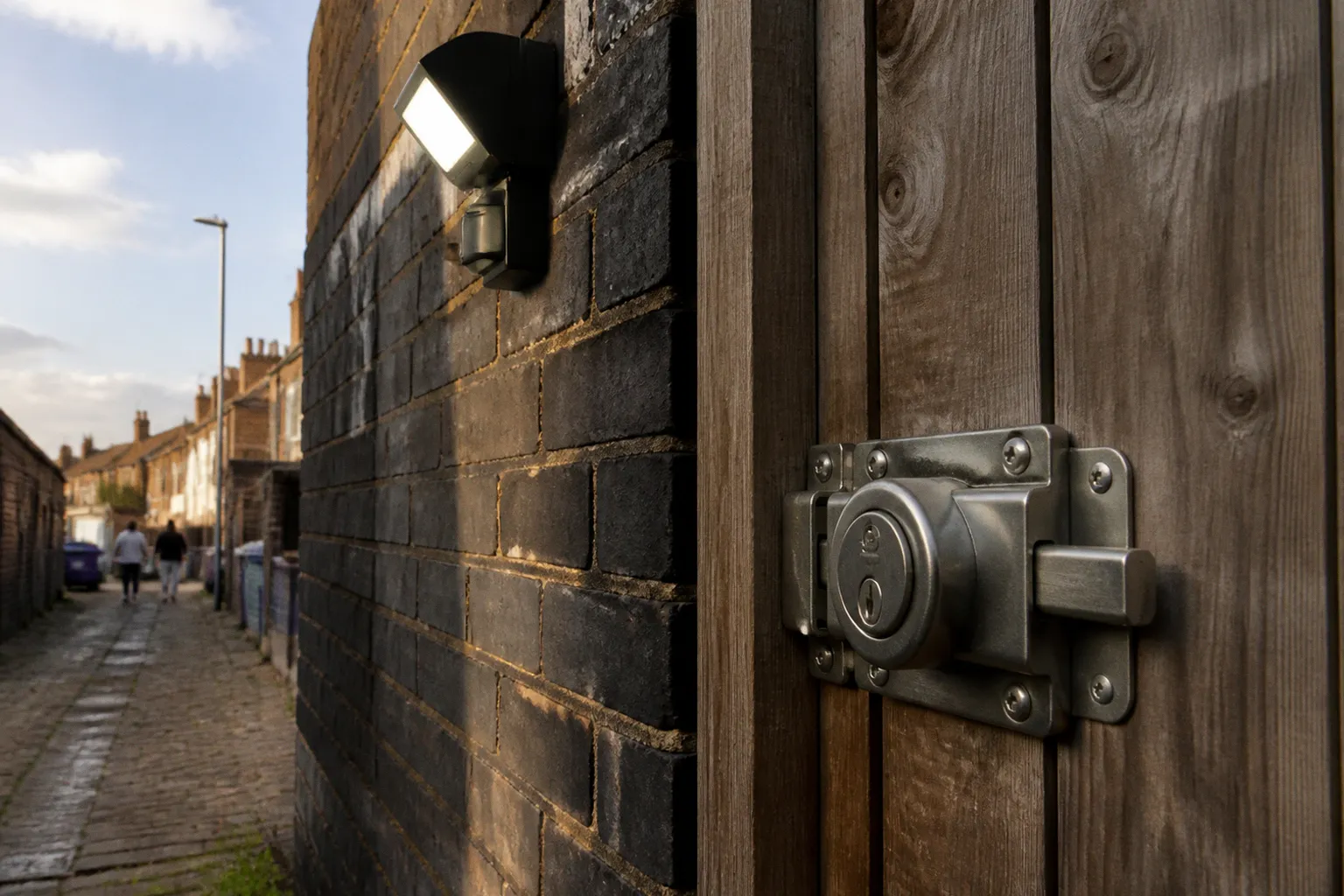
- gates that control access to rear alleys or gardens;
- visible property marking, which can make stolen goods harder to sell and easier to identify.
The wider decline in domestic burglary from the 1990s onwards has been associated with the broad adoption of combinations such as window locks, door locks and external security lighting. That history matters because it shows the value of ordinary, consistently applied improvements. The most effective security measure is not always the newest one. Often it is the unglamorous improvement that quietly removes an easy opportunity.
In North East Lincolnshire, the shape of the surrounding street matters as much as the specification of an individual lock. A terraced property in Grimsby may have a narrow rear passage, a shared alley and a garden gate that has seen better decades. A semi-detached home in Cleethorpes may have a side access point that is difficult to see from neighbouring windows. An Immingham property may face a more open frontage but still have a vulnerable rear door or garage.
These are different security problems, even when the houses have similar front doors.
Physical target hardening does not promise that nothing will ever happen. It makes the easiest route less easy, and that small change can alter the decision entirely.
The same principle applies to street-level projects. Alley gating schemes, better lighting and carefully designed public spaces can reduce concealment and improve natural observation. They are forms of household and neighbourhood target hardening because they alter the environment around the property, not only the lock within it.
Why physical barriers remain the first line of defence
A smart camera can identify movement. It cannot hold a door shut.
That distinction is central to any honest comparison of smart home security versus physical target hardening. Mechanical protection operates at the point where an intruder must cross from outside to inside. A locked door, reinforced frame or secured window introduces physical resistance immediately, without relying on a broadband connection, a mobile application, a battery or a cloud service.
Physical measures also work quietly. They do not need to recognise a person correctly, distinguish a delivery driver from a trespasser or deliver an alert to someone who happens to be in a meeting. Their job is simpler: resist forced entry and remove the conditions that make access quick.
The door is a system, not a single product
Residents sometimes replace a cylinder and assume the front door is now secure. In practice, the cylinder is only one part of the assembly. The frame, hinges, strike plate, multipoint mechanism and the way the door is fitted all contribute to the result.
A strong lock installed in a weak or poorly aligned door may offer less protection than expected. The same is true of a door with a sturdy leaf but an old frame that can flex under pressure. For a meaningful home security upgrade, the condition of the whole entrance should be considered.
This is where Secured by Design standards can provide a useful reference point. The scheme maintains accreditations for physical security products and building approaches, helping residents and housing stakeholders distinguish independently assessed security equipment from products that simply use reassuring language in their marketing.
That does not mean every home needs a complete replacement door. A practical assessment may point instead to a better cylinder, improved hinges, a reinforced strike area, repaired alignment or a gate that can no longer be lifted from its fittings.
Windows and rear access deserve more attention
Front doors receive most of the conversation because they are visible, familiar and easy to photograph for a product listing. Rear windows, conservatory doors, utility-room entrances and side gates can be more consequential when they are screened from the street.
A household target hardening plan for a property in North East Lincolnshire may therefore include:
- checking whether accessible windows have working locks rather than decorative catches;
- securing doors that open onto gardens, yards or shared passages;
- repairing gaps beneath gates and replacing loose or damaged hinges;
- removing objects that could be used to reach a window or climb over a boundary;
- improving lighting without creating glare that makes the area harder to observe;
- keeping bins, sheds and garden furniture from providing an easy route over a fence.
The aim is not to make every boundary high, harsh or unfriendly. Good security design creates a defensible space: an area that residents can see, understand and reasonably maintain, while discouraging unauthorised movement.
Lighting works best when it supports observation
Lighting is sometimes treated as a simple matter of installing the brightest possible floodlight. That can be counterproductive. Excessive glare may obscure faces on a camera and make it harder for neighbours to see what is happening.
A better arrangement usually gives attention to the approach, the entrance and the space immediately around the property. Motion activation can reduce unnecessary illumination, while a modest level of background lighting can prevent the surroundings from dropping into complete darkness between activations.
For a street in the East Marsh or a similar dense urban setting, the most useful solution may involve more than one property. A single brightly lit doorway cannot compensate for a dark alley, overgrown boundary or blocked sightline. This is why community conversations around lighting improvements, alley access and street design are so valuable: they move the discussion from isolated gadgets towards collective resilience.
The psychological impact of visible smart surveillance
Smart security systems add something physical measures cannot provide: information at a distance.
A doorbell camera can show who is at the entrance when nobody is home. A motion sensor can notify a resident before they return to the property. A connected alarm can draw attention to an event, while a camera may preserve video evidence that helps establish what happened. These functions are particularly useful for residents who work irregular hours, care for relatives or want greater visibility over a side passage, driveway or communal approach.
Research involving 422 convicted burglars at the University of North Carolina found that visible cameras were rated the second-strongest deterrent against break-ins, behind dogs. The finding does not mean that a camera physically prevents entry. It shows that visibility can influence how an offender assesses effort, risk and the likelihood of being identified.
There is also evidence that adoption can have a neighbourhood effect. Ring reported in 2023 that areas where doorbell cameras had reached 25% adoption experienced a 19% reduction in break-in occurrences. That figure is a company-reported result, so it should not be treated as a universal promise for every street in Grimsby or Cleethorpes. It does, however, point towards an important community principle: when surveillance is visible across a group of homes, the perceived risk may extend beyond one front door.
Smart systems are strongest before and after an incident
The value of connected security is often found in the moments around an event rather than in a dramatic confrontation.
Before an incident, a visible camera, a well-positioned doorbell unit or an alarm sign may encourage someone to choose another property. During an incident, a notification can prompt a resident, neighbour or monitoring service to respond. Afterwards, recorded footage, timestamps and images may assist with reporting and investigation.
That chain depends on realistic expectations. A camera may miss a face in poor light. A notification may arrive late. A battery can run low. A device may lose connection, and a recording may be overwritten if storage settings are not understood. Smart security is an early-detection and evidence tool, not a substitute for a lock.
Residents should also consider where cameras point. A device can protect an entrance without unnecessarily recording private gardens, bedroom windows or neighbouring properties. Good placement supports trust, particularly in close-knit streets where security measures need to strengthen partnership rather than create tension.
The weakness of visibility without resistance
A prominently mounted camera can deter some opportunistic offenders, but it does not close the gap beneath a rear gate or reinforce a fragile door. A siren may attract attention, but it cannot physically delay an intruder once the entry point has failed.
The same is true of a phone alert. It is useful only if someone can receive it, understand it and act safely. Residents should never be expected to confront an intruder because a notification appears on a screen. The safer response is to move away from danger, contact the appropriate emergency service where necessary and preserve information for later reporting.
Smart systems are therefore best understood as the visible and responsive layer of a wider security arrangement.
Integrating IoT security with Secured by Design standards
The most sensible question is not whether a household should choose smart or physical security. It is how the two layers should work together without leaving a basic weakness between them.
A useful sequence begins with the building:
1. Secure the entry points first. Check doors, frames, cylinders, window locks, side gates and rear access before purchasing connected equipment.
2. Identify the blind spots. Look from the pavement, garden and neighbouring properties to see where movement is hidden from ordinary view.
3. Add detection where it answers a real problem. A doorbell camera may suit a front entrance; a contact sensor may be more useful on a rarely used rear door.
4. Make the system visible but not intrusive. Cameras and lighting should support deterrence and observation without unnecessarily overlooking private space.
5. Build in resilience. Keep essential physical protection in place if the Wi-Fi fails, the power cuts out or a device needs updating.
6. Review the arrangement with neighbours where appropriate. Shared alleys, communal entrances and repeated nuisance activity are rarely solved by one household acting alone.
The UK Secured by Design framework has also expanded into the Secure Connected Device scheme, which evaluates aspects of cyber security in internet-connected technology. That development reflects a reality residents increasingly encounter: a smart camera is not only a piece of hardware fixed to a wall. It is also an account, an application, a network connection and a stream of data.
What to look for in a smart home security system
The product with the longest feature list is not necessarily the most dependable choice. A resident comparing smart home security systems should look for practical fit rather than novelty.
Useful questions include:
- Does the device continue recording or sounding an alarm if the internet connection drops?
- What happens during a power cut, and how long will any battery backup last?
- Can access to the account be protected with a strong password and multi-factor authentication?
- Are software updates provided, and is the support period clearly explained?
- Can motion zones be adjusted so that the system does not trigger constantly because of passing traffic, gulls or swaying branches?
- Is footage stored locally, remotely or through a subscription, and how long is it retained?
- Can the device be removed securely if a tenancy ends or the property changes hands?
- Is the camera positioned to capture the relevant approach rather than a wide area of neighbouring private space?
These are not abstract technical questions. They affect whether a system remains useful six months after installation, when the excitement of a new device has passed and residents need it to work quietly in the background.
| Security layer | What it does well | What it cannot do alone |
|---|---|---|
| Certified locks and reinforced doors | Adds physical resistance and slows forced entry | Cannot send alerts or provide visual evidence |
| Window locks and secured gates | Closes common access routes and reduces easy opportunities | Cannot identify movement or distinguish authorised visitors |
| External lighting | Improves visibility and can remove concealment | May be ineffective if badly positioned or excessively bright |
| Doorbell cameras | Creates visible deterrence, remote awareness and recorded evidence | Does not physically stop a door or gate from being forced |
| Smart alarms and sensors | Detects opening, movement or unusual activity and can notify residents | Depend on power, settings, connectivity and a safe response plan |
| Neighbourhood measures | Improve shared access control, observation and collective resilience | Require cooperation, maintenance and agreement across residents |
This layered view is especially important for older housing stock, where the most expensive connected equipment may be compensating for a basic weakness that could have been addressed more directly.
A notification tells you that something may be happening. A sound door and a secured gate help determine how far that something can go.
Street design, alley gating and the shared edge of home security
Individual household security ends at the boundary only on a property plan. In daily life, residents move through alleys, paths, car parks, communal entrances and poorly lit stretches of road before reaching their own front door.
That shared edge is where community safety work becomes practical. Alley gating schemes in Grimsby, for example, can reduce uncontrolled access where rear passages repeatedly provide concealment or an escape route. Lighting improvements in East Marsh can support natural observation when they are designed with the surrounding buildings, pedestrian routes and sightlines in mind. CCTV installation across North East Lincolnshire can help in locations where there is a clear public-interest purpose, provided its placement, management and data handling are properly considered.
None of these measures should be treated as a replacement for household responsibility. Equally, residents should not be left to solve a street-level design problem with doorbell cameras mounted one by one. A dark, overgrown or poorly observed access route is a collective issue, and its improvement depends on partnership between residents, landlords, local organisations and relevant public bodies.
The strongest grassroots initiatives tend to begin with specific observations:
- Which entrances are repeatedly left unsecured?
- Where do residents lose sight of the pavement or alley?
- Are gates being propped open because the locking arrangement is inconvenient?
- Does lighting illuminate faces and approaches, or only create glare?
- Are cameras covering a genuine concern, or simply duplicating one another?
- Who will report faults and maintain the improvement after installation?
That final question is often overlooked. A new gate that remains broken, a lamp that fails for months or a camera that no longer records will gradually lose its deterrent value. Revitalisation is not only about funding and installation; it is also about care, ownership and follow-through.
Balancing real-time alerts against mechanical resilience
The comparison between smart security and physical target hardening becomes clearer when the risks of each are placed side by side.
Physical measures are dependable but limited in awareness. They can resist entry whether or not anyone is awake, online or nearby, but they cannot tell a resident what is happening. Smart measures provide awareness and evidence, but their operation depends on a chain of digital and electrical components.
Neither set of limitations should be used to dismiss the other. They should guide the design.
A household might reasonably prioritise a stronger rear-door lock before buying a second camera. Another might already have sound doors and windows but need a reliable way to see a communal entrance while caring for an elderly relative. A landlord overseeing several properties may need a consistent standard for locks and lighting, alongside a clear policy for connected devices and recorded footage.
The right balance will depend on:
- the property’s construction and access points;
- whether the home is occupied throughout the day;
- the visibility of the frontage and rear boundary;
- the presence of shared alleys or communal spaces;
- the resident’s ability to manage apps, batteries and alerts;
- the reliability of power and internet connections;
- the maintenance arrangements for rented or shared properties.
For households with limited budgets, a sensible order is often to remove the simplest physical weaknesses first, then add connected detection where it provides a genuine improvement. A property marking kit, a repaired gate, a working window lock and a correctly fitted external light may together offer more useful protection than a single expensive device.
That is not an argument against smart technology. It is an argument for using it where it adds a distinct capability rather than disguising an unresolved problem.
A practical layered approach for North East Lincolnshire homes
Residents beginning a home security review can work through the property in a calm, methodical way:
1. Walk the boundary in daylight and after dark. Note where a person could approach unseen, where lighting fails and where gates or fences are damaged.
2. Test every accessible door and window. Look for loose frames, sticking mechanisms, missing keys, weak catches and doors that do not close fully.
3. Deal with overlooked rear access. Secure sheds, side passages, garden gates and doors that are not visible from the main road.
4. Choose lighting for visibility rather than spectacle. Aim it at approaches and faces, avoiding glare into windows or cameras.
5. Add a visible smart device only where it has a clear role. Decide whether the priority is a front-door camera, a contact sensor, an alarm or remote monitoring.
6. Protect the digital account. Use unique credentials, enable available security controls and keep software current.
7. Agree a response plan. Notifications are only useful when residents know what they will do, and what they will not do, when an alert arrives.
8. Share recurring street concerns through local partnerships. Repeated problems with an alley, lighting column or communal access point may need a neighbourhood response rather than another private purchase.
The final step is where local action can grow. If several households identify the same blind corner, insecure passage or broken light, that collective observation can form the beginning of a stronger case for intervention. Residents’ groups, landlords, councillors, neighbourhood teams and community safety organisations each hold part of the picture. Grassroots knowledge makes the picture more accurate.
The durable answer is a partnership between the physical and the digital
Smart home security systems and physical target hardening are not competing philosophies. They address different parts of the same problem.
Locks, frames, window security, gates and lighting create friction at the point of entry. Cameras, sensors and alerts make activity more visible and can support evidence after an incident. Street design and community projects extend both approaches beyond the private boundary, improving the shared spaces through which residents travel every day.
For homes in Grimsby, Cleethorpes and Immingham, the strongest security plan is likely to be the one that begins with the building as it really is: its doors, alleys, sightlines, lighting and routines. From there, smart technology can be added with purpose, not simply because it is available.
A safer street is rarely created by one impressive device. It grows through repeated practical decisions, maintained improvements and residents standing alongside one another. That collective effort may be less visible than a new camera or gate, but it is what allows both to keep doing their job.