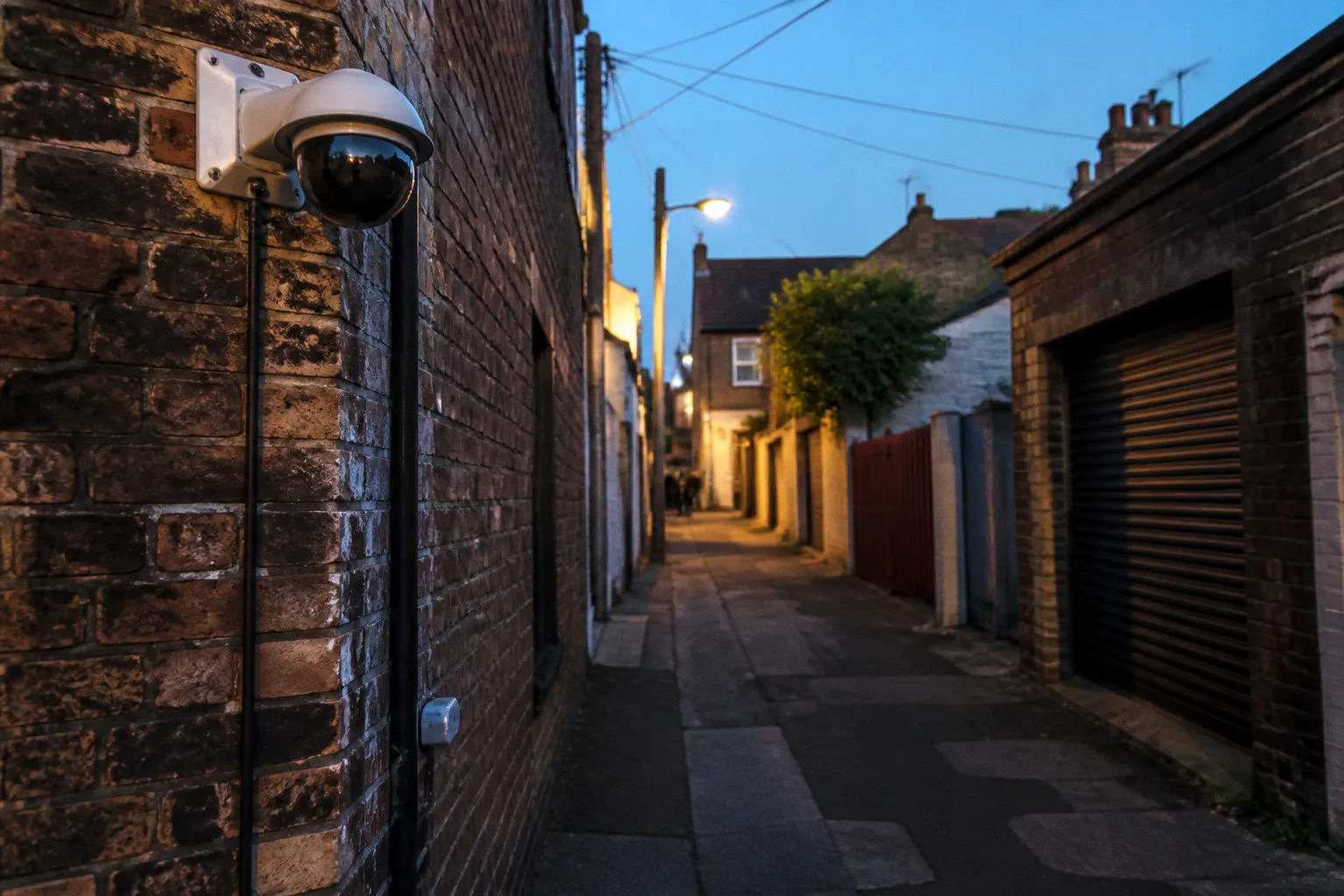
If it takes in a shared alleyway, a public footpath or part of a neighbour’s garden, the system may be recording people outside your home as well as protecting it.
That changes the practical and legal position. A domestic camera can still be used for security, but the household exemption is unlikely to cover footage that reaches beyond the property boundary. The owner may then have to comply with data protection requirements, respond to requests for personal data and justify why the field of view is wider than necessary.
For residents considering alleyway CCTV cameras, privacy laws in the UK are not a reason to abandon security altogether. They are a reason to install the system carefully, limit what it captures and be clear with neighbours about what is happening.
The legal threshold: when domestic cameras become public surveillance
It is easy to assume that anything mounted on your own wall is automatically a private household activity. That is not how the rules work. The key question is not simply who owns the camera, but what the camera records.
A system pointed only at your front door, driveway or enclosed garden will generally sit within the domestic setting. The position becomes more complicated when the footage includes:
- a shared alleyway used by several households;
- a public pavement or footpath;
- a road or communal parking area;
- the entrance to a neighbour’s property;
- windows, gardens or other private spaces belonging to someone else.
The wider the view, the harder it becomes to rely on the household exemption. Where a domestic camera captures people outside the owner’s private property, the operator may be treated as a data controller for that footage. The Data Protection Act 2018 and UK GDPR can then become relevant, alongside the principles set out in the Information Commissioner’s Office guidance on domestic CCTV.
That does not mean that every camera with a small amount of background pavement in view is automatically unlawful. Security cameras are often difficult to position with surgical precision, particularly on narrow terraces and properties that open directly onto a public route. The issue is whether the recording is justifiable, proportionate and managed responsibly.
The practical obligations can include:
- explaining the purpose of the system, usually property protection or crime prevention;
- using clear signage where people enter the area being recorded;
- keeping footage only for as long as there is a genuine reason to retain it;
- protecting recordings against unauthorised access;
- having a process for dealing with a Subject Access Request;
- responding appropriately if someone raises a privacy concern;
- adjusting or masking the camera if it captures more than is needed.
A sign should not be hidden behind a gate or placed where a person can only see it after entering the recorded area. It should make clear that CCTV is in operation and identify who is responsible for the system. The wording does not need to turn a domestic property into a public information board, but it should be visible and understandable.
Retention also needs a reason. Keeping every recording indefinitely is difficult to defend, particularly when the camera records a route used by neighbours and passers-by. Some systems are configured to retain footage for around a month, but there is no universal period that makes every installation compliant. The appropriate period depends on the purpose, the risk and whether footage needs to be preserved because an incident has been reported.
A data controller also needs to think about access. Cloud storage may be convenient, but it introduces another account, another password and another company handling the footage. Local storage avoids some cloud risks but still needs to be secured against theft or casual access. A camera that sends alerts to several household members may also expose more personal data than the owner initially considered.
Once a domestic camera looks beyond the boundary, the question is no longer only whether it can record. It is whether the recording is necessary, limited and properly managed.
The same principle applies when someone asks, “Can neighbours put CCTV pointing at my yard?” They may be able to capture a small area beyond their boundary where that is genuinely necessary for security, but a camera deliberately aimed into a neighbouring garden or at windows is much harder to justify. The direction of the lens, the amount of private space visible, the use of privacy masking and the availability of less intrusive alternatives all matter.
Lessons from Fairhurst v Woodard: the danger of audio and over-coverage
The Court of Appeal case Fairhurst v Woodard is an important warning for anyone planning shared alleyway security camera systems. The dispute concerned a neighbour’s CCTV and video doorbell, including the extent of the areas recorded and the collection of audio. The case showed how quickly a security measure can become intrusive when it reaches into neighbouring or public spaces.
One of the clearest lessons is that audio deserves particular caution. Video may show a person passing a gate; audio can capture conversations that the person reasonably expected to be private. A microphone may pick up discussions in a garden, near a doorway or across an open window without anyone realising that the system is listening.
For that reason, disabling audio should be the starting point unless there is a specific and defensible reason to use it. A camera does not become more responsible because it records everything. In many residential settings, sound adds little to the stated security purpose while increasing the privacy risk considerably.
The case also illustrates the problem of over-coverage. A wide-angle lens can be attractive because it appears to remove blind spots, but the extra view may include a neighbour’s entrance, a bedroom window, a public pavement or a route used by children and visitors. The owner may not be watching those areas deliberately, yet the system still processes the images.
Before installation, draw the proposed field of view on a simple sketch or check it through the camera’s setup application. Look at the picture from the position of a passer-by, not only from the perspective of the person standing inside the house. Ask:
1. What specific security problem is the camera intended to address?
2. Which part of the image is needed to identify an approach or incident?
3. Can the camera be mounted lower, angled differently or moved closer to the access point?
4. Can privacy zones block a neighbour’s window or garden?
5. Can recording be limited to movement near the gate, door or boundary?
6. Is audio genuinely necessary, or is it enabled simply because the device offers it?
The answer does not have to be perfect on the first day. A responsible installation should be reviewed after it is running. A camera may look narrowly focused in daylight but reveal much more at night when infrared illumination, digital zoom or a wider motion zone is active.
Navigating ICO compliance for shared alleyway monitoring
There is a difference between recording a shared alley incident and continuously surveying the entire passage. The first may be connected to a defined security purpose. The second can create a record of everyone who uses the alley, including neighbours returning from work, visitors, delivery workers and children walking through.
That distinction should shape the installation.
Start with the narrowest useful view
The camera should cover the point that needs protection rather than treating the whole alley as the target. If the problem is access to a rear door, the useful image may be the door, the gate latch and a short approach. If the problem is an insecure boundary, the camera may only need to show the fence line and the immediate area beside it.
Digital cropping is not always enough. If the sensor has already captured the full scene and the software merely hides part of it in the displayed image, the system may still be processing more information than the homeowner realises. Built-in privacy masking is helpful, but it should be tested and configured rather than assumed to work automatically.
Use signage and explain responsibility
Clear signage is central to any system that records beyond private domestic space. It should be positioned before people enter the recorded area and should state that CCTV is in operation, why it is being used and how the responsible person can be contacted.
For a shared alley, a conversation with the closest neighbours is often as important as the sign. Explain where the camera points, whether audio is disabled, how long footage is retained and who can view it. This will not remove the legal obligations, but it can prevent a technical security measure from becoming a personal dispute.
A resident who discovers a camera by accident is likely to feel watched, even if the owner has a legitimate concern. Telling people in advance makes the boundary of the system visible.
Keep the footage controlled
The owner should know who has access to recordings and why. Sharing a live feed with a large residents’ messaging group may be convenient, but it can create a new circulation problem. Footage that includes identifiable people should not be treated like ordinary social media content.
Passwords should be unique, firmware should be kept up to date where the manufacturer supports it, and old devices should not remain connected to the network without a reason. If a cloud provider is used, the privacy and security settings should be checked rather than left at their factory defaults.
A Subject Access Request may require the operator to search for footage containing the requester and provide it in an accessible form, subject to the relevant exemptions and the rights of other people appearing in the recording. That can be difficult if a system stores weeks of continuous footage without time stamps or a workable search function. Good housekeeping is therefore not just bureaucracy; it makes a legitimate request possible.
Set a retention period that matches the purpose
There is no magic number of days that makes a system acceptable in every situation. Retention should be linked to the time in which an incident would normally be discovered and reported. If a recording is needed for a reported offence or insurance matter, it may need to be preserved separately. Otherwise, routine footage should be deleted when it is no longer useful.
Motion detection can reduce the amount of material stored, but it is not a substitute for a clear policy. A system that records continuously may capture a large amount of personal information even when nothing happens. A system that records only movement may still collect unnecessary footage if the detection zone covers the full alley.
Public authority standards versus private residential responsibilities
Public CCTV operated by North East Lincolnshire Council or the police sits within a different governance framework from a camera on a terraced house. Public authorities may have to consider the Surveillance Camera Code of Practice, the principles associated with the Protection of Freedoms Act 2012, procurement controls, formal policies and broader public accountability. They may also need to assess necessity and proportionality at a scheme level.
A private resident is not automatically required to reproduce every part of that public-sector process. There is no need to create a miniature council CCTV department before fitting a camera above a back gate. But the underlying questions remain useful:
- What problem is the camera addressing?
- Is there evidence of a meaningful risk, or is the system being installed for general reassurance?
- Is the chosen view proportionate to that risk?
- Could lighting, a stronger gate or a better lock achieve much of the same result?
- How will neighbours know that they are being recorded?
- What will happen to the footage after it is captured?
The phrase “public surveillance” can make a domestic installation sound more powerful than it is. A resident with one camera does not suddenly acquire the authority or resources of a public CCTV network. The point is narrower: once a private system captures people outside the home, the owner may take on responsibilities that do not apply to a camera confined to the owner’s private space.
Nor does a visible camera prove that a location is a “known hotspot”. Residents should avoid using a broad view to investigate everyone who passes through an alley. The purpose should be tied to property security, not curiosity or informal monitoring of neighbours.
This is also where the question of shared ownership matters. If several households want a camera covering a communal passage, they should agree who owns the equipment, who controls the footage, who responds to requests and who pays for maintenance. A camera described as “the residents’ system” still needs a clearly identifiable person or organisation responsible for it.
Physical target hardening: alternatives to high-risk camera placement
CCTV is only one part of a security plan, and it is not always the best first measure. A camera can record an intruder without stopping the intruder from reaching the door. It may help with evidence after an incident, but it does not replace a sound lock, a secure gate or lighting that removes concealment.
Alley gating schemes can be effective where the layout, ownership and local authority arrangements make them possible. A lockable gate can restrict unauthorised access and make a back route less attractive, while also reducing the amount of shared space that needs to be monitored. It does not eliminate crime, and it is not free from practical or privacy questions: residents need to manage keys, access for deliveries and emergency services, maintenance, and the rights of people who legitimately use the route.
The important distinction is that gating changes access rather than creating a permanent record of movement. That may reduce privacy exposure, although it cannot guarantee that no incidents will occur.
The same principle applies to smaller improvements:
- A solid, properly hung side gate removes an easy route into the rear of a property.
- A lock that is suitable for outdoor use and protected from casual attack is more useful than a decorative latch.
- Motion-activated lighting can remove the cover provided by a dark entrance, but it should be positioned so that it does not dazzle neighbours or shine directly into bedrooms.
- A well-maintained fence and a difficult-to-climb gate increase the time and effort required to reach the house.
- Shed doors, rear doors and accessible windows should be treated as part of the same security line rather than separate problems.
- Clear sightlines can help residents notice unusual activity without requiring a camera to record the entire passage.
There is a balance to strike with defensive landscaping and fencing. Adding height or trellis may make climbing harder, but an arrangement that creates a concealed corner can work against the security objective. The best measures increase control without creating new hiding places or obstructing a neighbour’s route.
| Measure | Security benefit | Privacy and practical considerations |
|---|---|---|
| Narrowly aimed CCTV | Can deter, alert and preserve evidence around a particular door or gate | May trigger data protection duties if it records outside the property; audio should normally be disabled |
| Alley gating | Restricts unauthorised access before someone reaches individual homes | Requires agreement, maintenance, access arrangements and appropriate permissions |
| Motion-activated lighting | Removes darkness and can make an approach more conspicuous | Poor positioning can cause glare, nuisance or light into neighbouring rooms |
| Stronger gates, locks and boundaries | Makes entry slower and less convenient | Needs regular maintenance and should not create concealed spaces |
| Shared residents’ system | Can spread cost and cover a genuine communal risk | Ownership, access, retention and responses to footage requests must be agreed |
For residents who still need a camera, privacy-focused features are worth treating as part of the security design rather than optional extras. Privacy masks can block windows and garden areas. Motion zones can restrict recording to the area beside a gate or door. Scheduling can prevent unnecessary monitoring at times when the security risk is lower. A camera that records less can still provide useful evidence if it is placed where an incident is most likely to occur.
The manufacturer’s advertised field of view should not be the deciding factor. A wide lens may produce a reassuring picture on a phone while quietly collecting information about every person who uses the alley. A tighter, better-positioned camera is often the more defensible choice.
The strongest security plan is not the one that sees the most. It is the one that removes opportunities while recording as little private life as possible.
The real choice is not simply alley gating versus CCTV for back streets. In many North East Lincolnshire properties, the sensible answer will be a combination of modest measures: secure the access point, improve lighting, reduce blind corners and use a carefully limited camera only where there is a clear remaining need.
Before installing, talk to neighbours and check the local position on gates, shared access and any permissions that may apply. If the camera will cover a public path or communal alley, read the relevant ICO guidance and keep a short written note explaining the purpose, the field of view, the retention period and the steps taken to reduce intrusion. That record can be useful if the arrangement is later questioned.
A camera should not become a substitute for thinking about the space itself. If the alley is open, dark and easy to enter, the most effective improvement may be the one that changes those conditions. If a camera is appropriate, its lens should be focused on a defined risk, not on the daily lives of everyone who happens to pass. Security is more credible when it protects a home without quietly turning the shared route behind it into a private surveillance zone.