It is whether it has been tested against the kinds of physical attacks that burglars actually use, and whether the manufacturer continues to make it to the same standard.
That is the purpose of Secured by Design. The police-backed scheme is often described as a mark of quality, but it is more precise than that. It connects crime prevention advice with independently tested products, audited manufacturing processes and building design that makes unauthorised entry harder in the first place.
For homeowners, the phrase to look for is the Secured by Design Police Preferred Specification. It does not mean that a police officer has inspected every individual door or window fitted to a house. It means that the product belongs to a certified range that has met specified security requirements and that the manufacturer has been assessed against the scheme’s conditions.
That distinction matters, particularly when comparing new doors and windows, checking a developer’s specification or considering improvements to an existing property in North East Lincolnshire.
The evolution of police-led security standards since 1989
Secured by Design was introduced in 1989 as a police initiative focused on reducing opportunities for crime through better design. The underlying idea is straightforward: security should be considered before a building is occupied, not added as an afterthought after a burglary.
Older approaches to home security often concentrated on individual locks, alarms or visible deterrents. Those measures still have a place, but they do not answer every practical problem. A lock is only one part of a door assembly. A strong cylinder is of limited value if the surrounding frame is weak. A window lock cannot compensate for glazing beads or fixings that can be attacked from outside.
The Secured by Design approach is broader. It considers how a building is laid out, how people approach and observe it, how doors and windows resist attack, and whether the completed installation matches the tested product. This is why the scheme is relevant not only to homeowners but also to architects, housing providers, developers and planning teams.
In a housing project, the security conversation can begin with questions such as:
- Are entrances visible from surrounding homes or public routes?
- Are communal doors controlled without creating hidden corners?
- Can a rear garden be reached easily from an alley, parking area or open space?
- Are bin stores, cycle stores and garages creating an alternative route into homes?
- Are doors and windows specified as complete, tested assemblies rather than as separate attractive components?
These are design questions, not simply hardware questions. A high-security door fitted to an isolated entrance may still leave a property exposed if the approach is concealed or if another access point is overlooked.
The scheme has also developed alongside formal standards used by manufacturers and the construction industry. That has made the language of security more technical, but it has also made comparisons more meaningful. Instead of relying on vague claims such as “police approved” or “high security”, buyers can ask what certification applies, which product range is covered and whether the installation is being completed in accordance with the tested configuration.
The strongest security claim is not that a product looks difficult to break. It is that the complete assembly has been tested, certified and kept under control after certification.
The word complete is doing important work here. A door leaf, frame, glazing unit, hinges, cylinder, escutcheon, letter plate and fixing method can all affect the result. Changing one element may alter the performance of the whole assembly.
Decoding PAS 24: the physical stress tests behind certification
PAS 24 is one of the standards commonly associated with residential doorsets, windows and other security products used in Secured by Design applications. It is designed to assess resistance to unauthorised entry using a range of attack methods and tools.
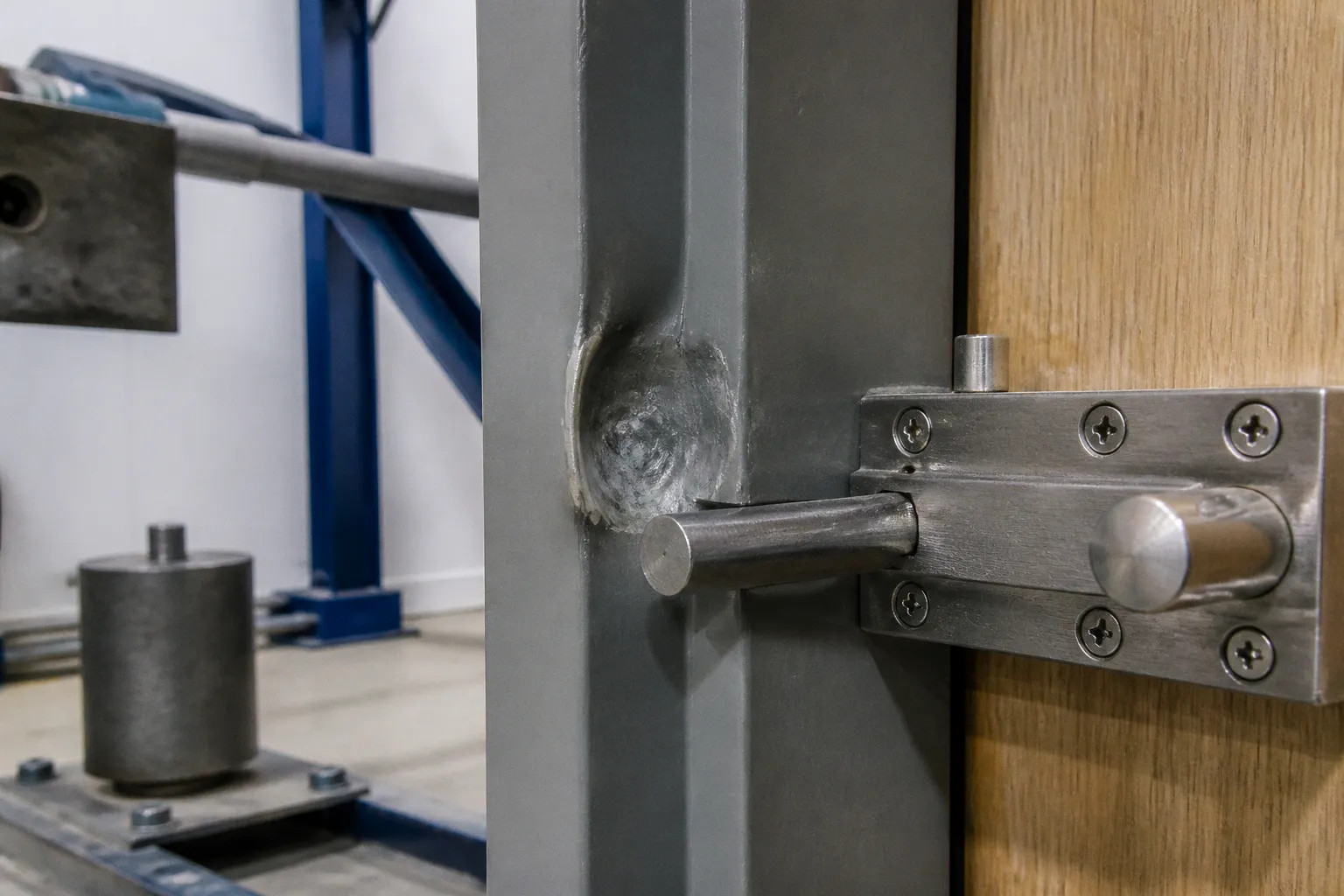
The testing is not a theatrical demonstration of whether someone can smash a product with unlimited time. It is a controlled assessment. Test laboratories apply defined loads, tools and attack methods for specified periods. The aim is to reproduce realistic attempts to force, manipulate or prise open the product while allowing results to be compared consistently.
The exact test arrangement depends on the product type, but the underlying challenges can include:
1. Attacking the locking area.
Testers examine whether the lock, cylinder, keeps and surrounding material can resist attempts to force or manipulate the point that holds the door or window closed.
2. Applying leverage.
Doors and windows may be subjected to attacks intended to create a gap between the opening element and its frame. The frame, hinges, fixings and locking points all become relevant.
3. Testing vulnerable edges and hardware.
A product may be attacked around handles, hinges, glazing beads, letter plates or other fittings. Security cannot depend on the most impressive component while leaving an easily exploited edge.
4. Using tools associated with forced entry.
The laboratory uses the tools and methods specified by the relevant test procedure. This is one reason a product’s marketing description is not a substitute for a recognised test.
5. Checking the assembly after attack.
The purpose is not merely to see whether the surface is scratched or damaged. The question is whether an attacker can create an opening large enough to gain entry or operate the locking mechanism.
PAS 24 should not be confused with a simple material-strength test. A thick door is not automatically a secure doorset, just as a heavy window frame is not automatically resistant to attack. Performance depends on the interaction between components and on the way the unit is installed.
What the test does not prove
Certification is valuable, but it has boundaries. A PAS 24 test does not promise that a product is impossible to defeat. No domestic door or window can carry that promise. Nor does certification guarantee that an installation will perform properly if the product is modified, badly fitted or combined with unapproved parts.
There are several practical limitations worth keeping in mind:
- A tested product can be weakened by cutting into it for additional hardware.
- A replacement cylinder, letter plate or handle may not be part of the tested configuration.
- The wall, lintel and fixings around the frame can determine whether the assembly remains secure.
- A certified window does not make an insecure garden gate, shed or garage irrelevant.
- Certification of a product range does not mean every visually similar model from the same manufacturer has passed the same assessment.
This is where the phrase SBD certified windows and doors can become misleading if it is used loosely. The buyer should identify the actual product, its certification scope and the installer’s obligations. “The manufacturer makes an SBD product” is not the same as “this exact door and its installation meet the required specification”.
A practical comparison
The difference between common descriptions can be set out simply:
| Description | What it may tell you | What it does not necessarily tell you |
|---|---|---|
| Police Preferred Specification | The product or service has been accepted within the Secured by Design scheme requirements | That every component on the installation is certified or that the installation is flawless |
| PAS 24 tested | A defined product type has undergone a recognised security assessment | That an altered or poorly fitted version will perform in the same way |
| Manufacturer’s “high-security” claim | The manufacturer considers the product resistant to attack | Which test was used, what configuration was assessed or whether production is audited |
| Compliance with building regulations | The work meets relevant statutory construction requirements | That it offers the higher level of resistance associated with police-approved home security standards |
The table is not a ranking of brands. It is a reminder to separate a regulated requirement, a test result and a marketing description.
Beyond the lab: why annual factory audits matter for security
A successful test is a snapshot. It shows how a particular product performed under a defined set of conditions at a particular time. It does not, by itself, prove that every later product leaving the factory is identical.
That is why ongoing manufacturing control is such an important part of credible certification. Factory audits examine whether the manufacturer continues to use the materials, components, processes and quality controls associated with the tested product.
An audit may look at matters such as:
- whether the approved components are being used;
- whether changes to locks, cylinders, glazing or fixings are controlled;
- whether staff follow documented production procedures;
- whether finished products are checked consistently;
- whether records allow a product to be traced back through the manufacturing process;
- whether non-conforming products are identified rather than quietly released.
For a homeowner, this is less visible than the test itself. There is no dramatic moment to watch and no obvious physical feature to point to. Yet it is one of the reasons certification carries more weight than a single laboratory demonstration.
A security product is a system of tolerances and relationships. A small change in the position of a locking point, the type of fixing used in a frame or the grade of a cylinder can affect how the assembly behaves under attack. Production control is intended to prevent the certified design from becoming a looser approximation in ordinary manufacture.
The audit process also matters when products are supplied through installers or developers. A certified doorset is not just a design idea that can be copied by eye. It is a controlled specification. If a contractor substitutes a component because it is easier to source, the finished installation may no longer represent the product that was tested.
Questions worth asking before ordering
A buyer does not need to become a certification auditor, but a few precise questions can expose weak claims:
- What is the exact certified product or range?
- Is the certification for the whole doorset or only for one component?
- Which lock, cylinder, glazing and hardware configuration is included?
- Will the installer provide evidence of the relevant certification?
- Are any parts being substituted because of availability, style or price?
- How will the frame be fixed into the wall?
- Does the warranty depend on installation by an approved or competent contractor?
- What happens if the door is later modified for a cat flap, access control system or additional letter plate?
A reputable supplier should be able to answer these without retreating into general language about “the strongest option”. The more a security claim depends on a brochure adjective, the more carefully it should be checked.
The role of Designing Out Crime Officers in modern building projects
Designing Out Crime Officers, often known as DOCOs, bring police crime-prevention expertise into the planning and design process. Their role is not to act as a private security installer or to certify every product on a building site. It is to advise on how the layout and specification of a development can reduce opportunities for crime and improve natural surveillance.
Their input can be useful at several stages.
At the early design stage, a DOCO may review the relationship between homes, streets, parking areas, footpaths, communal entrances and public spaces. A plan that looks efficient on paper can create hidden approaches, poorly observed side passages or rear boundaries that are easy to cross.
At the specification stage, the focus can move to doorsets, windows, communal access, cycle storage, bin areas, lighting and boundary treatments. The objective is not to turn a neighbourhood into a fortress. Excessive fencing, blank walls and complicated access arrangements can sometimes reduce visibility and make legitimate movement less comfortable.
At the construction and handover stage, the question becomes whether the installed measures match the design intent. A drawing may show a well-positioned entrance and secure communal door, but the practical result depends on details such as door closers, intercoms, lighting, planting and maintenance.
For a North East Lincolnshire community safety initiative, this design perspective is particularly relevant because crime prevention is not limited to individual houses. Streets, shared entrances, parking courts, pathways and boundaries influence how safe residents feel and how easily suspicious activity can be noticed.
Designing for observation, not just obstruction
Security design works best when it combines resistance with visibility. A tall, opaque boundary may make a garden harder to reach, but it can also hide an intruder from neighbours. Lighting aimed directly into windows can create glare without improving observation. A communal entrance that is technically controlled but routinely propped open has failed in practice.
Useful design decisions often include:
- placing front doors where they can be seen from the street or neighbouring properties;
- avoiding concealed recesses around entrances;
- keeping planting low enough to preserve views;
- designing rear boundaries to resist climbing while avoiding unnecessary hiding places;
- separating pedestrian routes from areas that provide access to private rear gardens;
- ensuring that lighting supports faces, doorways and routes rather than simply producing brightness;
- locating bins, stores and utility areas so that they do not become convenient climbing aids or hiding places.
None of these measures replaces a secure doorset. They reduce the number of easy approaches and make the certified security features more meaningful.
A secure building is not only one that resists an attack. It is one that gives an attacker fewer quiet, convenient places to begin.
Distinguishing SBD certification from basic building regulations
Building regulations and Secured by Design address different questions.
Building regulations establish statutory requirements for construction, safety, accessibility, energy performance and other aspects of building work. Depending on the project and the relevant rules, they may include requirements connected with doors, windows, access, glazing or resistance to particular hazards.
Secured by Design is a police-led security standard and accreditation framework. It generally asks for a stronger and more specific level of evidence about resistance to unauthorised entry, product certification, design and installation.
Meeting building regulations is therefore not automatically the same as meeting the secured by design door requirements used for a police-approved development or certified product. A door can be legally installed and still not have the tested security performance expected under the Secured by Design scheme.
The distinction is easiest to understand through a typical replacement project. A homeowner may choose a new front door that complies with general construction requirements. That establishes a baseline. If the homeowner instead chooses a doorset covered by the Secured by Design Police Preferred Specification, the supplier should be able to demonstrate a more specific chain of evidence: the relevant product has been assessed, the certified configuration is known, and the installation should follow the conditions attached to that product.
The same principle applies to windows. A window that meets requirements for ventilation, escape or thermal performance may still need additional security characteristics if it is to contribute to a Secured by Design specification.
The installation is part of the security result
One of the most common mistakes is treating certification as something that ends when the product arrives on site. In reality, installation can determine whether the tested performance survives contact with the building.
The frame must be secured to the surrounding structure using suitable fixings. Gaps must be dealt with correctly. Locking points need to engage as intended. Thresholds, hinges and keep plates must not be compromised by poor alignment. The wall around the frame also needs to be capable of resisting the forces transferred into it.
This is why the following details deserve attention during handover:
- the door or window identification and certification information;
- the installer’s name and any relevant approval status;
- confirmation that the specified hardware has been used;
- instructions for operating and maintaining the locking system;
- warranty conditions, particularly those covering adjustments and unauthorised alterations;
- advice on what to do if the door begins to drop, bind or fail to lock fully.
A door that is left on the latch, a window whose locking points do not engage, or a communal entrance that is routinely wedged open is not delivering its designed level of protection. Everyday behaviour is part of the security system.
What the testing process means for residents
The Secured by Design testing process is most useful when it gives residents a better basis for decisions, not when it becomes another badge to repeat in sales material.
For a new development, the important issue is whether the project has been designed and built to the applicable Secured by Design requirements. For a replacement door or window, the important issue is whether the specific product and installation are covered. For an existing home, certification can improve resistance at key entry points, but it will not remove the need to consider garages, side gates, sheds, communal areas and routines that expose the property.
A sensible review of home security should connect several layers:
1. The building layout. Look for hidden approaches, easy access to the rear and poorly observed shared areas.
2. The opening elements. Check front and back doors, accessible windows, patio doors and garage connections.
3. The tested product. Ask what standard applies and whether the exact configuration is covered.
4. The installation. Confirm that the frame, fixings and surrounding structure support the product’s performance.
5. The daily operation. Make sure locks are used, doors close properly and access-controlled entrances are not bypassed.
6. The wider street. Consider lighting, sightlines, boundary treatments, communal storage and routes that affect several homes at once.
This layered view is more realistic than searching for one perfect lock or assuming that a single certification mark solves every security problem.
For residents in North East Lincolnshire, it also makes community initiatives more practical. Police advice, planning input, housing management and resident behaviour work better together than any one of them operating in isolation. A secure door on an overlooked entrance is useful. A secure door in a well-designed, well-maintained and properly observed street is more useful still.
The value of a standard that can be questioned
The strength of Secured by Design lies in the questions it allows people to ask. What was tested? Which parts were included? Is the product still controlled in production? Was it installed as specified? Does the building layout support the security measures rather than undermine them?
Those questions are less glamorous than a claim that a door is unbeatable, but they are much more useful. They shift the conversation away from appearances and towards evidence.
The secured by design police preferred specification is not a guarantee that crime will never occur. It is a disciplined way of improving resistance, reducing easy opportunities and building security into the design of homes and neighbourhoods. PAS 24 testing provides the physical challenge. Factory audits help preserve the tested standard. DOCO advice connects products to the wider environment. Building regulations provide a statutory baseline, but they do not replace the additional security assessment.
For homeowners, developers and community safety teams, that is the practical lesson: security is strongest when the product, the installation and the surrounding place have been considered as one system.