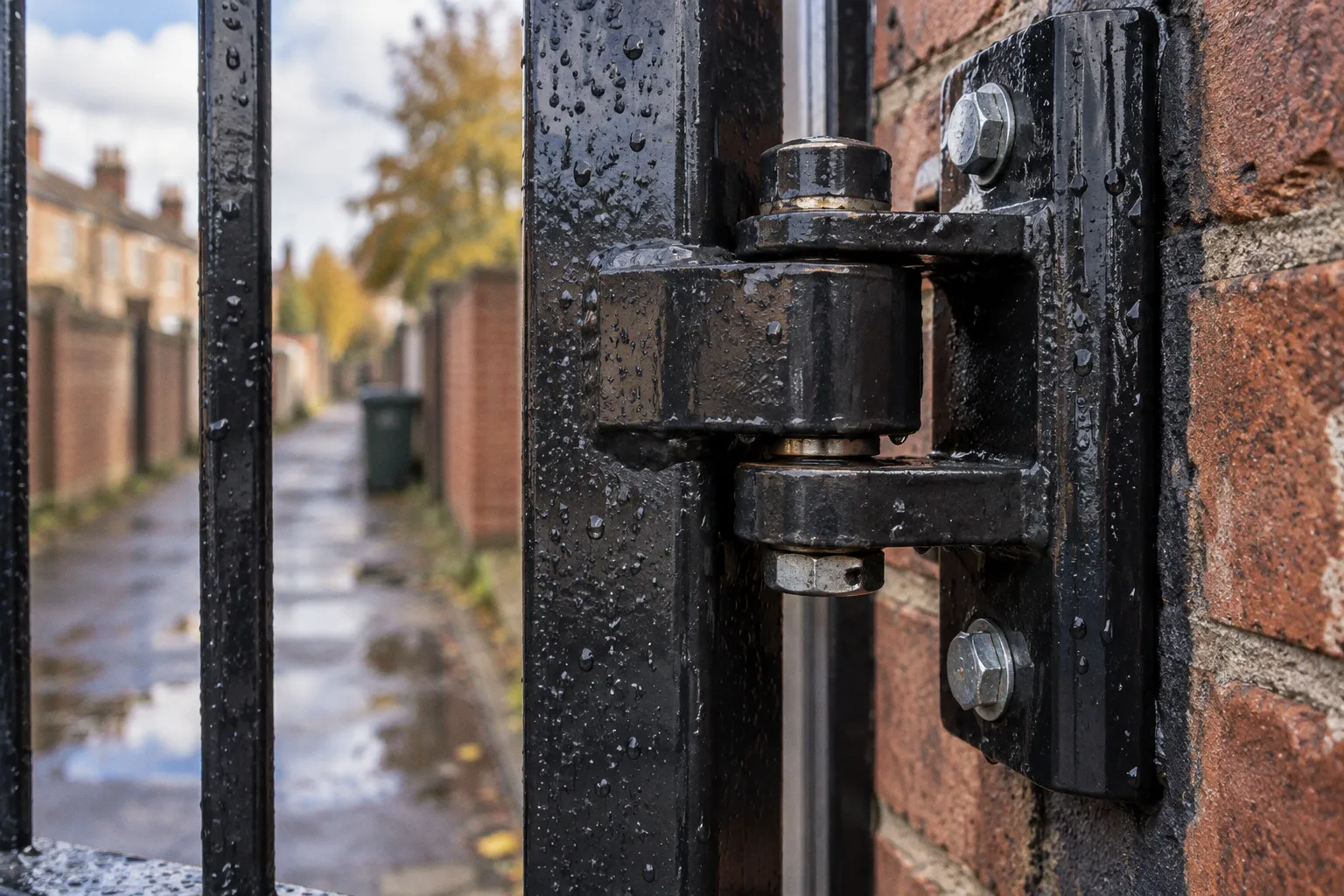
If the gate is missing, permanently open, easy to climb, or badly maintained, the perimeter is not controlled. It is simply another route into the property line.
That is why alley gating schemes in Grimsby have become part of a wider residential security strategy rather than a cosmetic street improvement. Safer Streets funding has supported gates, CCTV, lighting and home security upgrades in targeted areas, particularly West Marsh and East Marsh. But the practical result depends on more than installing a metal gate. Ownership, access rights, visibility, locks, maintenance and resident cooperation determine whether the barrier remains a real deterrent.
The progress made through funded programmes is significant. It is also specific. Residents should not assume that every alley in Grimsby has been secured, that every gate is council-maintained, or that a public funding round creates a permanent obligation to upgrade other private passageways.
What Safer Streets funding changed in West Marsh and East Marsh
The strongest phase of alley security work came through the Home Office Safer Streets Fund. In June 2021, the Office of the Police and Crime Commissioner for Humberside and North East Lincolnshire Council secured £432,000 through Safer Streets 2 for West Marsh in Grimsby.
The programme funded a combination of physical and environmental measures:
- alley gates to restrict uncontrolled rear access;
- CCTV to improve surveillance around vulnerable routes;
- street lighting improvements to reduce concealment;
- home target hardening, including practical security upgrades at individual properties.
That combination matters. A gate on its own can leave a dark approach route, an unprotected side entrance or a row of rear doors exposed beyond the barrier. Conversely, lighting without access control may make an alley easier to observe but still leave it freely available to anyone entering from the street.
The West Marsh programme was scheduled for completion in March 2022. The funding was directed at a defined area and a defined set of interventions. It should therefore be understood as a targeted target-hardening project, not as a town-wide installation programme.
East Marsh received a further package under Safer Streets 4. The Empower Safer Homes initiative offered free home security kits, including locks, outdoor lighting and CCTV, alongside support for alley gating. Streets named in the programme included Durban Road, Julian Street, Buller Street and Humberstone Road. More than 230 residents benefited from the initial rollout phases of the home security upgrade kits.
The East Marsh project delivery period ended in August 2023. That date marks the end of the funded project delivery phase, not the end of the need for maintenance or the automatic completion of every possible security improvement across the ward.
Funding can install the barrier, but residents still control whether the security measure remains effective five years later.
When I assess a street, I separate three questions. First, was a scheme funded or proposed? Second, was the physical work completed? Third, is the access point still being managed properly? Those are different stages. A gate that was installed under a Safer Streets project may now have damaged hinges, a failing latch, or a pattern of propping that defeats the original design.
There is also no reliable basis for claiming an exact town-wide total of alley gates installed across Grimsby. The available programme information identifies particular wards, streets and funding rounds, but it does not establish a single current figure for the whole town. That distinction prevents residents from mistaking a successful local scheme for universal coverage.
The private-land reality behind Grimsby alley gates
The most common misunderstanding concerns responsibility. Alleyways in North East Lincolnshire are private land owned by the adjacent property owners. North East Lincolnshire Council does not generally fund the installation or upkeep of private alleyway gating projects.
That changes the decision-making process completely. A resident may identify a clear burglary vulnerability, but a council-funded street improvement is not the only route to a solution. For a privately owned alley, the relevant households must usually organise the proposal, establish who holds access rights, agree the design, and take responsibility for the ongoing condition of the gate.
The access rights are the critical point. A rear passage may serve several houses, garages, gardens or businesses. A household that does not use the alley frequently may still have a legal right to pass through it. Installing a gate without accounting for every relevant right of access creates a dispute before it creates security.
A resident-led project therefore needs a proper property and access audit:
1. Identify every property connected to the alley. Include houses on both sides, properties at the ends of the passage, garages and any rear service access.
2. Establish who owns the land and who has access rights. Ownership of the ground and the right to use the route are not necessarily held by the same people.
3. Contact all households with relevant rights. A private gated alleyway requires consent from all relevant households that hold access rights over the path.
4. Agree how keys, codes or fobs will be controlled. A gate that has no clear access arrangement will be left open, propped, or fitted with an informal lock that fails quickly.
5. Set out maintenance responsibility before installation. The group should decide who will deal with broken hinges, damaged locks, lost keys, vegetation, lighting faults and deliberate damage.
6. Keep a written record. The arrangement should not depend on one resident remembering what was agreed several years earlier.
This is not administrative decoration. It is part of the physical security system. A gate with poor governance is a weak gate, even if its steelwork is sound.
The North East Lincolnshire Council alley gate policy position is straightforward: private alleyways are not automatically a council maintenance responsibility. Residents should not install a barrier assuming that the council will later clear waste, repair the lock or replace damaged components. Nor should a resident group treat a funded project as evidence that future upkeep will be publicly financed.
The same principle applies to access during emergencies, deliveries and repairs. A gate must restrict casual entry without creating an arrangement so awkward that residents bypass it. If every user needs a different unofficial method of entry, the access-control system will degrade.
A gate is a security device, not just a fence panel
The physical design determines whether an alley gate provides a genuine deterrent. The aim is not to make the route look closed. The aim is to control access while preserving enough visibility for residents, visitors and surveillance systems to detect activity.
Secured by Design guidance specifies that alley gates should maintain a minimum of 50% visibility through the opening section across its height. That requirement has a practical purpose. A solid gate can create a concealed pocket immediately behind it. An opportunist can stand there unseen, wait for someone to open the gate, or use the structure as cover while working on a lock.
Visibility should be assessed from both sides. Look from the street towards the alley and from the alley towards the street. Check the sightline at night, not only in daylight. A gate that appears open and observable at midday may become a dark visual block after dusk, particularly where a streetlight is shielded by a building, tree or projecting wall.
The core specification points include:
| Security element | What a sound arrangement should achieve | Typical vulnerability |
|---|---|---|
| Visibility | At least 50% visibility through the opening section across the gate height | Solid panels or added screening create concealment |
| Hinges | Anti-lift hinges that prevent the gate being lifted from its fixings | Standard exposed hinges allow tampering or removal |
| Latch and cylinder | Components aligned with recognised standards, including BS3621:2007+A1:2009 and BS EN 1303 recommendations for mortice latches and cylinders | Cheap, poorly protected locks become the failure point |
| Gate frame | A rigid frame securely fixed to the boundary structure | Flexible or poorly anchored panels can be forced |
| Closing action | The gate returns to the closed position and cannot be casually wedged open | Users prop it open for convenience |
| Key control | A defined system for residents and authorised users | Uncontrolled copies circulate beyond the intended group |
| Approach lighting | Light supports observation without producing glare or deep shadows | A bright fitting can leave hiding places beside the gate |
The lock is often treated as the main component, but the surrounding structure matters just as much. If the latch is strong while the masonry fixing is weak, an offender attacks the frame. If the gate is secure but the adjacent wall can be climbed easily, the barrier has only redirected the route.
Anti-lift hinges are particularly important on alley gates. A gate that swings correctly but can be lifted clear of its hinges is not properly secured. The hinge side should be examined for exposed fixings, loose masonry and signs of repeated impact. Small defects become access opportunities when they are left through several seasons.
The gate should also be positioned so that it does not create a concealed recess. Keep the line of sight as open as the site allows. Avoid adding opaque boards, advertising panels or uncontrolled vegetation that turns a visible threshold into a hidden one.
Rear doors and gardens still need target hardening
Closing the alley does not secure the houses by itself. It controls one access point on the perimeter. Each property still needs a defensible rear boundary and a resistant rear door.
Look beyond the gate:
- Is the rear door fitted with a suitable lock, and is the frame sound?
- Can a person reach the door from a low wall, shed roof or adjoining garden?
- Are garden tools, ladders or bins positioned beside the door?
- Does a side passage bypass the gated alley?
- Can a rear window be reached without crossing an obvious boundary?
- Is the rear garden visible from neighbouring properties, or does high fencing provide complete concealment?
- Does external lighting illuminate the approach, or merely shine into the camera lens and leave the lock in shadow?
These are the vulnerabilities that determine whether reducing rear access produces a meaningful security improvement. A gate can reduce casual entry into the alley while a poorly secured side passage continues to provide direct access to the same row of gardens.
Home target hardening works best when it addresses the complete route. That may include improved locks, outdoor lighting, CCTV, property marking and boundary repairs. The East Marsh home security kits show the value of combining several modest measures rather than relying on one expensive device.
How to organise a resident-led gating project
A community alley gating petition process is not just a matter of collecting signatures and ordering a gate. The residents need to build an access-control arrangement that can survive disagreement, turnover and ordinary wear.
Start by walking the full length of the alley in daylight and after dark. Record every entrance, opening, damaged section of boundary, external light and position where someone could stand unseen. Do not begin with the gate design. Begin with the vulnerability.
Then draw up a simple ownership and access map. It does not need to be a technical drawing. It needs to answer practical questions: which properties use the passage, who owns each boundary, where are the gates located, and who must be consulted before any work can proceed?
A useful project sequence is:
1. Survey the whole perimeter. Include the street entrances, rear gardens, side passages and adjoining structures.
2. List the relevant households and access holders. Do not assume that only occupied homes matter.
3. Agree the security problem in precise terms. For example: uncontrolled entry from the street, repeated damage to rear boundaries, poor visibility or persistent fly-tipping.
4. Choose the gate location based on control and sightline. The nearest possible position is not always the best position if it leaves a hidden approach or a bypass route.
5. Obtain agreement before commissioning work. All relevant access rights must be accounted for.
6. Specify the hardware. Include visibility, anti-lift hinges, lock standards, frame strength and the method of closing.
7. Set the maintenance arrangement. Name the responsible group or individuals and agree how repairs will be paid for.
8. Control keys and replacements. Keep a record of authorised users and avoid distributing unrestricted copies.
9. Review the arrangement after installation. Inspect the gate during the first weeks and again after bad weather or damage.
10. Treat misuse as a security fault. A propped-open gate needs a practical correction, not merely another reminder on a noticeboard.
The most difficult stage is usually not getting residents to agree that burglary and anti-social behaviour are concerns. It is agreeing who will hold the keys, who pays for repairs and what happens when a property changes hands. These issues should be settled while cooperation is high, not after the first lock fails.
Residents should also distinguish between a gate that controls pedestrian access and a gate that needs to accommodate vehicles. A vehicle-width opening introduces different hinge, locking and impact requirements. It may also create more opportunities for the gate to be left open. The design must match how the alley is actually used, not how the group wishes it were used.
Do not rely on a sign as the primary deterrent. Signs can support a controlled perimeter, but they do not replace a secure gate, a working lock or a clear access arrangement. Likewise, CCTV cannot compensate for an unlocked route if the camera view is obstructed or the recording position is poorly chosen.
What the evidence says about burglary reduction
Alley gating is supported by more than local experience. A College of Policing review of 43 studies found that alley gating leads to a statistically significant reduction in domestic burglary rates without displacing crime to surrounding areas.
That finding is important because displacement is often raised as an objection: close one route and the problem will simply move next door. The evidence reviewed does not support that conclusion for alley gating. It indicates a reduction in domestic burglary without the expected shift into surrounding areas.
The practical explanation is consistent with how an opportunist selects a property. An unsecured rear alley offers access, concealment and a route away from the property after an offence. A controlled gate increases effort and uncertainty. It may also improve natural surveillance by making unusual movement more visible to residents who know who normally uses the passage.
The benefit is not limited to burglary. The local programmes linked alley gates with concerns including fly-tipping and anti-social behaviour. Restricting uncontrolled access can make it harder to use a rear alley as a dumping point or a place for low-visibility nuisance activity.
But physical security is not absolute. A gate does not identify every person who enters. It does not stop someone climbing a boundary, following an authorised user through, or attacking a vulnerable rear door once inside the perimeter. It changes the conditions. The route becomes more controlled, more observable and less convenient for unauthorised access.
That is why diffusion of benefits matters. When a secured alley improves the wider environment rather than merely moving activity to the next street, the result can extend beyond the exact gate line. Better lighting, clearer sightlines and more active resident oversight may improve adjacent access points as well.
The strongest results come from layered measures:
- Access control reduces the number of people who can enter the rear route.
- Lighting limits concealment and supports observation.
- CCTV can provide a record and increase perceived risk, provided the view is correctly positioned.
- Target hardening makes the individual home more resistant if an offender reaches the garden.
- Property marking can affect the value and traceability of stolen goods.
- Resident management keeps the physical measures working after the project team has left.
No single layer should be asked to perform the work of all the others. A camera facing a gate does not secure a rear door. A new lock does not fix a dark, open alley. A high fence does not necessarily improve security if it removes the line of sight from neighbouring homes.
The immediate audit for a Grimsby rear access route
Walk the alley as an opportunist would, but record the findings as a maintenance and design problem. Begin at the public street and move towards the houses. At each point, ask what creates access, concealment or delay.
The following short audit is enough to identify the most urgent weaknesses:
- Street entrance: Is the alley open, gated, damaged or easy to bypass?
- Line of sight: Can residents see the full approach, or are there blind corners and solid screens?
- Gate condition: Does it close automatically, latch correctly and resist lifting?
- Lock position: Can the cylinder or latch be attacked directly, and is the frame stronger than the hardware?
- Lighting: Is the threshold illuminated evenly, without glare or deep shadow?
- Boundary continuity: Are there gaps between walls, fences, sheds and gates?
- Climbable features: Could bins, trellis, low roofs or stored materials provide a step?
- Rear doors: Are they visibly protected, and are frames and hinges in sound condition?
- Windows: Are accessible windows overlooked, locked and free from easy concealment?
- Household behaviour: Is the gate routinely propped open or the key shared without control?
- Maintenance: Is vegetation blocking the view, or is damage being left unrepaired?
- Recording and oversight: If CCTV is present, does it cover the actual access point rather than an empty section of wall?
Prioritise defects that create direct access first. A broken gate latch, open side passage or missing section of boundary deserves attention before decorative improvements. Then deal with concealment and observation. Finally, address equipment and management issues such as camera positioning, key records and inspection schedules.
The cost-effective approach is not to buy the most technology. It is to close the easiest route. Repair the boundary, fit the right lock, restore the light, remove the concealment and establish who maintains the gate. Those actions usually produce more security than adding another device to an already weak perimeter.
What current progress really means
The Grimsby alley gating schemes demonstrate that physical security can be improved through a coordinated programme. West Marsh received a £432,000 Safer Streets 2 investment covering gates, CCTV, lighting and home target hardening. East Marsh later received support through Safer Streets 4, including home security kits and alley gating activity on named streets. These are material interventions, and the resident numbers recorded during the East Marsh rollout show that the work reached individual homes as well as public-facing access routes.
The limitation is equally clear. Funding was targeted, while many alleyways remain private land. A project completion date does not transfer maintenance responsibility to North East Lincolnshire Council. Nor does one ward-based programme establish that every vulnerable rear access point across Grimsby has been secured.
For homeowners, the practical position is therefore direct: inspect the perimeter you actually use, establish who controls the alley, and treat the gate as a long-term security asset. If the route is private, resident consent and maintenance planning are part of the protection, not paperwork around it.
Secure the obvious access points first. Preserve the line of sight. Use a gate that cannot be lifted or casually left open. Then harden the rear doors and boundaries that remain inside the perimeter. That is how alley gating supports residential security in Grimsby: not as a standalone barrier, but as a controlled, maintained and visible part of the street’s physical design.