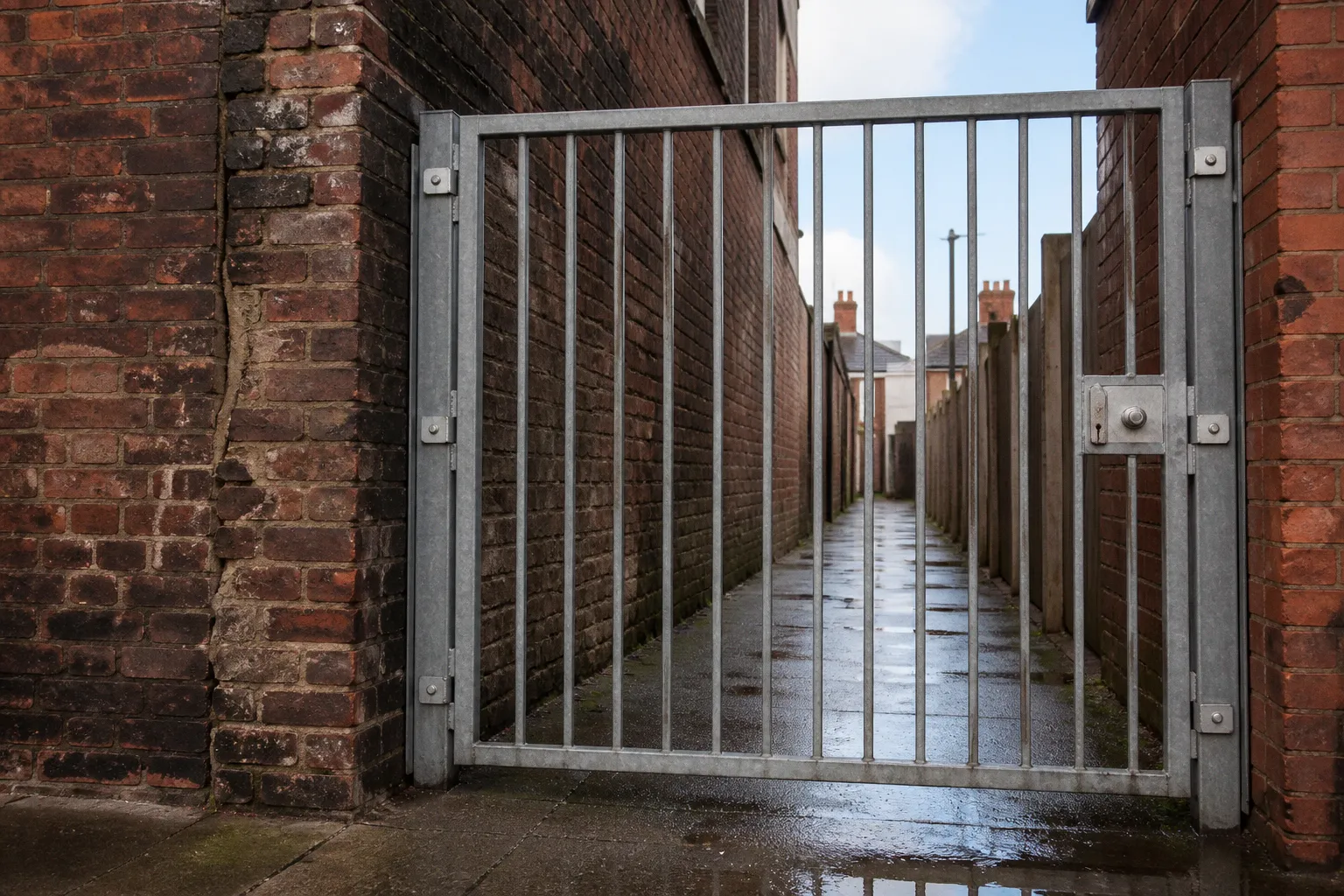
The first question is not which gate to buy. It is whether the passage is private land, a recorded public highway, or a public right of way.
That distinction determines who can authorise the gate, whether unanimous resident consent is required, and whether a formal Public Spaces Protection Order is needed. It also determines who pays for installation, who holds the keys, and who remains responsible when the lock fails or the passage fills with waste.
For residents considering alley gating schemes in Grimsby, the central rule is therefore administrative rather than technical: establish the status of the alley before treating it as a household target-hardening project.
Private passageways and public rights of way are different legal categories
Rear passages in residential areas can appear functionally identical while having very different legal status. A narrow route between terraces may be owned by adjoining households, held by a private management arrangement, or recorded as a public highway. The physical appearance of the alley does not resolve the issue.
On privately owned land, the adjoining residents generally control access subject to the rights attached to the properties. A proposed gate is therefore a shared property and management decision. On a public right of way, residents cannot simply place a lock across the route because they consider it unsafe or inconvenient. Public access is governed through a separate legal framework.
This is the point at which many informal discussions about Grimsby alley gate consent become inaccurate. A majority decision may be sufficient for some neighbourhood arrangements, but it is not the stated requirement for gating a private passageway covered by the relevant household interests. The available council guidance requires agreement from all affected households before a gate is installed on private land.
The practical categories can be set out as follows:
| Passageway status | Who must authorise access control? | Main legal issue | Ongoing responsibility |
|---|---|---|---|
| Private passageway | All relevant affected households | Unanimous agreement before installation | Residents responsible for management and maintenance |
| Recorded public highway | Public authority through the relevant legal process | Public access cannot be removed informally | Conditions attached to the legal order and local management arrangements |
| Public right of way | Formal process, including a PSPO where applicable | Access restriction requires statutory authority | Responsibility depends on the order and ownership of the infrastructure |
The table is not a substitute for checking the title or highway status of a specific route. It does, however, identify the first decision in any alleyway target-hardening project: determine the legal category before discussing hardware, contractors or funding.
A gate is a security measure only after the access rights have been established. Before that, it is an unresolved property and public-law question.
Why 100% consent matters on private alleys
The requirement for agreement from all relevant households is operationally significant. It means that a private alley gating scheme cannot be treated as a simple neighbourhood vote. One household refusing to participate may prevent the scheme from proceeding, particularly where that household has a legitimate right to use the passage or would be affected by the gate’s operation.
This requirement exists for practical reasons as much as formal ones. A gate changes how residents enter and leave the passage. It introduces keys, codes or other access controls. It may affect deliveries, maintenance work, emergency access and the movement of tenants or visitors. If one affected property is excluded from the agreement, the scheme may create a dispute rather than a defensible boundary.
A workable consent process should address several questions in writing:
- Which properties have access rights over the passage?
- Who owns the land beneath the alley?
- Are there tenants, leaseholders or landlords whose interests must be included?
- Where will the gate be positioned?
- Who will hold keys or administer any digital access system?
- How will lost keys, broken locks and unauthorised duplication be handled?
- Who will pay for the initial installation?
- How will future repairs and replacement be funded?
- What arrangements apply to contractors, postal workers and emergency services?
- How will a new owner or tenant be given access when a property changes hands?
These are not secondary details. They are the control framework for the installation. Without them, a gate can become a source of friction between households, particularly if some residents use the passage more frequently or assume that another party will manage the infrastructure.
North East Lincolnshire Council does not fund the installation or upkeep of gated alleyways on private land. The council’s position, as reflected in the available factual material, is that maintenance and management of private gated alleys are the responsibility of residents. The financial consequence is direct: a private scheme requires both a capital decision and a continuing maintenance arrangement.
The exact turnkey purchase and installation cost for private alley gate hardware in Grimsby is not established in the available information. That figure will vary with the width of the passage, the gate design, the locking system, the condition of the surrounding walls and the need for associated works. Residents should not infer a standard council-funded package from publicly supported projects elsewhere in the borough.
Consent should be treated as a documented control
Verbal support at a residents’ meeting is useful but weak as a long-term record. A more robust arrangement identifies every affected household and records agreement to the proposed location, access system, cost allocation and maintenance plan.
This is particularly relevant in areas with a mixture of owner-occupied and rented properties. The household using the passage may not be the party with authority to agree changes to access. Landlords and managing agents may need to be involved, while residents still need a reliable method of accessing the gate.
The purpose is not bureaucratic excess. It is to avoid a predictable failure mode: a gate is installed, a resident later challenges the arrangement, and the group discovers that no one agreed who had the right to control the lock.
Public routes require a statutory process
A recorded public highway or public right of way cannot be gated by residents acting alone. Public access must be restricted through the appropriate legal procedure. The relevant framework identified for gating a public route is a Public Spaces Protection Order under section 64 of the Anti-social Behaviour, Crime and Policing Act 2014.
A PSPO is not simply a larger version of resident consent. It is a formal public-authority intervention. The justification must relate to persistent or continuing problems that have a detrimental effect on the quality of life in the locality, and the authority must use the legal process applicable to the route and circumstances. Residents can provide evidence and make representations, but they do not create the restriction by installing a padlock.
This distinction prevents a common form of informal escalation. A rear alley may be associated with burglary, waste dumping or antisocial behaviour, but that association does not itself convert a private installation into a lawful public restriction. Nor does concern about security authorise residents to block a route that others have a legal right to use.
The evidence relevant to a public-space intervention is likely to be broader than a single incident. It may include:
1. Recorded crime and antisocial behaviour data. Incidence rates over time provide a stronger basis than isolated reports. The relevant geography should be defined carefully; a broad ward-level figure may not describe the specific passage.
2. Environmental evidence. Repeated dumping, damage, poor lighting and signs of unauthorised access can show how the space is functioning, although these conditions still need to be documented rather than assumed.
3. Operational information. Reports from policing, council services and local enforcement teams can help establish whether the problem is persistent and whether other interventions have been attempted.
4. Access and proportionality issues. A restriction affects residents, pedestrians, service workers and potentially emergency access. Those consequences form part of the policy assessment.
5. A management plan. A gate without a clear owner, maintenance budget and access protocol may transfer the problem rather than resolve it.
The precise outcome of a PSPO process cannot be guaranteed from a general description of the legislation. The route, evidence base, consultation requirements and local authority decision-making remain material. Residents should therefore separate two questions: whether gating appears desirable, and whether the statutory threshold and process support a restriction on public access.
West Marsh shows what funded prevention can look like
The Safer Streets 2 project in West Marsh provides a useful example of area-based prevention rather than a template for private alleyways. In June 2021, the Office of the Police and Crime Commissioner for Humberside, working with North East Lincolnshire Council, secured £432,000 from the Home Office Safer Streets Fund for the project.
The programme included alley gating, street lighting and CCTV improvements. It concluded in March 2022. The allocation demonstrates that targeted security infrastructure can form part of a wider preventative framework when it is attached to a defined locality, public funding and an organised delivery programme.
It does not establish that the council will install gates on request for individual residents. Nor does it remove the consent requirement for private land. Funding announcements are often read as evidence that a service is generally available. The West Marsh project supports a narrower conclusion: public investment can be directed at specific neighbourhood safety objectives under a defined programme.
The distinction matters for resource allocation. A public scheme may combine:
- improvements to lighting across a defined area;
- CCTV installation or upgrades;
- access control at selected alleys;
- environmental improvements;
- partnership work between the council, police and community organisations.
A private alley scheme normally starts from a different position. It has a smaller geographic footprint, a resident-funded budget and a responsibility structure tied to adjoining households. Its security value may still be substantial, but its governance is not interchangeable with that of a borough-wide or ward-based programme.
Lighting and surveillance are not substitutes for access control
Alley gating is often discussed as though it is the primary intervention. In practice, the security effect depends on the surrounding conditions. A gate may reduce through-access, but it will not correct poor visibility, unmanaged vegetation, damaged boundaries or a persistent waste problem.
Street lighting affects natural surveillance and the ability of residents or cameras to identify activity. CCTV can improve evidential coverage where placement, maintenance and monitoring are adequate. Neither measure should be treated as automatically effective. A camera pointed at an obstructed wall or a light positioned to create glare may produce infrastructure without producing useful security information.
This is why the West Marsh project is more informative as a package than as a list of individual assets. It links access control with lighting and CCTV improvements. The wider lesson for North East Lincolnshire is that home security upgrades and public-space measures should be assessed as a system:
- Does the intervention reduce unauthorised access?
- Does it improve visibility?
- Does it create usable evidence?
- Is there a named party responsible for maintenance?
- Will the change displace activity into a nearby alley or street?
- Can residents and services operate the system consistently?
The answer will differ between Grimsby neighbourhoods. A gate is not a universal response to every passageway problem.
Waste management is part of the security outcome
Neglected alleys create a separate management problem. Waste accumulation reduces visibility, signals weak guardianship and can obstruct access. It also creates a recurring burden for residents who may assume that the local authority will clear a private passage.
The available council information states that North East Lincolnshire Council does not fund or legally maintain privately owned rear passageways in Grimsby. That places responsibility on the adjoining residents for maintenance and management. The same principle applies to waste clearance on private land: ownership and access arrangements cannot be replaced by a general expectation of council service.
There have nevertheless been organised clearance initiatives. The initial launch of the council’s voluntary Clear It scheme in 2022 helped volunteers dispose of 48.73 tonnes of illegally dumped waste from problem alleyways and neglected land. A separate campaign cleared 7 tonnes from the Castle Street alleyway in East Marsh.
Those figures demonstrate the scale that can accumulate in problem locations. They do not mean that every private alley is eligible for repeated council-funded clearance, and they do not transfer permanent maintenance responsibility away from residents. A one-off clearance can remove accumulated material; it cannot by itself prevent further dumping.
The scheme was relaunched with applications starting on 1 November 2023, according to the available material. Residents considering an application should establish the current eligibility and operating arrangements rather than rely on historic publicity. Programmes can change, and a previous clearance does not create an automatic entitlement to future work.
For a private gated alley, a workable waste-control arrangement should identify:
- who reports dumped waste;
- who confirms whether the land is private or public;
- how access is provided to authorised clearance teams;
- who removes routine household waste or bulky items;
- how the gate remains usable during clearance;
- what happens when dumping occurs outside the gated boundary;
- how incidents are recorded for any future enforcement or funding case.
The council street cleansing contact line identified in the factual material is 01472 326300, option 3. That contact route may be relevant to reporting street cleansing issues, but residents should not assume that a report converts a privately maintained passage into a council-maintained asset.
The maintenance model is part of the security design. If no one owns the lock, the lighting fault or the waste problem, the intervention has no durable operating capability.
Designing a gate that remains useful
Once legal status and consent are settled, the hardware becomes relevant. The objective is not to install the most elaborate gate available. It is to create controlled access that residents can operate reliably and that does not introduce avoidable safety or management problems.
A basic gate may be suitable for a private passage if the surrounding boundary is sound and the access requirements are limited. A more complex system may be considered where there are multiple households, frequent contractor visits or a need to manage access records. Digital systems introduce their own dependencies: batteries, network availability, user administration and recovery procedures when a resident loses access.
The selection should be linked to the passage rather than to a generic home-security product category. The following parameters affect performance:
- Gate geometry: The opening must accommodate ordinary resident movement and any agreed service access without leaving large gaps at the sides or base.
- Lock resilience: The mechanism should withstand repeated use, weather exposure and predictable attempts at forced entry.
- Key control: A system with uncontrolled key duplication can reduce the value of the gate as an access barrier.
- Emergency access: The operating method must be understood by the parties who may need to enter the passage during an incident.
- Visibility: Solid panels can reduce sightlines. In some locations, a design that preserves visibility may support natural surveillance more effectively.
- Boundary condition: A gate cannot compensate for broken walls, climbable structures or adjacent openings that provide an alternative route.
- Maintenance access: The arrangement should allow inspection, lubrication, repair and replacement without a new dispute over entry rights.
- Resident turnover: The access protocol must function when properties are sold, let or occupied by new households.
Secured by Design principles and defensible-space thinking can provide a useful reference for assessing the broader layout. The relevant question is not whether a product carries a security label in isolation. It is whether the passage has a clear boundary, controlled points of entry, usable visibility and an accountable management structure.
The same logic applies to smart home security systems. A camera, door sensor or connected light can improve awareness around an individual property, but a private device does not establish authority over a shared alley. Household security upgrades should reinforce, not replace, the agreement governing communal space.
A rational sequence for residents
The most efficient route is to resolve the structural questions in the right order. Purchasing a gate before confirming ownership and consent creates avoidable cost. Equally, collecting crime anecdotes without establishing the route’s legal status may produce an evidence file that cannot support the proposed intervention.
A rational sequence is:
1. Define the passage. Record its entrances, adjoining properties, gates, walls and any connection to a public street or route.
2. Establish ownership and access rights. Determine whether it is private, a recorded public highway or a public right of way.
3. Identify every affected household. Include properties with legal or practical access interests, not only those that attend local meetings.
4. Agree the operating model. Set out keys, codes, visitors, contractor access, emergency arrangements, repairs and cost allocation.
5. Separate private and public applications. Use resident agreement for a private scheme; do not treat that agreement as authority to obstruct a public route.
6. Build an evidence record. Keep dated reports of crime, antisocial behaviour, dumping, lighting faults and damage where relevant.
7. Assess the full environment. Consider lighting, CCTV, boundary condition, visibility and waste management alongside the gate.
8. Confirm long-term ownership. Name the person, committee or arrangement responsible for maintenance and records.
9. Only then specify the hardware. The gate should fit the legal and operational model already agreed.
This sequence is less dramatic than an immediate installation, but it is more likely to produce a functioning intervention. Security infrastructure fails most often at the interfaces: between residents and landlords, between private land and public access, or between installation funding and future maintenance.
The likely direction of local security planning
North East Lincolnshire’s experience indicates that future safety interventions will continue to combine environmental design with targeted enforcement and local partnership work. Alley gating, improved lighting, CCTV and waste clearance address different parts of the same risk environment. Their value depends on whether the measures are matched to the location and maintained after the initial programme ends.
For Grimsby residents, the immediate policy reality is clear. Private alley gating remains a resident-managed proposition requiring agreement from all affected households. Public routes require a formal legal mechanism, including a PSPO where applicable. The council’s role in funded neighbourhood programmes should not be confused with an open-ended obligation to install or maintain gates on private passages.
The security case for gating can be sound, but the intervention must be governed with the same precision used to justify it. A gate can reduce access opportunities. It cannot resolve unclear ownership, absent maintenance funding or unmanaged waste. Those are separate control failures, and they require separate decisions.
The most credible alley gating schemes in Grimsby will therefore be the ones that begin with legal classification, document unanimous consent where required, integrate lighting and surveillance into a wider preventative framework, and assign responsibility beyond the installation date. That is not an administrative footnote. It is the difference between a security asset and a locked piece of infrastructure that gradually stops working.