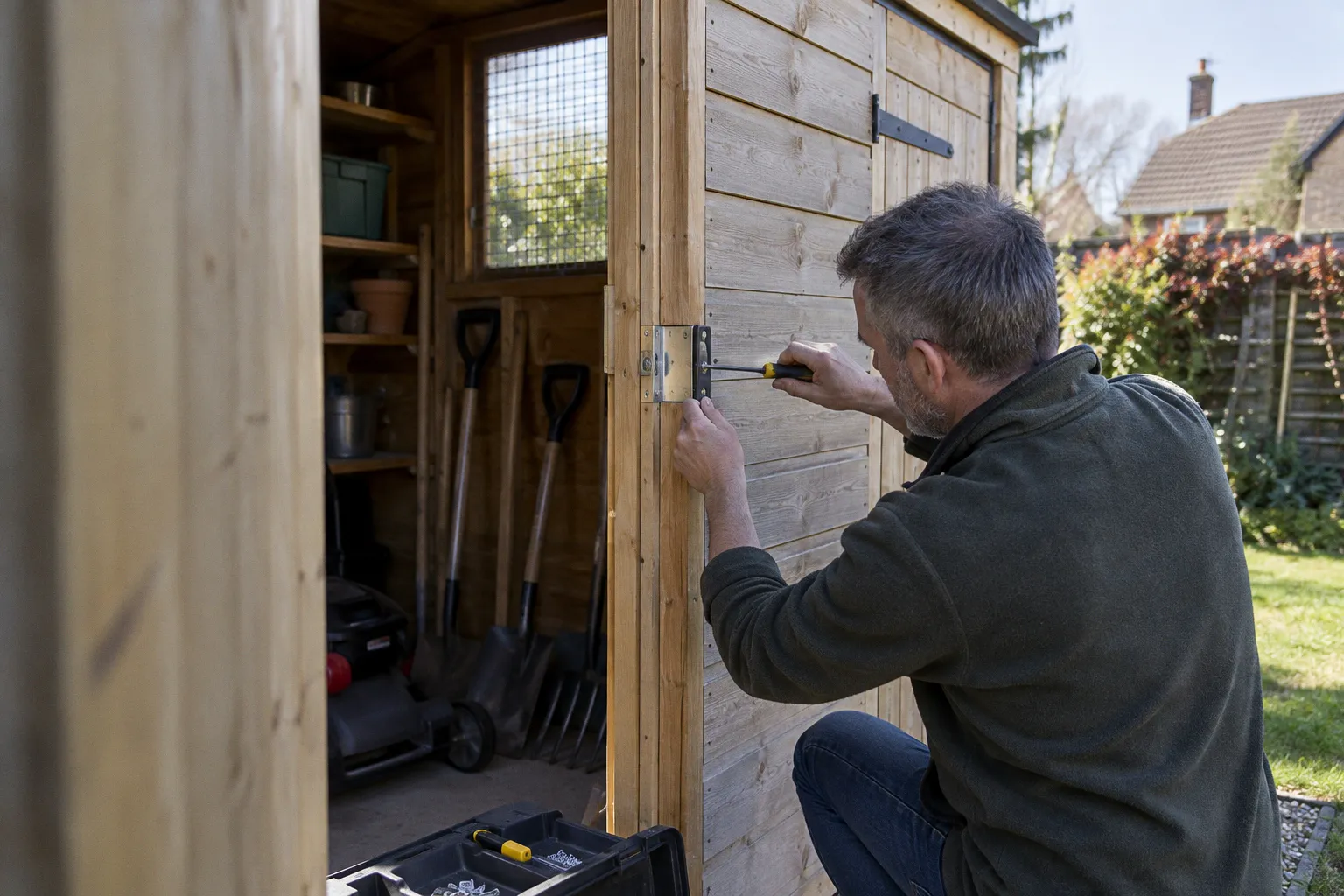
Its door hangs on standard T-hinges fixed with short 25-millimetre screws that an opportunist can back out in under a minute with a slotted driver — recovered, more often than not, from the shed itself. The hasp is closed by a budget laminated padlock with a six-millimetre shackle, clearly visible from the service alley or the lane between the terraces. From that line of sight, an offender has a clear run back to a vehicle or a cycle path before anyone inside notices the loss.
The numbers behind the story are well established. Across the UK, roughly one in seven households experiences some form of garden theft each year, and the average contents of a domestic garden shed are valued at around £600. Insurance data from Aviva shows thefts from gardens and outbuildings rise by more than 25 per cent in the weeks after the clocks go forward in spring, with the average haul worth around £850. The seasonal spike matters because shed theft is rarely the end of the story. A spade, a garden fork, or a crowbar recovered from an unsecured outbuilding is precisely the lever an opportunist uses to force entry into the main house. Treat the shed as the perimeter door it functionally is, and the rest of the upgrade plan follows.
The garden shed is the rehearsal space for the main event. Secure it like a second front door, or accept the risk it actually represents.
Audit the access points before you buy anything
Before spending money on hardware, walk the perimeter the way an offender would. Three questions give you most of what you need:
- Where is the line of sight from public land — the alley, the lane between rows, the back gate?
- What is the weakest single point of entry: the door, a window, a panel joint, the hasp?
- Are tools stored inside close enough to the door or wall that a hand can reach them through a small breach?
The answers decide what you actually need. A shed that backs onto a gated alley in Cleethorpes with motion lighting above it is not the same problem as an exposed corner plot in East Marsh where the rear fence is short and the lane is unlit. Most gardens in the urban parts of NEL fall closer to the second category, which is one reason the seasonal figures move so sharply once daylight returns in March and opportunists resume their patrols after dark.
Doors: lock the timber to British Standard, or replace the door
For a solid timber shed door at least 44 millimetres thick, Secured by Design guidance points to a mortice sash lock certified to British Standard BS3621. This is the same standard that has been required of domestic front doors for decades. If the door is thinner than 44mm, a BS3621 mortice lock cannot be fitted cleanly — and at that point you are better off replacing the door panel than dressing up a flimsy slab with chrome fittings that will not anchor properly.
For thinner stock, or for sheds where a mortice lock is impractical, a heavy hasp and staple closed by a close-shackle or discus padlock rated to a recognised standard (look for Sold Secure or SS-EN 12320 ratings) buys meaningful time. The weakness is rarely the padlock itself; it is the hasp's fixing screws and its exposure to bolt cutters from the alley.
This is where the hinge attack comes in. A standard T-hinge is fixed with two short screws per leaf. Replace them with tamper-proof clutch-head screws or coach bolts that an ordinary driver cannot remove, and add a third fixing point where the manufacturer has not. The same logic applies to the hasp and staple: long coach bolts through the door frame into the shed's structural studwork, not just into the door skin. A minute spent on this detail adds several minutes to the entry attempt.
| Upgrade | What it addresses | Difficulty |
|---|---|---|
| BS3621 mortice sash lock on a 44mm+ door | Keyed entry, lever-and-pry attack | Moderate — chisel work required |
| Close-shackle or discus padlock on a reinforced hasp | Bolt-cutter vulnerability on thin doors | Easy — drill, bolt, close |
| Clutch-head screws or coach bolts on hinges and hasp | The minute-long unscrew attack | Easy — driver, ten minutes |
| Full door panel replacement for sub-44mm doors | Inherent weakness of thin stock | Moderate — depends on frame |
The implicit point of the table is that a basic padlock on a stock hasp is not a sufficient upgrade on its own. It addresses one attack vector while leaving the others open, and a standard wooden shed with a padlock and nothing else remains a soft target.
Windows, sightlines, and the back of the shed
A shed window is not there for the homeowner's benefit. It is a line of sight for someone considering entry. Three options handle it:
1. Obscure the view. Frosted film, a curtain, or simply a sheet of hardboard fitted internally removes the catalogue display effect — an opportunist can no longer tell whether the shed is worth the effort.
2. Reinforce the glazing. Interior wire mesh, fixed through the frame into the studs, stops a hand reaching the latch or handle. A welded metal grille does the same and reads as a deterrent from the lane before entry is even attempted.
3. Eliminate the window. Apex and pent sheds can be ordered windowless, and the loss of natural light inside is a small price for the loss of opportunity outside.
If the shed sits against a back alley, the more important variable is what the alley sees. A motion-activated bulkhead light mounted above the door, fed from the house supply and adjusted to trigger on approach rather than on small animals, removes the cover that darkness provides. Lighting does not need to be bright; it needs to be unpredictable to someone who has watched the property for a week.
Anchor the contents so the shed itself is not the prize
Securing the door is only half the job. Inside, the tools should be tied down. A heavy floor or wall anchor — the type sold for bicycles and motorbikes — lets you chain a spade, a set of forks, a strimmer, and a toolbox to a fixed point that does not lift off with the shed floor. The mechanic of the attack changes: instead of walking off with the full kit, an offender is forced to cut a chain or abandon the haul.
Tool chests with their own integral lock, bolted through the floor of the shed, serve the same function for smaller items. The aim is to raise the time and noise required, not to make entry impossible — no domestic shed is genuinely entry-proof against a determined and equipped offender. The objective is to make your shed take longer than the next one down the lane.
Time is the only currency that matters in opportunistic theft. Every minute you add to the entry is a minute an offender chooses a different shed.
Mark it, register it, advertise it
Property marking is the part most homeowners skip, and it is the part that recovers stolen goods once they have left the premises. Three approaches work in combination:
- Forensic marking kits (SelectaDNA, SmartWater, and similar products) leave a unique chemical signature on the metal that survives cleaning and links the item to your address in police records.
- Etching your house number or postcode into the body of the tool — using a vibratory engraving pen or acid etching paste — achieves the same identification more cheaply, if less discreetly.
- Registration of serial numbers and descriptions on the national Immobilise database gives police a direct lookup when recovered items surface in pawn shops, second-hand platforms, or local resale markets.
For maximum effect, combine methods and advertise the marking on the outside of the shed. A simple warning label, visible from the alley, acts as a deterrent in its own right. Offenders who know an item is marked and registered are more likely to move on, because resale becomes harder and recovery becomes more likely.
Local context: alleys, lighting, and the East Marsh corridor
In North East Lincolnshire, the urban geography shapes the threat. Much of Grimsby's older housing stock sits on back-to-back plots accessed by service alleys that are gated in some streets and open in others. Where the council and partner schemes have rolled out alley gating, the effect on shed and outbuilding theft is consistent with what you would expect from removing easy foot and light-vehicle access to rear plots. Where the lanes remain open — particularly around parts of East Marsh and parts of Immingham's older streets — the perimeter of the shed is effectively public space, and the hardware on the door has to do all the work.
Street lighting improvements in residential areas of East Marsh have similarly reduced the cover available to offenders approaching from the lane. Lighting is not a standalone solution, but it is a free multiplier when the hardware is already fitted and the angle of approach is exposed.
Insurance: read the sub-limit, not the headline
Standard household contents policies treat outbuildings differently from the main dwelling. Many policies cap cover for items in sheds and garages at a sub-limit that is well below the contents figure quoted for the house. Some policies also require minimum security standards — a BS-rated lock, for example — before they will pay out on outbuildings. Check the schedule before assuming the cover is automatic. The £850 average haul from the Aviva figure is roughly the same number as a typical outbuilding sub-limit, which means a single theft can wipe out the cover you thought you had in place.
The low-cost, immediate checklist
For a typical timber shed on a back garden backing onto an alley, these are the upgrades in priority order. None requires a tradesperson; all can be completed in a weekend with basic tools and parts from a hardware retailer.
1. Replace hinge screws and hasp fixings with clutch-head screws or coach bolts — minimum 50mm length, three fixings per leaf.
2. Fit a close-shackle or discus padlock, rated Sold Secure or SS-EN 12320, on a reinforced hasp bolted through the door frame into the structural stud.
3. If the door is 44mm or thicker, retrofit a BS3621 mortice sash lock for the strongest option.
4. Obscure or reinforce every window: frosted film for low-value storage, interior mesh or grille for anything more serious.
5. Install a motion-activated bulkhead light above the shed door, fed from the house and angled across the approach.
6. Add a floor or wall anchor inside, and chain the most portable tools to it.
7. Mark tools with your postcode, register them on Immobilise, and stick a visible warning label on the shed door.
8. Check your contents insurance schedule for the outbuilding sub-limit and any required lock standard.
The shed is the cheapest part of the property to harden and the most often neglected. Most of the upgrades above cost under £150 in total and require nothing beyond a drill, a driver, and half a day. The arithmetic is straightforward: an offender working the back alleys of Grimsby, Cleethorpes, and Immingham has a long list of sheds to choose from in any given week. The objective is to make sure yours is not the one that gets a closer look.