The Front Door's Hidden Weakness
Stand at the threshold and the impression is one of weight and resistance. Now look down at the jamb — that vertical strip of timber running along the lock side where the deadbolt throws into the frame. On the majority of UK residential installations, that jamb is a 3/4-inch wooden frame, and the strike plate sitting flush in it is held by screws barely an inch long.
That is the real perimeter. And it is the perimeter that fails first.
Most homeowners evaluate their front door the way they evaluate a wall — solidity of the panel, quality of the cylinder, presence of a deadbolt. The opportunist looks lower. They look at the gap between door and frame, the screws visible around the lock face, the hinges, the lip of the threshold. According to FBI crime data referenced in industry security reviews, 34% of burglars enter through the front door, and 55.7% of burglaries involve some form of forcible entry. The front door is not just the most common access point; it is the most common forced access point.
The Structural Weakness of Standard Residential Door Frames
A standard residential door jamb is not structural. It is dressed timber, typically pine or a similar softwood, fixed to the structural framing of the wall behind it. The visible 3/4-inch thickness is the cosmetic face. When a kick lands squarely on a door — even a moderate one, the kind delivered in trainers rather than boots — the energy flows directly into the lock side. The deadbolt is the point of contact with the jamb. The strike plate around that bolt is held by two short screws, each one anchored only into the jamb itself, not into the framing stud behind it.
The mechanics of failure are predictable. The screws, only an inch or so long, hold the strike plate to softwood. Under sudden lateral force, the wood around the screw threads compresses, splits, and gives. The screws pull free — not because they snap, but because the timber that holds them shears away. The jamb itself cracks along the grain. Within seconds the deadbolt has nothing to throw into, and the door swings open.
The lock cylinder doesn't fail first. The timber around it does.
This is the critical sequence: a strong lock on a weak frame is not a strong door. The hardware matters, but the substrate matters more. And the substrate on the majority of properties across North East Lincolnshire — Victorian terraces in the East Marsh, post-war semis through Cleethorpes, modern infill around Immingham — is the same 3/4-inch dressed timber that has been standard in UK residential construction for decades.
How Heavy-Duty Strike Plates Distribute Impact Force
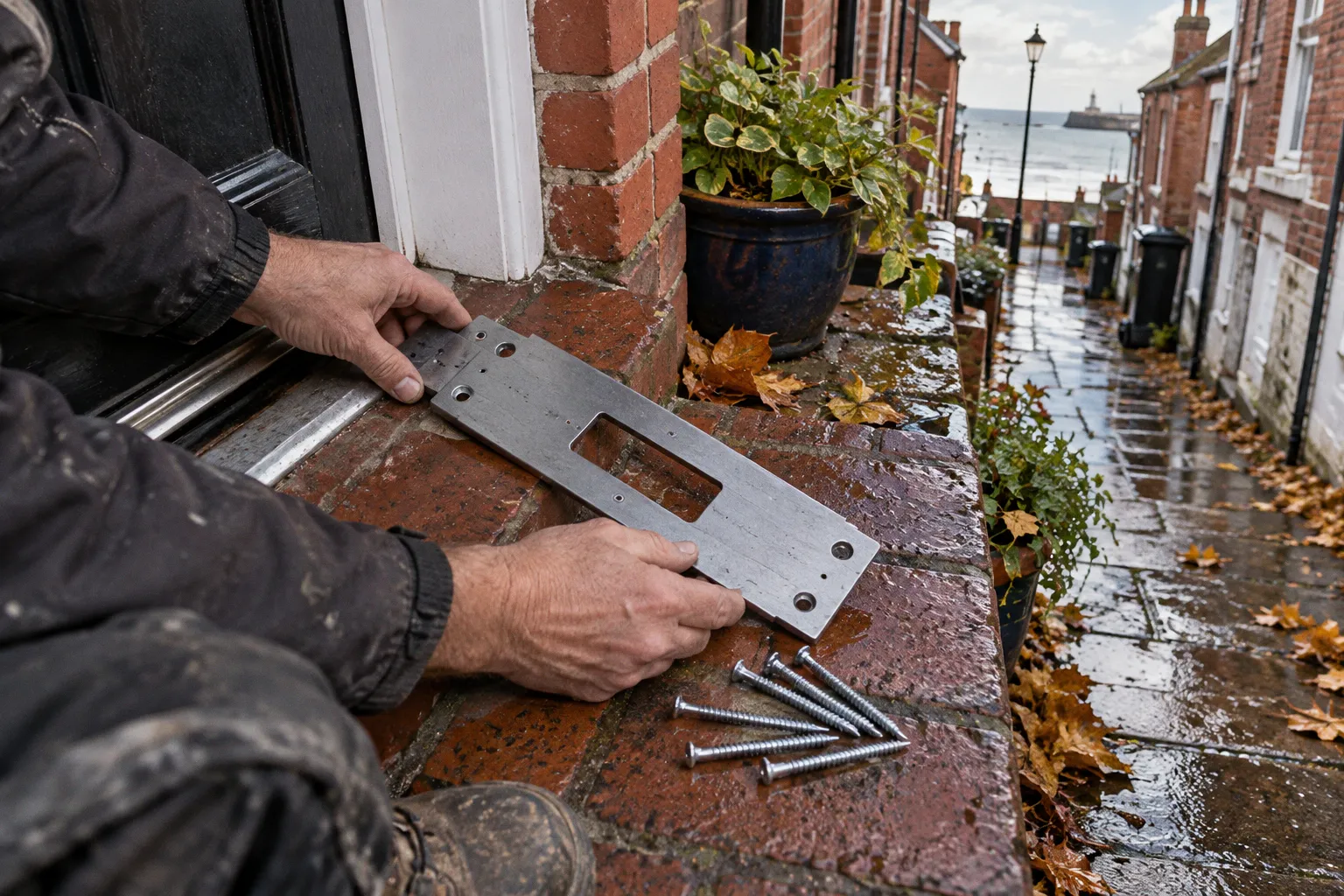
Door reinforcement plates for residential security are designed to address exactly this failure mode. A heavy-duty strike plate is not a cosmetic upgrade. It is a piece of 12-gauge galvanized steel — roughly 2.6mm thick — that wraps around the existing strike point and extends the load path. Instead of concentrating impact energy at the single bolt hole of a standard strike, the reinforced plate spreads that energy along a wider section of the jamb.
The geometry matters. A standard factory strike plate covers perhaps three inches of jamb height around the deadbolt. A heavy-duty reinforcement plate extends significantly beyond this — both above and below the lock — and is anchored with multiple screws, not just two. The result is that a kick does not load one point. It loads six, eight, sometimes twelve anchor points simultaneously, each one pulling into the timber framing rather than the cosmetic face.
| Feature | Standard Strike Plate | Reinforced Strike Plate |
|---|---|---|
| Material | Stamped thin-gauge steel or brass | 12-gauge galvanized steel (~2.6mm) |
| Screw count at lock point | 2 short screws | 4–6 long screws |
| Screw length | ~25mm (1 inch) | 75–100mm (3–4 inches) |
| Anchor target | Door jamb only | Stud framing behind jamb |
| Load distribution | Single point | Distributed across plate height |
| Failure mode under kick | Timber splits, screws pull | Plate flexes, deadbolt holds |
The plate itself does the structural work that the timber could not. Under impact, it flexes — steel of that gauge will deform before it fails — and in doing so it dissipates the kinetic energy across a much wider zone. The jamb timber holds because the load is no longer localised at one bolt hole.
The Mechanics of Anchoring: Why 3-Inch Screws Matter
The single most important variable in any anti-kick door hardware installation is screw length. A reinforced plate fitted with 1-inch screws is no better than a factory strike. The screws must reach the structural framing behind the jamb — the actual stud wall of the house — and they must bite deep enough to transfer load.
Industry-standard practice for strengthening front door frames specifies screws of 75 to 100mm — three to four inches — so the threads pass entirely through the jamb timber and seat firmly in the stud behind. On a typical UK cavity wall this means drilling through dressed jamb, through any reveal, and into the stud itself. The screws do not pull out because the material they are anchored into is no longer the 3/4-inch cosmetic face. It is the wall frame.
A common mistake when carrying out residential door security upgrades is to fit the reinforcement plate and use the screws supplied with it. Those screws are almost always too short. The installer assumes length; the screws assume standard. Replace them. For each anchor point, use a screw long enough to reach the stud, and pre-drill to avoid splitting the jamb further.
This is also where door jamb reinforcement kits earn their cost. A kit is not a single plate. It typically includes a reinforced strike plate for the main lock, a separate plate for any additional bolts or chains, longer screws sized for the application, and often a wrap-around edge protector that shields the timber immediately behind the strike zone. Each component addresses a different failure point along the lock side.
Full-Length Steel Channels and Hinge Reinforcement
The lock side is not the only access point to consider. A full door jamb reinforcement kit often includes a 46-inch steel channel — a full-length lock-side shield that runs almost the entire height of the door. This component exists because opportunists do not always aim for the deadbolt. A kick placed higher or lower on the door still loads the jamb, just at a different point. A full-length channel ensures that wherever the impact lands, the steel is there to take it.
Hinge reinforcement is the second commonly overlooked vulnerability. The hinge side of a door is rarely attacked directly — but a determined kick near the top or bottom hinge, especially on an outward-opening door, can peel the frame away from the stud in the same way the lock side fails. Reinforcement kits address this with hinge-side plates, longer hinge screws (again, 75mm or more, reaching the stud), and sometimes security hinge studs that prevent the door being lifted off its hinges even if the hinge pins are removed.
Edge protectors — thin steel strips fitted along the door edge where it meets the lock side — prevent the timber from splitting under repeated impact. They are a small component but they close off a slow-failure mode: a door that survives one kick but weakens at the grain over time.
Assessing Your Door's Vulnerability to Physical Breaching
A physical audit of a front door takes fifteen minutes and requires nothing more than a screwdriver, a torch, and the willingness to see the door the way an opportunist would. Walk through the following points in order.
1. Strip the existing strike plate. Unscrew it and check the screws. If they are under 50mm long, the strike is cosmetic regardless of how solid the plate looks.
2. Inspect the jamb timber. Look for existing cracks, compression marks around screw heads, or daylight visible between jamb and frame. Any of these indicates the substrate is already compromised.
3. Measure the gap. The door should sit flush against the jamb when closed, with no daylight. A wide gap means the deadbolt has further to travel — and a longer throw is a weaker throw under impact.
4. Check the hinge side. Open the door and examine the hinges. Are the screws 25mm or shorter? If so, the hinge side will fail before the lock side under a serious attack.
5. Test the threshold. The bottom of the frame is often the weakest point because it sees the most weathering and the least maintenance. Probe with a screwdriver. If it gives, the door is being held by the top half only.
6. Look at the glazing. Any glazed insert below waist height is a secondary access point. A burglar breaking that glass can reach inside and operate the handle from within.
7. Consider the door material. A solid timber or composite core holds screws far better than a hollow-core door. If the door itself is hollow, no amount of jamb reinforcement will compensate.
The audit's job is not to make the homeowner anxious. It is to make the homeowner accurate.
The realistic outcome of fitting door jamb reinforcement kits is not a door that resists a hydraulic ram indefinitely. It is a door that resists the average forced-entry attempt — the kick, the shoulder-charge, the pry-bar leverage applied for the thirty or forty seconds an opportunist is willing to commit before the calculus of risk changes. In practice, that is what most residential door security upgrades are buying: not invulnerability, but delay. And delay, in physical security, is the only currency that matters.
For properties across North East Lincolnshire — particularly the older housing stock where original frames are still in service — the cost of a full reinforcement kit is modest relative to the perimeter it covers. The work can be carried out in an afternoon with basic tools. The result is a front door that reads the same to a passer-by as it did before, but performs very differently when tested.