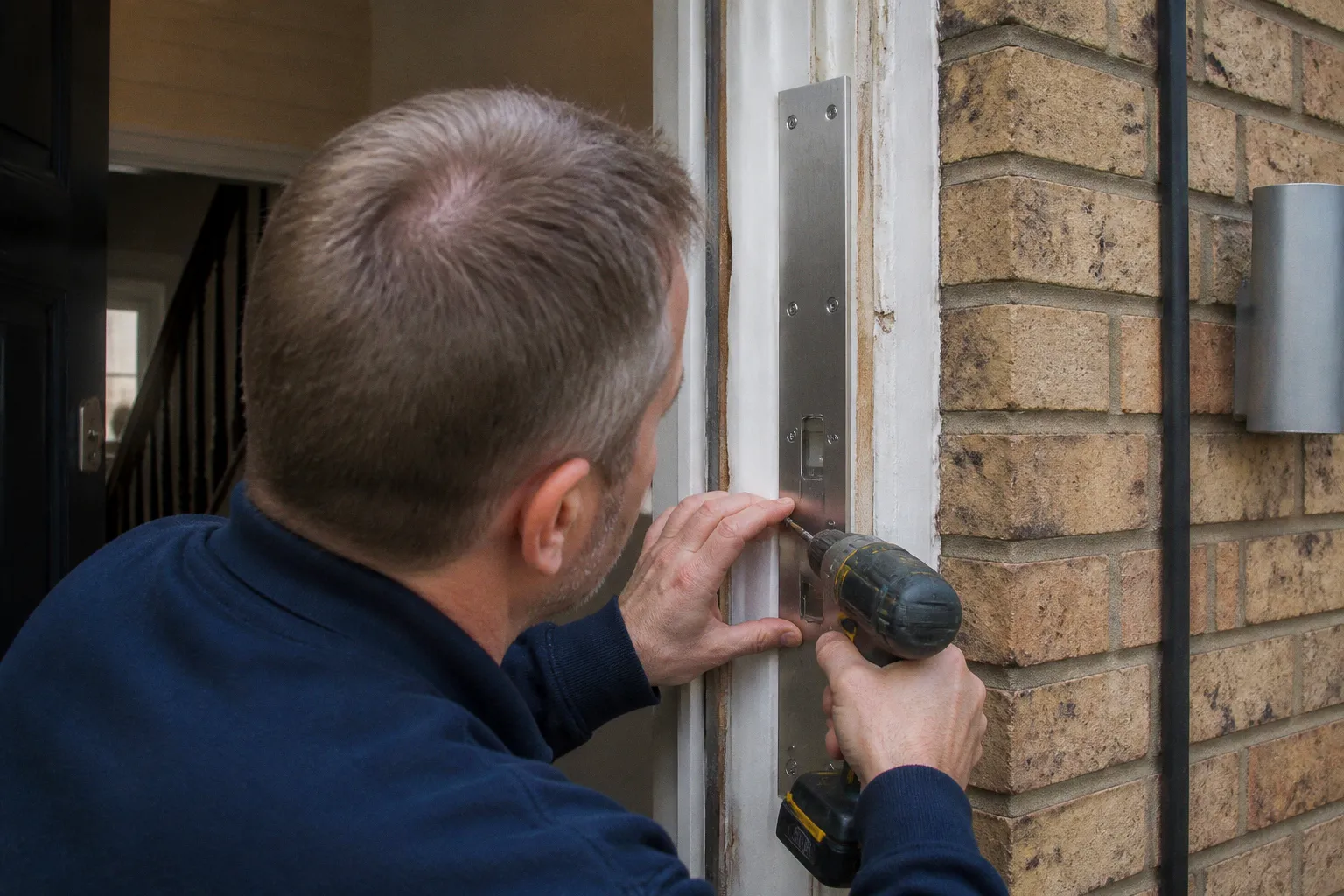
That may be enough for everyday use, but it leaves the most important part of the entrance vulnerable when someone applies sudden force.
For households in Grimsby, Cleethorpes, Immingham and the surrounding streets, door reinforcement is one of the more practical forms of home security because it addresses the structure around the lock rather than treating the lock as the only point of defence. Door reinforcement plates for residential security can help distribute impact across a wider section of the frame, especially when they are fixed with 3-inch to 4.5-inch heavy-duty screws that reach into the wall studs behind the jamb.
This is not about turning a front door into an impenetrable barrier. It is about removing a familiar weakness from the entryway, so that a kick or shoulder impact is not concentrated on a small piece of trim and a few shallow screws.
The structural weakness of standard door frames
When residents talk about a strong front door, they often mean the slab, the cylinder or the deadbolt. Those parts matter, but forced entry frequently succeeds at the point where the latch or bolt meets the frame.
A conventional strike plate has a simple job: it receives the latch or deadbolt and keeps the door closed. In many factory-fitted installations, however, the plate is attached to a narrow section of decorative or finishing timber with short screws. The plate may look substantial from the hallway, while its actual connection to the building is limited.
Under ordinary pressure, that arrangement works perfectly well. Under repeated impact, the force can split the jamb, tear out the screws or distort the opening around the bolt. Once the timber begins to fail, the quality of the lock becomes less relevant because the lock is no longer secured to a stable frame.
This is particularly worth considering in terraced housing, where adjoining properties may share walls and entrances can sit close to pavements, alleys or communal access routes. The frontage may be compact, leaving little room between the street and the door. A well-lit street and good neighbour awareness remain valuable, but physical resilience at the doorway gives those wider community measures something solid to support.
Strengthening door frames against forced entry begins with identifying where the force would travel:
- The strike side carries the latch and deadbolt.
- The jamb holds the strike plate and can split around the fixing points.
- The hinges transfer movement on the opposite side of the door.
- The door edge can be crushed or distorted around the lock.
- The wall behind the frame determines whether longer fixings can achieve a meaningful anchor.
A reinforcement product only performs as well as the material into which it is installed. Long screws driven into weak trim do not create the same protection as long screws reaching sound structural timber.
The lock may stop the door from opening normally; the frame must withstand what happens when someone tries to open it abnormally.
How reinforcement plates distribute impact
A security strike plate is larger and stronger than the small factory plate supplied with many doors. Its purpose is not merely to cover the opening around the bolt. It spreads the impact over a broader area of the jamb, reducing the chance that one small section of timber will absorb the entire load.
That principle becomes more pronounced with a full-length jamb shield. Heavy-duty steel shields can extend roughly 40 to 46 inches along the lock side of a door, reinforcing a substantial portion of the frame rather than one isolated point. The shield helps connect the latch area with stronger sections of the jamb and can make the frame less susceptible to splitting, kicking and prying.
A useful way to understand the difference is to compare the load path.
With a basic strike plate, the impact is concentrated around the bolt opening and the short screws holding the plate to the trim. With a longer reinforcement plate, the force is distributed across a wider steel surface and transferred through more fixing points. When those points reach the structural studs behind the jamb, the wall assembly rather than the thin door casing takes more of the strain.
This does not mean that every long plate is automatically suitable. The door frame may be too narrow, the wall construction may not provide the expected timber, or the surrounding wood may already be damaged. The principle is sound, but the installation has to match the building.
Strike plates, jamb shields and complete kits
The terms are sometimes used interchangeably, although the hardware can serve different purposes.
| Hardware | What it reinforces | Where it is most useful |
|---|---|---|
| Heavy-duty strike plate | The area around the latch or deadbolt | A focused upgrade where the existing strike plate is the clear weak point |
| Full-length jamb shield | A long section of the lock-side frame | Doors exposed to repeated impact or frames that need broader reinforcement |
| Door wrap or lock shield | The edge of the door around the lock body | Preventing crushing, splitting or deformation around the lock |
| Hinge reinforcement shield | The hinge-side edge and fixing area | Balancing protection so the opposite side of the door is not neglected |
| Comprehensive door hardening kit | Several core failure points together | A more complete retrofit where the door and frame need to be treated as one system |
A plate around the latch is often the first improvement residents consider, and it can be a sensible one. But a strong strike side paired with weak hinges, a brittle door edge or a deteriorated frame leaves the entryway unevenly protected.
For that reason, door jamb reinforcement kits can be helpful when they are designed as a coordinated system rather than a collection of unrelated pieces. The most useful kits typically combine a heavy-duty strike plate or jamb shield with door wraps, lock shields and hinge reinforcement shields.
Selecting hardware for a real doorway
The right product is not determined by the length of the steel alone. A reinforcement plate has to fit the door, the frame, the lock and the wall behind the frame. A product that cannot sit flat, clear the trim or align with the latch may create more frustration than protection.
Before choosing heavy duty door hardware for home safety, look closely at the following parts of the entrance.
1. The condition of the jamb
Sound timber can hold a fixing securely. Rotten, split or badly compressed timber cannot. If the jamb has already been damaged by a previous attempted entry, repeatedly painted over, or weakened by moisture, reinforcement may need to begin with repair or replacement.
A plate installed over decayed wood can conceal the problem without solving it. The steel may remain intact while the surrounding frame pulls away from the wall.
2. The material behind the frame
Long screws are useful only when they reach something capable of holding them. In a timber-framed section, 3-inch to 4.5-inch screws may pass beyond the trim and jamb into the structural wall studs. That is the anchoring depth that makes the upgrade meaningful.
The same assumption cannot be made in every property. Masonry, steel framing, cavity construction and unusual door reveals require different fixing methods. Drilling into an empty cavity is not the same as anchoring into a stud. Equally, a screw that is too long for the construction may damage services or fail to clamp the frame correctly.
Where the structure is unclear, a competent installer should inspect the frame rather than relying on appearance from the room side.
3. The type of door
A solid timber or composite door may respond well to reinforcement, provided the frame is sound. A hollow-core internal door is a different proposition. Long screws do not create a strong fixing if the door edge or surrounding frame lacks solid material.
The same caution applies to doors with extensive glass panels, thin decorative skins or poorly supported lock sections. Reinforcement hardware must be compatible with the construction. It cannot compensate for a door that was never designed to resist external impact.
4. The lock and bolt projection
A reinforcement plate must align with the existing latch or deadbolt. The bolt should extend into the reinforced area without binding, scraping or stopping short. After installation, the door should close cleanly and the lock should operate without unusual resistance.
A stiff lock is not a sign that the security upgrade is working. It may indicate that the plate is misaligned, the frame has shifted or the screws have drawn the jamb out of square.
5. The hinge side
The lock side attracts most attention because it is where the latch meets the frame. The hinge side still carries the door's weight and can become a failure point if the fixings are shallow or the timber is weak.
Hinge reinforcement shields and longer hinge screws can help connect the hinge area more securely to the frame and wall structure. The goal is not to make one side exceptionally strong while leaving the other untouched. A resilient entryway needs a balanced approach.
Installation essentials: anchoring into structural studs
A security strike plate installation guide should begin with measurement and inspection, not with the drill.
Remove or loosen the existing hardware carefully and examine the fixing holes. If the factory screws are under 1 inch long, they may have secured only the trim or the outer section of the jamb. That is a common reason a door can feel solid in daily use while remaining vulnerable to a forceful attack.
The installation process generally involves these stages:
1. Check the frame and wall construction.
Establish whether there is sound timber behind the jamb and where the structural studs or other suitable anchors are located. Do not assume that the visible frame reveals the full structure.
2. Measure the lock and door edge.
Record the position of the latch, deadbolt, hinges and trim. A full-length jamb shield may require more clearance than a compact strike plate.
3. Position the reinforcement hardware.
The plate or shield should sit flat against the frame, with the bolt openings correctly aligned. Avoid positioning it so close to the edge that the timber becomes prone to splitting.
4. Prepare pilot holes where needed.
Pilot holes can help keep long fixings on line and reduce the risk of cracking, particularly in older timber. The hole size and depth should match the fixing and the material being entered.
5. Use suitable heavy-duty screws.
Fixings in the region of 3 to 4.5 inches are used where they can pass through the jamb and reach the structural wall studs. The exact fixing must suit the construction; length by itself is not a guarantee of strength.
6. Tighten progressively.
A long shield can distort the frame if one screw is driven fully home before the others are positioned. Work across the plate so it remains seated without pulling the jamb out of alignment.
7. Test the complete door.
Check closing, latching, deadbolt engagement and key operation from both sides. Open and close the door several times before considering the work finished.
This is one of those jobs where a few extra minutes spent understanding the frame can matter more than buying the largest plate available. The objective is a secure connection, not simply a visible piece of steel.
Why screw length matters
The contrast between a short factory fixing and a structural fixing is straightforward. A screw under 1 inch may hold a strike plate to the surface trim, but it has little opportunity to engage with the timber that forms the wall-side structure. A 3-inch to 4.5-inch screw can pass through the plate and jamb and reach further into the frame assembly.
That additional reach changes how impact is handled. Instead of allowing the plate and a thin strip of casing to absorb the load alone, the fixing can transfer more of the force into the stronger material behind it.
But this only works when the structure is actually there. A long screw in a hollow void, damaged timber or unsuitable substrate is not a substitute for a correctly assessed installation. Nor should a resident force an unusually long fixing through a frame without considering pipes, cables and other concealed services.
Hardening the entire entryway, not just the lock
Door reinforcement plates are most effective when they form part of a wider home security plan. That plan does not need to be expensive or elaborate. It needs to follow the way the entrance is used and the way the surrounding space is laid out.
A front door on a busy, well-overlooked street has different practical conditions from a rear door opening onto an unlit passage. In parts of North East Lincolnshire, general discussions about alley access, lighting, CCTV and neighbourhood visibility often sit alongside household improvements for exactly this reason: how safe a door feels depends on both the building and the public space around it.
Reinforce the door edge
A lock shield or door wrap can protect the section of the door where the lock body is fitted. Without that support, the edge may split or crush around the lock even if the frame-side strike plate is strong.
The lock-side jamb and the door edge should work together. Reinforcing only one of them can leave the other carrying an excessive share of the impact.
Improve the hinge-side connection
Hinges are not merely decorative fittings. They support the door and transfer load into the frame. Where the existing screws are short, replacing them with suitable longer fixings may improve the connection, provided the frame and wall can accept them.
Hinge reinforcement shields are another option where broader coverage is appropriate. They are particularly relevant for a full door-hardening approach, in which the aim is to reduce weak points on both vertical sides.
Secure accessible secondary doors
The back door, side door, garage entry and doors leading from communal areas deserve the same calm inspection as the main entrance. A beautifully reinforced front door does not compensate for a rear door with a weak frame and poor visibility.
This is also where the wider environment matters. A door reached through a narrow side passage, shared alley or recessed yard may benefit from more than hardware: improved lighting, controlled access, clear sightlines and regular neighbour communication can all contribute to a safer setting.
Consider visibility and surveillance carefully
CCTV and smart home security systems can support prevention and provide useful information after an incident, but they should not be treated as a replacement for sound physical security. A camera that records a forced entry is not the same as a door that is harder to force.
Lighting should reveal the approach to the door without creating deep glare or shadows. Cameras should be positioned to cover the entrance and access routes while respecting neighbours' privacy. Property marking kits can also help identify belongings and demonstrate ownership if items are recovered.
These measures are strongest when they are part of a partnership between households, local groups and the wider community rather than isolated gadgets attached to individual properties.
Good home security is layered: a stronger frame, a visible entrance, alert neighbours and sensible technology each make the others more useful.
Where door reinforcement fits into safer streets
Household target hardening is sometimes discussed as though it is separate from public safety work. In practice, the boundary is much less clear than it appears. A door that resists a kick is doing the same job as a well-placed light fitting: it changes how easy a target is to approach and how long an attempt takes. Both buy time, and time is what makes someone give up, change their mind or get noticed.
For residents in terraced streets, the entrance is rarely just a private boundary. It opens onto shared paths, alleyways and pavements that are used by neighbours, postmen, dog walkers and anyone else passing through. Improvements that make a single doorway stronger also tend to make the row a little harder to work along without being seen. That effect is modest on its own, but it stacks up when several homes on the same stretch take similar steps.
The same logic runs in the other direction. Better lighting, clearer sightlines and reasonable levels of natural surveillance from passing pedestrians all make the investment in a reinforced frame more effective. A door that would resist a kick for thirty seconds instead of five is more useful when those thirty seconds are visible to the street rather than hidden behind a high fence in a dark recess.
None of this requires a coordinated scheme or a grant programme. Most of the meaningful gains come from individual decisions made sensibly and repeated across a neighbourhood over time. A resident who fits longer screws into the jamb, swaps a short factory plate for a proper one, and asks the council about a flickering alley light is doing exactly the kind of layered work that makes the area harder to exploit.
Preventing kick-in burglaries in terraced housing is rarely about a single dramatic upgrade. It is about removing the small, predictable weaknesses that an opportunistic attempt relies on, and doing it before the attempt is made. The frame is the most overlooked of those weaknesses, and a reinforcement plate fixed properly is one of the more straightforward ways to deal with it.