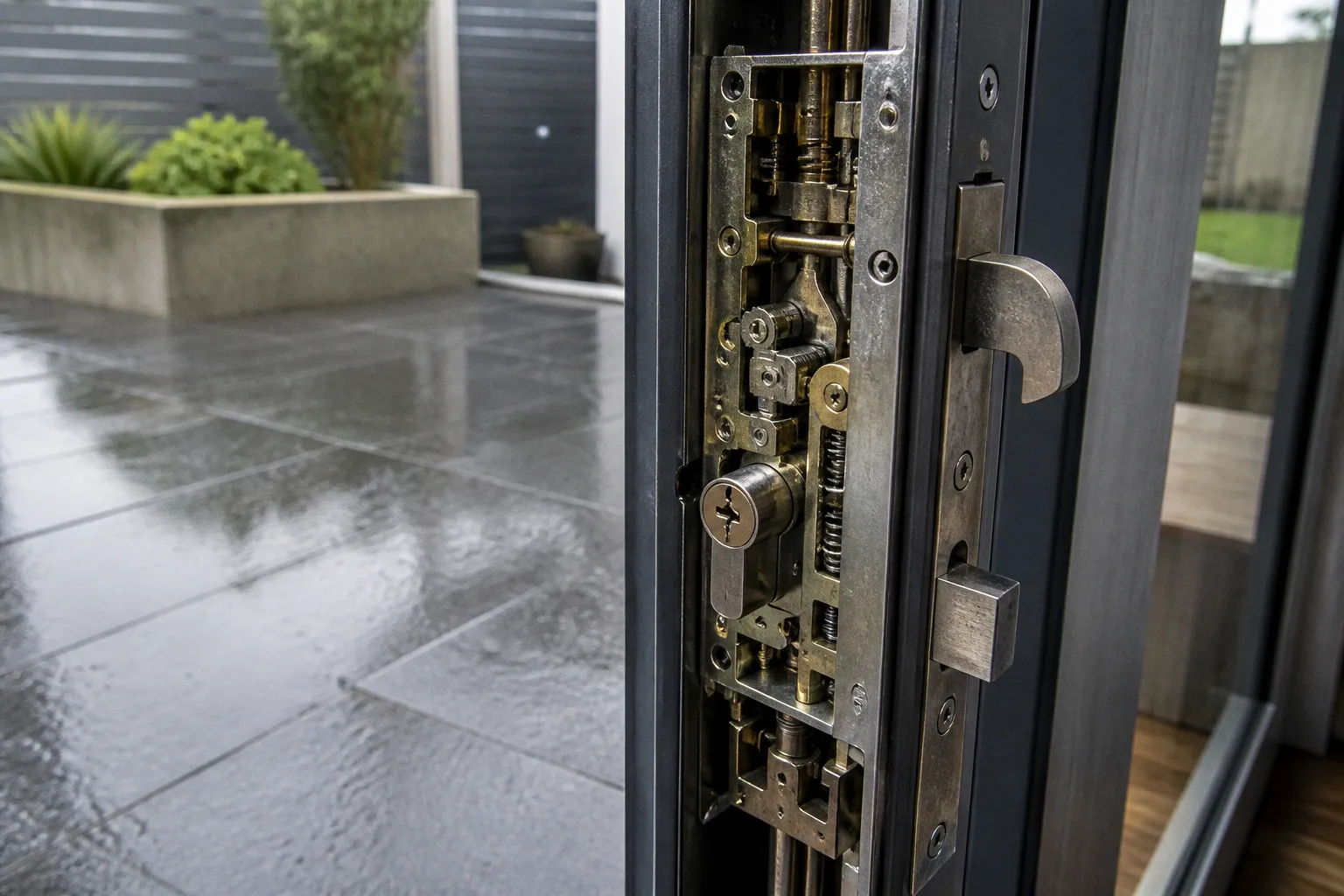
Its protection comes from a coordinated mechanism inside the door: a central gearbox drives steel rods up and down the edge of the sash, engaging several locking points into the frame at the same time.
That arrangement is now familiar on many uPVC and composite doors across North East Lincolnshire, from homes in Grimsby and Cleethorpes to properties around Immingham. Yet the mechanism is often misunderstood. A handle that feels stiff, a key that no longer turns smoothly, or a door that appears to lock while its bolts extend less than they should can all point to wear inside the gearbox or to a problem with alignment.
Understanding the multipoint door lock’s internal mechanics makes it easier to spot a developing fault before a door becomes difficult to secure, and it helps prevent the wrong replacement gearbox being ordered.
The central gearbox is the mechanism’s control room
The central gearbox, also called the centre case, sits inside the door edge, usually behind the handle and cylinder. It contains the parts that receive movement from the handle or key and pass that movement into the rest of the locking system.
At its centre are several small but important components:
- The latch holds the door closed when it is pushed into the frame.
- The deadbolt provides a more substantial locking element once the mechanism is operated.
- The spindle follower receives the square metal spindle connected to the handle.
- The cam follower transfers the rotation of the euro cylinder into the lock.
- The internal drive system moves the rods that connect the central gearbox to the upper and lower locking points.
From the outside, the faceplate running along the door edge can make the lock look like a long, simple strip of metal. In practice, it is a linked system. The centre case is the part that coordinates the movement, while the drive rods carry that movement to the top and bottom of the door.
Most multipoint locks have at least three locking points: one near the top, one around the centre, and one near the bottom. Larger doors or particular hardware arrangements may use five, seven, or more points. Those points can be made up of different components, including deadbolts, hook bolts, roller cams, or mushroom cams.
The number alone does not tell the whole security story. A door with several points is not automatically better protected if the mechanism is poorly adjusted, worn, badly fitted, or dependent mainly on roller cams rather than stronger bolts and hooks.
The strength of a multipoint lock lies in coordination: the gearbox, rods, frame and locking points must all work as one system.
The internal gearbox also explains why a fault at the handle can affect the entire door. If the spindle follower, drive gear or another part of the centre case begins to wear, the problem is not limited to the handle. The rods may fail to travel their full distance, leaving the upper or lower points only partly engaged.
How handle and cylinder movement reaches the top and bottom of the door
The basic movement is straightforward, although the parts are tightly packed inside the door.
When the handle is lifted, the square spindle attached to it turns the spindle follower in the centre case. The gearbox then transfers that movement into the steel drive rods running vertically through the faceplate. These rods move towards the top and bottom of the door, operating the remote locking points.
The key works through a separate route. A euro cylinder sits through the centre case, and its cam engages with the cam follower. When the key is turned, the cam follower rotates the internal mechanism, moving the deadbolt and the connected drive system.
This is why a multipoint door can feel different depending on whether the handle or key is being used. The handle normally retracts the latch and releases the locking points for opening. The cylinder can operate the deadbolt and secure the door, depending on the particular lock design and how the handle is used.
A simplified description of the movement looks like this:
1. The handle turns the square spindle.
2. The spindle follower inside the gearbox converts that turn into movement within the centre case.
3. The drive system pushes or pulls the steel rods.
4. The rods operate the upper and lower hooks, bolts or cams.
5. The locking points enter their keeps in the frame, while the centre latch and deadbolt remain correctly positioned.
The mechanism relies on the door being properly aligned with its frame. If the sash has dropped, the hinges have shifted, or the keeps are no longer in the right position, the locking points may rub against the frame. The user may then lift the handle harder, creating extra stress on the spindle, gearbox and rods.
That is one reason a stiff multipoint lock should not simply be treated as a handle problem. The resistance may be coming from the frame, the keeps, the hinges or the locking mechanism itself. Repeatedly forcing the handle can turn an adjustment issue into a gearbox replacement.
What the split spindle changes
Some multipoint locks use a split spindle arrangement. This prevents the exterior handle from operating the latch in the usual way. Once the door closes, a person outside must use the key to operate the latch and regain entry.
This can be useful where the household wants the door to resist straightforward operation from outside, but it should not be assumed that every multipoint lock uses a split spindle. Lock functions vary between systems, and a replacement centre case must match the existing setup.
Nor should every multipoint lock be described as automatically deadlocking as soon as the door closes. Some systems require the user to lift the handle and turn the key; others have different operating sequences. The way the door is secured is part of the hardware specification, not a universal feature of the multipoint format.
Hooks, deadbolts and cams do different jobs
The visible points along a door edge may look similar when the door is open, but they are not interchangeable. Each type contributes differently to security, sealing or ease of operation.
| Locking component | Main function | What it contributes |
|---|---|---|
| Hook bolt | Engages into the frame and resists attempts to lever the door | Strong physical resistance when correctly aligned with its keep |
| Deadbolt | Extends into the frame as a solid locking element | Adds a firm central locking point |
| Roller cam | Presses the door against its weather seals and helps guide it into position | Better compression and smoother closing, but limited resistance on its own |
| Mushroom cam | Engages with a shaped keep in the frame | Helps resist separation between the door and frame |
| Latch | Holds the closed door in place before full locking | Everyday closing function; it should not be treated as the main security bolt |
Hook bolts are particularly useful because their shape makes them difficult to withdraw by simply levering the door away from the frame. Deadbolts also provide substantial resistance when they extend fully into the correct keep.
Roller cams are different. They help draw the door tightly against the seals, which matters in exposed coastal areas and during colder weather, but their primary purpose is compression and guidance. Roller cams alone should not be presented as equivalent to hook bolts or deadbolts in resisting a determined physical attack.
Mushroom cams can add another layer of engagement, but their performance depends on the matching keep and on accurate adjustment. If a cam is not properly seated, the apparent presence of several locking points may give a false sense of security.
This distinction matters when a homeowner is considering a replacement or an upgrade. A catalogue listing that says a lock has five or seven points does not necessarily explain how many of those points are hooks, bolts or cams. The configuration is more useful than the headline number.
For residents researching secured by design door locks or household target hardening, the sensible question is not simply how many points the mechanism has. It is how those points engage with the frame, whether the cylinder and surrounding door construction are suitable, and whether the complete installation has been fitted and maintained as a working system.
The signs of multipoint lock gearbox failure
Gearbox failure is often gradual. A door may continue to close and lock for some time while the internal components become increasingly worn. That can make early symptoms easy to dismiss, especially when the door still appears secure.
Common warning signs include:
- The handle has become noticeably harder to lift or pull down.
- The key turns only when the handle is held in a particular position.
- The lock works more easily with the door open than with it closed.
- The latch retracts, but one or more remote locking points do not move fully.
- The handle feels loose or returns poorly after operation.
- The key rotates without producing the expected bolt movement.
- The door needs to be pushed, pulled or lifted while the key is turned.
- The bolts extend less than they previously did.
- A grinding, clicking or slipping sensation develops inside the centre case.
One particularly useful failure indicator is bolt extension loss. If a bolt used to extend around 20 mm but now reaches only approximately 15 mm, the reduction can suggest wear or a problem within the drive mechanism. The exact amount of movement varies between lock types, so this is not a universal pass-or-fail measurement, but a visible reduction from the mechanism’s normal travel should not be ignored.
The first distinction to make is whether the problem occurs with the door open, closed, or both.
If the handle and key operate smoothly with the door open but become stiff when the door is closed, the cause may be alignment. The bolts could be striking the edges of their keeps rather than entering cleanly. If the same stiffness occurs with the door open, the issue is more likely to be within the gearbox, cylinder, handle, rods or another internal part.
That does not mean a homeowner should dismantle the lock to identify the failed component. Multipoint mechanisms contain several linked parts, and replacing one visible piece without understanding the underlying issue can leave the door unreliable. A locksmith or experienced door hardware specialist can assess whether the mechanism needs adjustment, lubrication, repair or replacement.
Why forcing the handle makes matters worse
A multipoint handle often requires a firm upward movement, but there is a difference between normal operation and forcing a mechanism against resistance. When the door is misaligned, the rods and locking points are placed under additional load. The spindle and gearbox then carry that load every time the user lifts the handle.
Over time, this can damage the internal drive components or wear the spindle follower. Once the follower no longer transfers movement properly, the handle may move without giving the bolts their full travel.
The practical response to increasing stiffness is to stop treating it as an inconvenience. A door that needs progressively more force is giving useful information. Early adjustment may restore smooth engagement; leaving the problem until the handle fails can turn a manageable repair into an urgent security issue.
Replacing a gearbox is a measurement exercise, not a brand guess
A common mistake is to identify a multipoint lock by its general appearance and order the first replacement that seems similar. The faceplate may look almost identical while the internal dimensions are different enough to make installation impossible or unsafe.
Two measurements are particularly important:
Backset
The backset is the distance from the edge of the door, or the faceplate, to the centre of the spindle or relevant operating point. Common sizes include 30 mm, 35 mm and 45 mm.
A replacement with the wrong backset will not place the handle and cylinder in the correct position. Even a small difference can affect the alignment with the existing door furniture and the holes through the door.
PZ centre distance
The PZ measurement is the distance between the centre of the spindle and the centre of the euro cylinder. A common standard is 92 mm, but it should be measured rather than assumed.
The right PZ measurement is essential because the handle and cylinder must line up with the centre case. If the measurement is wrong, the replacement may not fit the existing cut-outs or furniture.
Other details also need to match:
- The length and width of the faceplate.
- The position and shape of the fixing holes.
- The arrangement of the upper and lower locking points.
- The direction and position of the latch.
- The distance between the centre gearbox and the remote components.
- The type of spindle and cylinder operation.
- The length of the drive rods and the position of their connections.
- Whether the door uses hooks, deadbolts, rollers, mushroom cams, or a combination.
A photograph can help with initial identification, but it is not a substitute for measurements. The same broad pattern of lock appears across many doors, while the gearbox dimensions may differ between manufacturers and models.
| Measurement or feature | Why it matters during replacement |
|---|---|
| Backset, such as 30 mm, 35 mm or 45 mm | Places the spindle and operating mechanism correctly within the door |
| PZ centres, commonly 92 mm on some systems | Aligns the handle with the euro cylinder |
| Faceplate width and length | Determines whether the mechanism fits the routed channel in the door edge |
| Locking-point layout | Ensures the hooks, bolts and cams meet their existing keeps |
| Latch handing | Allows the latch to face the correct way for the door |
| Rod connection positions | Allows the centre case to drive the top and bottom sections |
| Cylinder and spindle arrangement | Preserves the intended method of operation, including any split-spindle function |
Measurements should be taken from the existing lock where possible, with the door open and the hardware safely accessible. If the door is currently difficult to secure, it may be wiser to have the mechanism identified by a specialist rather than risk removing a working component and leaving the property without a reliable lock.
Door alignment is part of lock security
A multipoint lock cannot perform independently of the door and frame. The hooks and bolts need to enter their keeps cleanly, the cams need to compress the seals without excessive force, and the door must sit squarely enough for the handle and key to operate without strain.
This is especially relevant in older housing stock, where repeated seasonal movement, hinge wear or minor frame distortion can affect the relationship between the sash and the frame. A door can look closed while its locking points are not travelling into the keeps as intended.
There are several practical observations that can help narrow the problem:
1. Operate the handle with the door open. If the mechanism is smooth, resistance with the door closed may point towards alignment or keep adjustment.
2. Watch the locking points along the edge. All connected bolts, hooks and cams should move in a coordinated way rather than one section stopping early.
3. Check whether the key turns fully. A key that stops partway may be meeting resistance from the lock or frame.
4. Notice where the door needs pressure. If pushing or pulling the door changes how easily it locks, the frame and keeps deserve attention.
5. Compare the current bolt travel with its normal position. Reduced extension can indicate wear inside the gearbox or an obstruction in the mechanism.
6. Do not rely on the latch alone. A door that has clicked shut has not necessarily been fully secured by its multipoint system.
These observations are not a replacement for a professional inspection, but they can make the conversation more precise. Instead of reporting that the door is simply broken, a resident can describe whether the fault appears only when the door is closed, whether the bolts move together, and whether the key or handle is responsible for the resistance.
That kind of clear information helps local tradespeople arrive with the right parts and reduces unnecessary disruption for households.
Maintaining a reliable locking system
Multipoint locks benefit from ordinary care, but maintenance should be appropriate to the hardware. The mechanism should not be flooded with unsuitable oil, and force should never be used to compensate for a door that is out of alignment.
Keep the door edge and frame keeps free from grit and paint build-up. Check that screws securing the handles and visible hardware remain firm, without overtightening them. If the handle becomes loose, deal with it promptly, since excess movement can place strain on the spindle and follower.
A suitable lock lubricant may be appropriate for the cylinder and moving parts, but the correct product depends on the lock and manufacturer. Grease that attracts dirt can make an already worn mechanism harder to operate. Where the issue is stiffness, scraping or incomplete bolt travel, lubrication alone may conceal the symptom without correcting the cause.
For a broader household security approach, residents may also consider measures such as property marking kits, improved external lighting, secure side access and well-maintained boundaries. In neighbourhoods where alley gating schemes, street lighting improvements or community surveillance projects form part of a wider safety partnership, the front door remains one element of a larger effort. Secure homes and safer public spaces reinforce one another.
The strongest results usually come from practical cooperation: residents reporting faults early, landlords maintaining doors properly, installers matching replacement hardware accurately, and community groups supporting sensible improvements rather than waiting for a serious incident to expose a weakness.
A multipoint lock is only as dependable as its weakest connection: the gearbox, the rods, the keeps, the frame or the way the door is used.
The useful lesson inside the mechanism
The engineering of a multipoint lock is compact but not mysterious. The central gearbox receives movement from the handle or cylinder, transfers it through its internal followers and drive components, and sends the force along steel rods to the upper and lower locking points.
Hooks and deadbolts provide the more meaningful physical resistance. Roller cams help compress the weather seals and guide the door into the frame, but they should not be mistaken for heavy security bolts. Split spindles may change how the door can be reopened from outside, but they are not present on every system.
When a lock begins to fail, the clues are usually mechanical: incomplete bolt extension, increasing handle resistance, a key that turns unevenly, or a door that locks smoothly only when open. Accurate measurements, particularly the backset and PZ centres, are essential before ordering a replacement gearbox.
For households across Grimsby, Cleethorpes and Immingham, that knowledge offers something practical rather than theoretical. It means a stiff door can be investigated before it becomes an emergency, and a replacement can be chosen by specification rather than guesswork. Good home security is often built through this kind of quiet, careful attention: one properly aligned door, one maintained frame and one informed repair at a time.