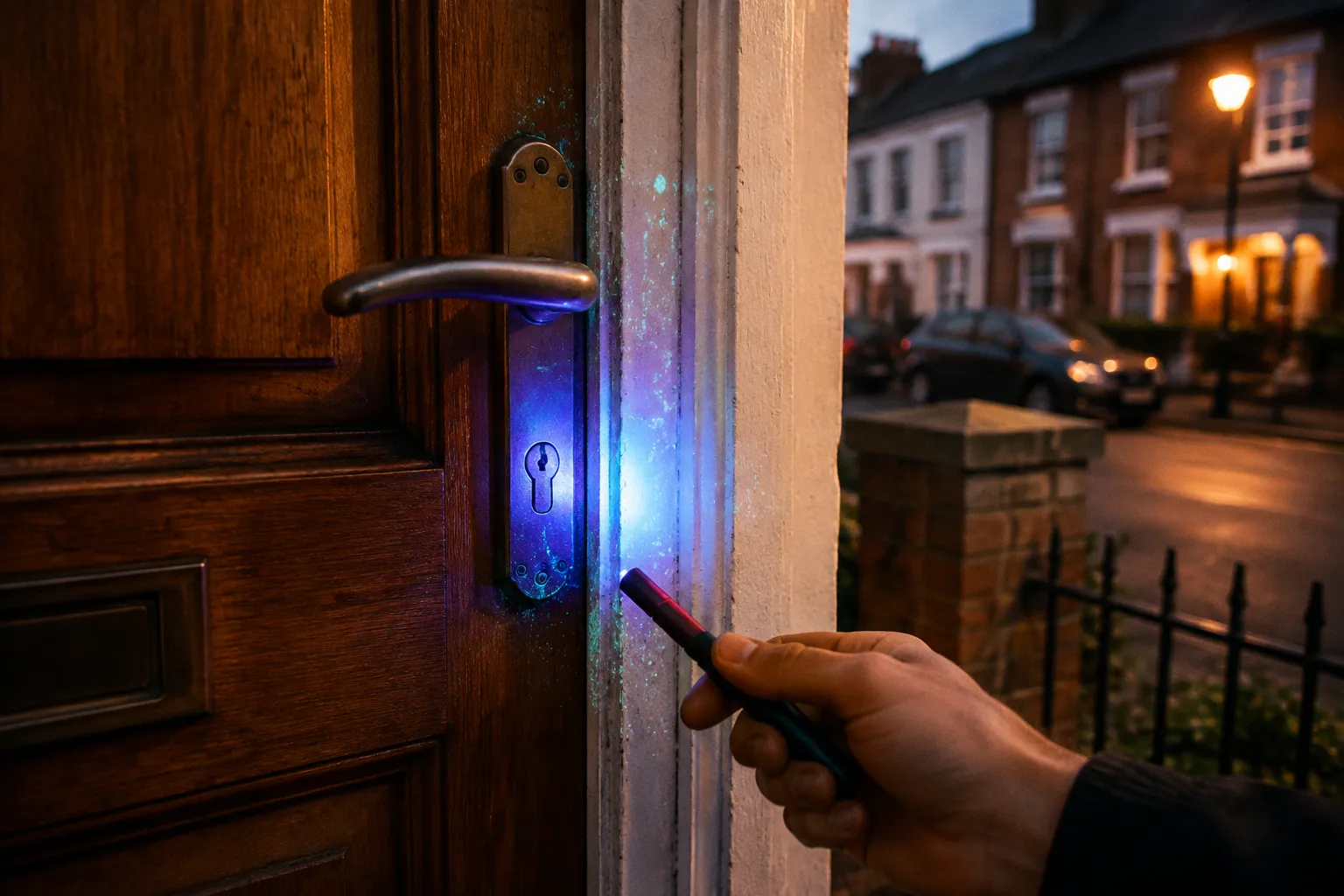
When officers from Humberside Police knock on a door in Grimsby, Cleethorpes or Immingham and hand over a small forensic marking kit, the message is usually the same: register your valuables, fix the warning sticker to your window, and your home becomes a harder target. The residents I talk to on the beat are not fools. They want straight answers, not sales pitches. So let us deal with the question head-on — do forensic property marking kits actually work, or is the bottle of synthetic DNA a theatrical prop that gives householders a warm feeling and burglars a laugh?
The honest answer is that the kits are a tool, not a magic wand. Their effectiveness depends almost entirely on two things: whether offenders see the warning stickers in the first place, and whether the surrounding street is covered too. Get those details right, and the evidence says they help a great deal. Get them wrong, and you are paying for a comfort blanket.
The Psychology of Deterrence: Why Signage Outperforms the Liquid
Let us start where the burglars are, not where the marketing brochures are. When Perpetuity Research, working under Professor Martin Gill, sat down with offenders and asked about their habits, 74% of those interviewed said they would be put off breaking into a building displaying SmartWater warning signage. That figure is the one the police repeat on the doorstep, and for once it is not police PR spin. It is the closest thing we have to a direct line into the criminal mind: thieves do not want traceable goods, and they do not want a buyer asking awkward questions about why the laptop is daubed in a unique forensic code.
What is rarely explained properly is that the deterrent effect is about the sticker, not the liquid. Synthetic DNA solution is invisible once applied. A burglar standing at your window in the dark cannot tell whether you have marked your laptop, your jewellery, or your grandmother's silver tea set. What they can see is the warning label on the window frame. That visual signal is the actual deterrent. The forensic liquid is what gets your property back once it has already been stolen; the signage is what stops it being taken in the first place.
This matters because it tells us that a poorly placed sticker, or a faded one, or one that has been covered over by the new owner's net curtains, does almost nothing. The liquid sits in the loft. The burglar sees a normal home. Nothing has been deterred.
A forensic marking kit is only as good as the sticker on the window — and only as good as the street around it.
The 80% Threshold: Why Neighbourhood Saturation Dictates Success
If there is one figure every resident in North East Lincolnshire should know, it is 80. That is the local saturation level identified by the European Crime Prevention Network (EUCPN) at which property marking delivers meaningful results. Below that level, the scheme is essentially decoration on a few willing households while the rest of the street remains an easy target for the same offender.
The clearest evidence for this comes from an unintended natural experiment in Denmark. Researchers ran a randomised controlled trial involving 12,000 previously burgled households, handing out marking kits and warning stickers to a treatment group, placebo materials to another, and nothing to a control group. The fifteen-and-a-half-month follow-up showed no statistically significant difference between the three groups: 4.6% in the treatment group were burgled again, compared with 5.1% in the placebo group and 4.9% in the control group.
Why did a well-funded trial produce essentially zero benefit? Because compliance in displaying the warning stickers was only 29%. In other words, fewer than a third of households that received the kits actually fixed the stickers where burglars could see them. The saturation on the street looked nothing like the 80% threshold. The scheme, in plain English, was not properly deployed.
Compare that with a 2021 study published in the Security Journal by Spencer Chainey. An English city was given 345 forensic marking kits as part of a focused initiative, and the treatment area recorded an 82% reduction in burglaries over the first six months. The figure is dramatic, and it is also the one police tend to lead with. The detail they sometimes leave out is that burglary levels in that same area had returned to pre-intervention rates by the twelve-month mark. The initial drop was real; the long-term shift was not.
| Saturation on the street | Visible deterrent to offenders | Likely burglary outcome |
|---|---|---|
| Below 30% (stickers rarely seen) | Weak | Little to no measurable effect |
| 30–60% (patchy coverage) | Moderate | Modest, inconsistent reduction |
| 60–79% (good but incomplete) | Strong on covered homes | Useful but undermined by gaps |
| 80% and above (full coverage) | Strong across the street | Best available evidence of significant reduction |
The lesson here is uncomfortable for community groups. A property marking scheme is not a personal purchase; it is a collective agreement. Until the street looks visibly marked from the pavement, individual households are paying for something the criminal on the beat can simply walk past.
Forensic DNA vs. UV Pens: Understanding the Technical Divide
Not all property marking products are the same, and residents deserve to know what they are actually being offered. The two broad categories on the market are forensic synthetic DNA solutions and standard ultraviolet (UV) pen markings. They look similar at a kitchen table, but they behave very differently in the real world.
Standard UV pen markings are cheap, widely available, and largely cosmetic. The ink is invisible under normal light and shows up under a UV torch, which sounds impressive until you realise that a burglar carrying a UV torch is a rare thing. More importantly, the marking fades. Standard guidance is to re-apply every six months because UV ink degrades under daylight and household conditions. Forget to re-do it, and your "permanent" record quietly disappears.
Forensic synthetic DNA solutions use a unique chemical code assigned to your address and registered on a police-accessible database. The code is microscopic and lasts for years. If a marked item turns up in a pawnshop, a police search or a suspect's possession, the link back to your home is immediate. SelectaDNA, one of the more established UK brands, holds Secured by Design police accreditation and includes lifetime database registration without an annual licence fee. That is the kind of detail that matters when you are weighing up what to put on your television, your tablet, and the family camera.
| Feature | Standard UV pen | Forensic DNA solution (e.g. SelectaDNA) |
|---|---|---|
| Visibility to offender | None without UV light | Linked to database; not directly visible |
| Warning sticker included | Sometimes | Yes, standard with most kits |
| Marking lifespan | Re-apply every ~6 months | Long-lasting, multi-year |
| Police database registration | No | Yes |
| Secured by Design accredited | No | Often yes |
| Typical use case | Low-value items, short-term | High-value items, permanent record |
A standard forensic kit will usually cover somewhere in the region of 50 to 60 items, which is enough for the average household's laptops, phones, cameras and small electronics. The maths is straightforward: it is the database, the sticker and the longevity you are paying for, not the liquid.
The Reality of Long-Term Efficacy Beyond Initial Police Campaigns
Here is where the slightly skeptical voice in me has to come out. The English city study that produced the 82% drop did so during an active, visible police-led campaign. The kits were distributed. The stickers went up. There was a public relations push, media coverage, and officers on doorsteps. The burglary figures responded.
Twelve months later, the same area had drifted back to its pre-intervention baseline. The police had moved on to the next initiative. The neighbourhood's attention had moved on. Sticker compliance had dropped as tenants changed, windows had been replaced, and a generation of new residents had not received the same briefing. The deterrent effect, in other words, decayed in step with the visible presence behind it.
This is not a criticism of the officers who do the original distribution work; they do a difficult job well, and often on top of everything else. It is a comment on how community safety works in practice. Schemes that depend on a burst of energy and a press release tend to deliver a burst of results and then settle. The schemes that hold their ground are the ones where Neighbourhood Watch groups, local coordinators, and residents themselves take ownership of the follow-through. Re-sticking faded labels. Re-marking new purchases. Telling the new family three doors down what the bottle in the loft is actually for, and why the sticker on the window is not just decoration.
If you have ever wondered why some streets seem to recover from a burglary spike and others do not, the answer often has less to do with lock quality and more to do with whether the community memory of a scheme survives the first news cycle. Community intelligence is only useful when it is passed on.
The 82% figure tells you what a fully engaged police campaign can do. The 12-month return to baseline tells you what happens when residents stop paying attention.
Integrating Marking Kits into a Broader Target Hardening Strategy
No one offering straight answers on community safety should leave you with the impression that a forensic marking kit is the front line. It is not. It is one layer in a stack, and a competent burglar who finds a window that lifts out of its frame will not be stopped by a sticker that promises traceable goods.
What the kit does, properly deployed, is reduce the resale value of what is taken, increase the chance of a conviction when stolen items are recovered, and put a visible question mark over your home in the mind of a casual offender. The serious work — the work that actually keeps people out — is target hardening in the physical sense. PAS 24-rated doors and windows. Proper deadbolts. External lighting on the alley. Defensible space around the property that says someone is watching. CCTV where it is sensible and well-maintained. Secured by Design standards on anything new being fitted. Smart home security systems, used as a complement to rather than a replacement for the basics.
In North East Lincolnshire specifically, residents have access to a practical set of options that sit alongside property marking: alley gating schemes in parts of Grimsby where they suit the street layout, street lighting improvements in areas such as East Marsh, broader home security upgrade programmes, and property marking kits distributed through local Neighbourhood Watch and police contact points. The mistake is to treat any one of these as the answer. They are tools. They work best together, and they only work at all when the community uses them, maintains them, and reports back when something is wrong.
What I would ask of any resident reading this, and I say it as someone who has done the door-knocking and sat through enough police briefings to know the difference between commitment and spin: if you have a kit, check the sticker is still on the window. If you do not have one, ask your local Neighbourhood Watch coordinator how to get hold of one. If your street is below that 80% coverage mark, that is where the conversation needs to go next, because a handful of marked homes in a sea of unmarked ones is not a deterrent. It is a suggestion, and suggestions do not stop a determined thief on a dark evening.
The straight answer, then. Forensic property marking kits are effective when they are visible, when the street behind them is covered, and when they sit alongside proper physical security rather than replacing it. They are not effective when the stickers fade, when the saturation is low, or when they are treated as a one-off police handout rather than a continuing piece of community housekeeping. The evidence supports that conclusion clearly. The job, as always, is ours to do with it.