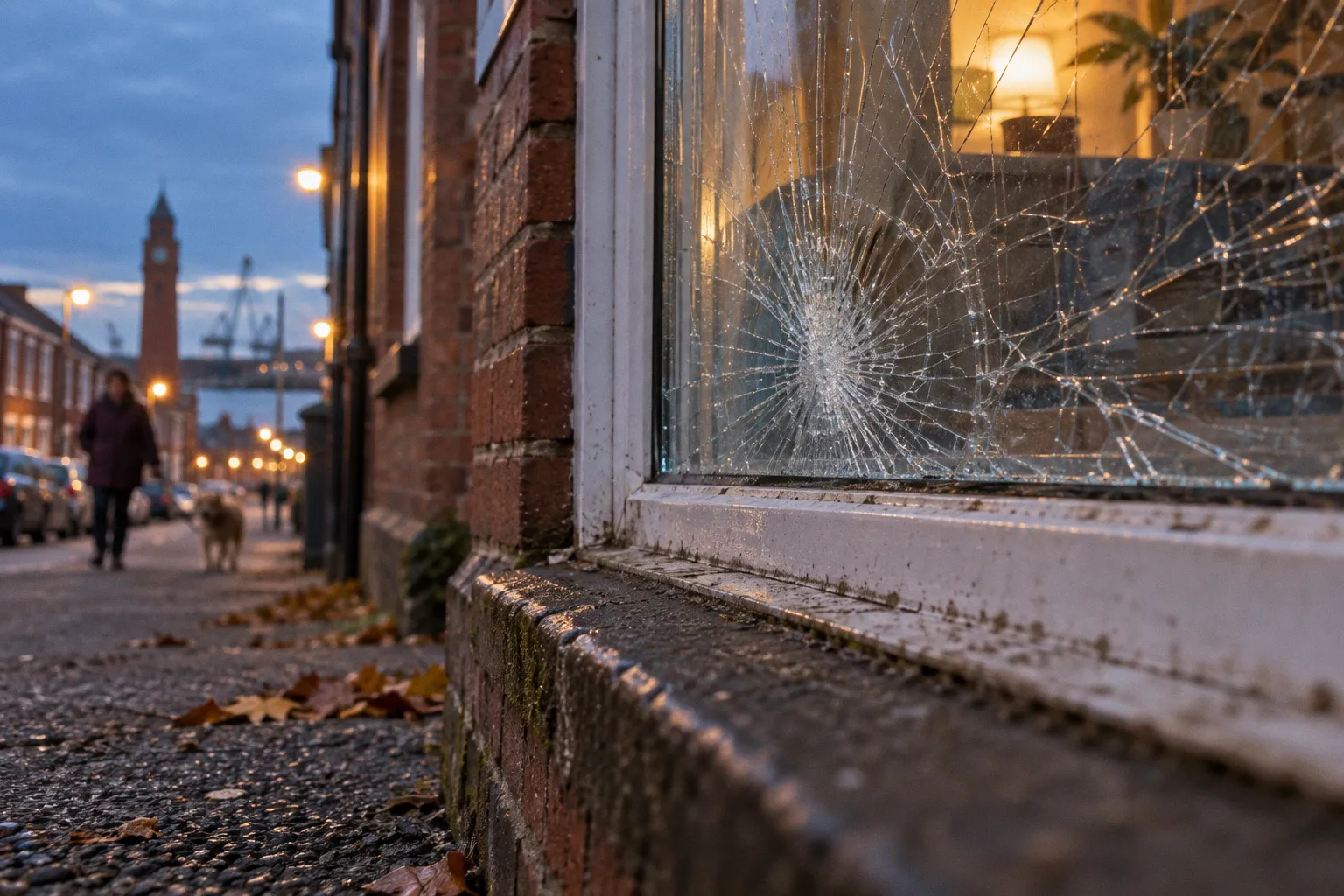
If an opportunist can break the pane, reach the internal handle and leave without crossing a visible perimeter, that window has become a practical entry route.
Window security film can make that route slower, noisier and more difficult. It cannot make ordinary residential glass unbreakable, and it will not compensate for a weak frame, an unlocked handle or an exposed rear elevation. Its effectiveness depends on three things working together: the film’s thickness, the quality of the attachment system and the condition of the window around it.
That is the point often lost in the sales language around shatterproof window film. The film is not a force field. It is a delay system.
What security window film actually does
When ordinary glass is struck, it may fracture into multiple pieces and fall inward. If the impact creates a large enough opening, the person outside may be able to reach through and operate a handle, remove a secondary latch or clear the remaining shards.
Security film changes the failure pattern. It bonds to the glass and helps hold the broken fragments together in the frame. The pane can still crack. The film can still be damaged. But the broken surface is less likely to immediately collapse into the room as a collection of loose pieces.
That creates resistance in three practical ways:
1. The glass remains partly in place. A person outside has to continue working against a connected, damaged pane rather than simply clearing loose fragments.
2. The attack becomes noisier. Repeated impacts, flexing and pulling create sustained sound rather than one quick break.
3. The entry takes longer. Even a short delay changes the conditions around the attack. The person must remain exposed, exert effort and risk being seen.
For home security, those seconds matter because forced entry is rarely carried out in a controlled workshop. It happens at a window, usually under time pressure, with poor visibility and an uncertain view of neighbouring properties.
Security film does not stop the first impact. It makes the second stage of entry harder, louder and less predictable.
This is the correct way to understand window security film effectiveness for residential homes. The question is not whether the glass can be cracked. The question is whether the attacker can create a usable opening quickly and quietly.
The weak point is usually not the pane alone
Before choosing a product, I assess the complete access point. A film applied to the glass may be useful, but the glass is only one component of the window assembly.
Look at the following:
- Is the window on the ground floor or accessible from a flat roof, conservatory, garage or extension?
- Is it hidden from the road by a high fence, shed, hedge or side gate?
- Can a person stand directly in front of it without being seen from neighbouring houses?
- Does the window have a robust lock, or is the handle worn and loose?
- Is the frame sound, or does it flex when pressure is applied?
- Is there a letterbox, cat flap or door within reach of the opening?
- Is the window overlooked by a street, walkway or regularly used rear path?
- Does the external lighting create a clear view, or does it produce deep shadow around the frame?
A film may hold fractured glass together while the entire pane, frame or glazing bead remains vulnerable. If the window can be forced out of its frame, the film has not solved the access problem. It has only strengthened one part of it.
This is why I treat film as a component of household target hardening, not a standalone burglary solution. The target is the route into the building, not the product on the glass.
Thickness: why 8–14 mil is the relevant range
Security films are sold in different thicknesses, and the number matters. A thin safety film may help retain glass after accidental breakage, but that is not the same requirement as resisting deliberate impact and forced entry.
Basic safety films commonly begin around 4 mil. Anti-intrusion security films are typically specified in the 8–14 mil range or thicker. A mil is one-thousandth of an inch, so this is a material specification rather than a marketing description such as strong, tough or shatterproof.
For a residential security upgrade, I would separate the products like this:
| Film type | Typical purpose | What it may do | What it does not prove |
|---|---|---|---|
| Thin safety film, around 4–7 mil | Reduce loose shards after accidental breakage | Helps retain fragments and limit scattering | It does not establish resistance to deliberate forced entry |
| Anti-intrusion film, around 8–14 mil | Delay impact-based access through glass | Holds damaged glass together and increases resistance | It does not make the pane unbreakable |
| Security film with an attachment system | Keep the filmed glass connected to the frame | Reduces the chance of the whole broken pane collapsing inward | It does not replace a secure frame, lock or alarm |
| Certified security glazing system | Higher-assurance resistance to repeated attack | Designed and tested as a complete assembly | Film applied without matching installation may not provide equivalent performance |
The thicker film is not automatically the better installation. If the product is thick but poorly bonded, incorrectly fitted or left without a proper edge attachment, the assembly can still fail at the perimeter.
The glass also matters. Film behaves differently on different glazing types, and the manufacturer’s installation requirements should be followed rather than guessed. A product intended for general safety is not automatically suitable for a vulnerable ground-floor window beside a concealed alley.
The attachment system is the part people overlook
This is the most important technical point in the entire subject.
Film alone may hold shattered fragments together, but the broken pane can still move as one large sheet. If the film is not anchored to the frame, the entire damaged pane may collapse inward when struck with enough force. The glass has remained connected, but the connection has not remained connected to the window.
A proper attachment or anchoring system is designed to secure the film at the edge of the glazing. One method uses a structural silicone bead or a comparable system specified for that purpose. The details matter: the film must be compatible with the glass, the frame and the adhesive system, and the installation must be carried out with the correct preparation and curing process.
Do not treat a narrow visible bead of adhesive as proof that the installation is suitable. Ask what system is being used and what performance it is intended to provide.
The practical distinction is straightforward:
- Film without edge attachment: may retain fragments but can allow the broken pane to dislodge.
- Film with a correctly installed attachment system: gives the damaged glass a better chance of remaining connected to the frame.
- Film, attachment and robust frame together: provide a more coherent forced-entry delay system.
This is also where do-it-yourself installation becomes less attractive. Applying the film neatly is not the same as creating a tested security assembly. Dust, poor edge preparation, incorrect overlap and unsuitable adhesive can all weaken the perimeter. The visible centre of the pane may look acceptable while the critical edge is failing.
If the window is a high-risk access point, the attachment detail deserves more attention than the product label.
What the standards tell you—and what they do not
Two standards commonly appear in discussions of security glazing and film systems: ANSI Z97.1 and UL 972.
ANSI Z97.1 is associated with impact safety for glazing materials. It helps address how a material behaves under impact and whether it presents a particular hazard when broken. That is useful, but impact safety is not identical to burglary resistance.
UL 972 concerns burglary-resisting glazing material and includes repeated impact testing using steel balls. A product or assembly associated with this type of testing has been evaluated against a more relevant forced-entry scenario than a basic decorative or safety film.
The distinction is essential:
- A safety rating does not automatically mean the window will resist a determined attack.
- A burglary-resistance test does not mean every installation of the product will perform identically.
- A film rating may apply to a particular glass type, thickness, frame and attachment method.
- A certificate for one configuration should not be treated as proof for a different window assembly.
When comparing products, ask whether the stated performance applies to the complete system or only to the film material. The phrase complete system should include the glass, film, adhesive or attachment method and frame arrangement. If the supplier cannot explain this clearly, you do not yet have a security specification. You have a roll of material and a claim.
How much delay can film provide?
Security film systems are commonly described as delaying forced entry from a few extra seconds up to several minutes. A typical stated range is around one to six minutes, depending on the configuration and the nature of the attack.
That range should not be read as a guarantee for a particular house. Impact tool, angle, glass type, frame condition, attachment method and attacker persistence all change the result. An unanchored DIY installation should not be assigned a guaranteed breach time.
The value of delay is practical rather than dramatic. A person who intends to enter through a window needs to do more than break the glass. They need to create a hand-sized or body-sized opening, remove dangerous fragments, reach the locking mechanism and climb through. Every stage exposes them to noise, observation and interruption.
Film is most useful when it forces the attack to continue beyond the first strike. It becomes less useful when the attacker can simply move to an unprotected adjacent window, force the frame or use a concealed access route at the rear.
That is why the surrounding layout matters. A visible front window may benefit from film because repeated impacts attract attention. A hidden rear window may require a stronger combined approach: upgraded locks, external lighting, an alarm contact and improved sight lines.
Film versus laminated glass
The usual comparison is security film against laminated glass. They are not the same intervention.
Laminated glass is manufactured with a bonded interlayer between glass sheets. Security film is applied to existing glass. In broad terms, laminated glazing is an engineered glazing product, while film is a retrofit layer that can improve the behaviour of the existing pane.
For a household choosing between replacement and retrofit, the decision usually comes down to access, cost, disruption and the condition of the existing window.
| Consideration | Security window film | Laminated security glass |
|---|---|---|
| Installation approach | Retrofit to existing glazing | Usually requires glazing replacement |
| Main benefit | Adds fragment retention and forced-entry delay | Provides an integrated laminated glazing construction |
| Disruption | Generally lower than replacing the whole pane | More work, with removal and refitting |
| Dependence on installation | High, especially at the edges and frame | Still dependent on correct fitting and frame compatibility |
| Suitability for weak frames | Limited; film cannot repair a failing frame | Also limited if the surrounding frame is inadequate |
| Best use | Targeted upgrade where existing windows are sound | Higher-assurance upgrade during replacement or renovation |
This is not a simple contest in which one material always wins. If a window is already due for replacement, laminated glass may be the more coherent long-term specification. If the frame and lock are sound and the objective is to improve a vulnerable pane without replacing the window, properly installed security film may be a cost-effective retrofit.
The mistake is treating film as equivalent to a complete laminated security-glazing system. It is not.
A physical audit for a North East Lincolnshire home
When I assess a property in Grimsby, Cleethorpes or Immingham, I start outside and work inward. The aim is to view the home as an opportunist would: identify the quietest access point, the shortest route and the place with the least line of sight from other people.
1. Walk the perimeter in daylight
Start at the pavement and follow the boundary. Note every gate, passage, alley, side return, rear fence and low roof. A side gate that closes but does not lock is not a controlled perimeter. It is an invitation to move from the public area into a concealed one.
Look for places where a person can stand close to a window without being visible from the road. Dense planting, tall fencing and poorly positioned sheds can create concealment even when the property appears well maintained.
2. Identify the accessible glazing
Mark all ground-floor windows and any upper-floor windows reachable from:
- A conservatory or extension roof
- A garage or outbuilding
- A boundary wall
- A stored ladder or garden structure
- A flat roof or neighbouring structure
- A low section of fencing
Do not assume that a small bathroom window is irrelevant. Size, position and the presence of an internal handle determine whether it is useful to an intruder.
3. Test the line of sight
Stand outside each vulnerable window and look back toward the street, neighbouring houses and likely walking routes. Then stand inside and look outward at night with the internal lights on.
If the window is hidden from every normal observation point, film alone is unlikely to be enough. Improve visibility where possible. Trim vegetation, remove visual clutter and consider lighting that illuminates the approach without producing a bright glare that blinds occupants.
4. Examine the lock and frame
A filmed pane with a poor lock remains a poor access point. Check for loose handles, damaged keeps, cracked frames and signs that the window has been forced previously. The frame should not flex noticeably under ordinary hand pressure.
Do not drill or modify a window locking system without understanding the hardware. A badly fitted secondary lock can damage the frame or create an emergency escape problem.
5. Decide whether film addresses the actual vulnerability
Film is a logical upgrade where the main concern is impact-based access through otherwise sound glazing. It is not the first answer where:
- The frame is rotten, loose or badly damaged.
- The window does not lock properly.
- The pane is already cracked.
- The window is concealed and completely unobserved.
- A nearby door or roof provides an easier route.
- The installation cannot include a suitable attachment system.
In those cases, repair the access point or redesign the perimeter first.
The strongest window upgrade is wasted if the person outside can simply choose the next, weaker window.
Integrating film with the rest of the security perimeter
Home burglary prevention glass upgrades work best when they form part of a layered arrangement. The layers do not need to be expensive, but they need to cover different stages of the attack.
At the window itself, consider:
- A correctly specified 8–14 mil anti-intrusion film where appropriate.
- A manufacturer-approved attachment system.
- Sound locks and properly fitted keeps.
- An alarm contact on vulnerable opening windows.
- Clear visibility from the street or neighbouring properties.
- External lighting directed at the approach route.
- Property marking for items visible through the window.
- Removal of tools, ladders and garden equipment that can assist an attack.
At the perimeter, focus on access control and delay. A side gate should close reliably and resist casual opening. An alley-facing boundary should not create an easy concealed route to the rear elevation. Where local alley gating schemes or street lighting improvements have changed movement and visibility in an area, homeowners should still inspect their own boundary. Public-space improvements do not repair a private access point.
CCTV can help with detection and evidence, but a camera pointed at a dark hedge does not create useful surveillance. Position it so that faces, approach routes and the relevant window are visible. Avoid relying on a mobile notification as the only response layer.
Smart home security systems are useful when they connect detection to a real action: a visible alarm, prompt occupant response, neighbour awareness or recorded evidence. A silent device hidden inside the property does little to deter someone already working at the glass.
Making the decision without overspending
The sensible order is to spend first on the weakest physical link.
If the lock is defective, repair it. If the side gate is unsecured, fix the gate. If a hedge blocks the view, restore the line of sight. If the glazing is sound but exposed and accessible, then security film may be a reasonable retrofit.
For a typical property, I would rank the work in this order:
1. Remove the easiest access route. Secure gates, doors, sheds and roof-access points.
2. Repair defective window hardware. A secure pane with a weak handle is not a secure window.
3. Improve visibility. Deal with concealment before adding technology.
4. Add detection. Use alarms, lighting or cameras where they cover a real approach route.
5. Specify security film for suitable glazing. Choose the thickness and attachment system for the vulnerability, not simply the cheapest roll.
6. Replace glazing when the existing assembly is beyond sensible improvement. Film is a retrofit, not a repair for failing windows.
This order avoids the common mistake of spending on a visible product while leaving the actual access point unchanged.
The immediate actions I would take
For a ground-floor window that could reasonably be used for entry, I would do the following today:
- Walk outside and identify whether the window has a clear line of sight from the street or neighbouring homes.
- Check the handle, locking points, frame and glazing bead for looseness or damage.
- Remove ladders, bins, tools and garden furniture that could provide leverage or concealment.
- Trim vegetation that hides the window or the approach to it.
- Confirm whether the chosen film is intended for anti-intrusion use rather than basic safety glazing.
- Ask the installer how the film will be anchored to the frame.
- Ask which test or performance standard applies to the complete installed system.
- Do not treat an unanchored film application as a replacement for locks, alarms or secure frames.
- If the frame is defective, price a proper glazing or window replacement instead of layering film over a failed assembly.
Window security film can be worthwhile. It can hold fractured glass together, create noise and delay entry by seconds to minutes. That is a useful physical advantage at a vulnerable access point.
But its performance comes from the installation system, not the label alone. The correct thickness, edge attachment, sound frame, working lock and visible perimeter all matter. Used in that context, film is a sensible retrofit for some North East Lincolnshire homes. Used as a promise that ordinary glass has become unbreakable, it is simply the wrong product expectation.