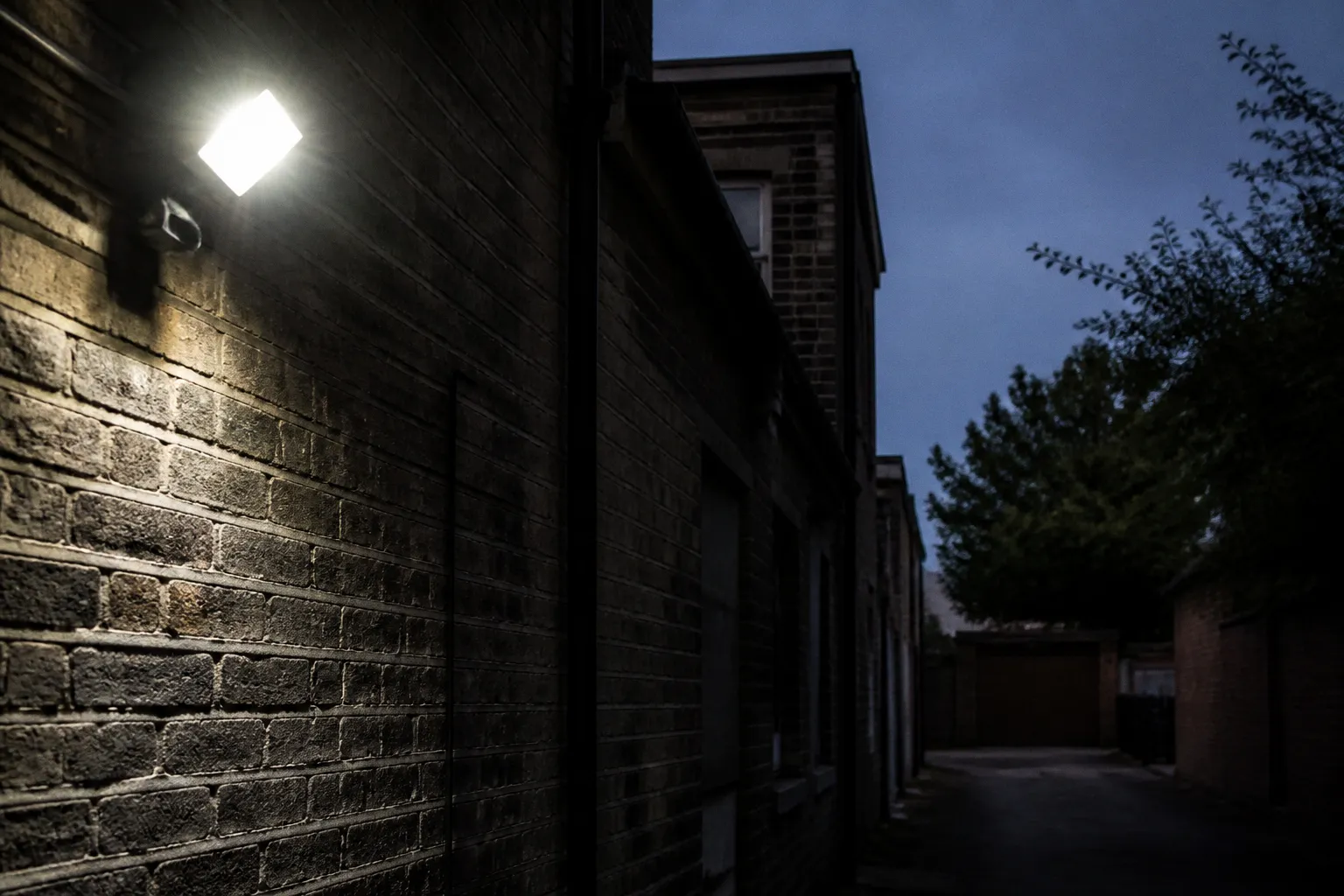
It is what the light reveals, when it comes on, where it is aimed and what other security measures are working alongside it.
That is why the question of whether security lights are a burglary deterrent or an aid has no useful yes-or-no answer. A permanently lit back door is not automatically safer than a dark one. In some layouts, it may even make the property easier to read from outside. A well-positioned motion sensor light, on the other hand, can change the situation at the moment someone approaches and draw attention to movement that would otherwise go unnoticed.
For households in North East Lincolnshire, the practical principle is straightforward: use lighting to support observation and create uncertainty for an intruder, not to illuminate the property continuously for everyone who happens to be looking at it.
The Paradox of Illumination: Why Static Lighting Can Backfire
The instinct behind an all-night floodlight is understandable. If the rear path, side gate or patio is bright, a person approaching the house should be easier to see. But light only improves security when someone is in a position to make use of that visibility.
A permanently lit area can become predictable. The householder knows which section of the garden is illuminated, and so does anyone watching the property for long enough. The light may show exactly where the back door is, whether the side passage is open, and whether there is a clear route from the gate to the house. It can also reveal the type of lock, the position of a doorbell camera or the places where a person would need to stand to work on a window or door.
The problem becomes more serious when the fitting is bright but poorly shielded. Glare makes it harder to see beyond the brightest part of the beam. Someone looking out from a kitchen window may see a white patch of illuminated paving and little else. The darker areas beside it can become more difficult to inspect, particularly when the light is aimed towards the house rather than down across the approach.
This is the security-lighting version of a blind spot: the equipment is present, but it does not produce useful visibility. A light that shines into an upstairs bedroom, across a neighbour’s garden or directly towards the pavement may create annoyance without improving awareness of the private boundary.
There is also a distinction between seeing a property and seeing a person. Constant lighting can make the building easy to recognise, while still leaving the approach, fence line or planting beds poorly observed. The aim should not be to make every surface equally bright. It should be to make movement near vulnerable points noticeable.
An all-night floodlight may illuminate the door without making the person approaching it easier to see.
Static lighting is not always wrong. A low-level, shielded light may be useful beside a path that residents regularly use, especially where steps or uneven paving create a genuine safety risk. A porch light can help visitors identify the entrance. The difficulty comes when one powerful fitting is expected to provide safety, deterrence, facial visibility and complete coverage of the garden at the same time.
The WIDE Strategy: Integrating Lighting into Multi-Layered Security
External lighting works best as one layer in a wider arrangement. It cannot compensate for an unlatched side gate, an insecure window or a rear door with a weak locking arrangement. Nor can it tell you whether movement is a fox, a neighbour returning home or someone testing the boundary.
A commonly cited approach from research associated with Nottingham Trent University is the WIDE combination:
- W — Window locks
- I — Indoor lights operated by a timer
- D — Door double-locks or deadlocks
- E — External lights operated by a timer or sensor
The value of this approach is not that one particular product solves the problem. It combines physical resistance, signs of occupancy and a change in the external environment when movement occurs. The study reported that homes using this combination had substantially greater protection against burglary than homes with none of the measures. The often-repeated figure is 49 times greater protection, but it should be read as an association from the research, not as a guarantee that every household using the four measures will experience the same result.
That qualification matters. Security measures are affected by the design of the property, the quality of installation, residents’ habits and the opportunities available to an offender. A door that is double-locked only when someone remembers to do it is not providing the same protection as one used consistently. A sensor that points at a public footpath and activates every few minutes may eventually be ignored. A timer that switches an indoor lamp on at exactly the same time every evening can create a different kind of predictability.
The layers should support one another:
1. Make entry physically harder. Keep windows and doors locked, use appropriate door hardware and secure side access rather than relying on a light to make a weak point visible.
2. Make occupancy plausible. Indoor lighting on timers can make an empty property look less obviously empty during periods when residents would normally be at home.
3. Make approach noticeable. External lighting should respond to movement near the boundary or vulnerable access points.
4. Make observation possible. A resident, neighbour or passing pedestrian needs to be able to see what the light is revealing.
5. Make the layout less convenient. Locked gates, trimmed planting and secure storage remove easy routes and places to pause unseen.
This is also why a brightly lit rear door with no other visible security can send a mixed signal. It identifies the target but does not necessarily increase the effort required to reach it. Lighting is most useful when it forms part of a property that is consistently maintained and occupied, rather than acting as a substitute for basic precautions.
Motion Sensors vs. Continuous Floodlights: Criminological Evidence
Motion-activated lighting is often recommended because it changes the conditions for an intruder. A continuous light is part of the background. A sensor light introduces an event: the area changes from dark to illuminated when movement is detected.
That change can have several effects. It may attract the attention of people inside the property or nearby. It may make the person approaching pause or retreat. It may also remove the advantage of choosing a dark route across the garden. The light does not need to remain on indefinitely to perform those functions.
The strongest version of the deterrent argument is not that every activation proves a crime is taking place. It is that an unexpected light makes the situation less predictable. An intruder cannot be as confident that nobody is watching, that the house is empty or that the approach will remain concealed.
Research into outdoor lighting and crime has produced mixed results, partly because lighting is rarely installed in isolation. A well-known controlled study in New York City public housing reported a reduction in night-time index crimes after outdoor lighting was improved. That result is useful, but it does not mean that installing any floodlight in any residential garden will produce the same outcome. The surrounding design, resident presence, sightlines and management of the area all matter.
The most defensible conclusion is that lighting can contribute to natural surveillance when it makes a person, route or action easier to notice. It is less convincing when it simply increases brightness without improving the ability of residents to observe.
Choosing the lighting arrangement
| Feature | Static all-night floodlight | Motion-activated sensor light |
|---|---|---|
| Main function | Keeps an area continuously visible | Creates a sudden change when movement is detected |
| Effect on approach | Makes the route predictable and consistently illuminated | Makes movement more conspicuous at the point of activation |
| Useful location | A regularly used path or entrance, provided the beam is shielded | A side passage, gate, rear approach or vulnerable access point |
| Main risk | Glare, deep contrast and a clearly marked target | Nuisance activation from animals, pedestrians or moving vegetation |
| Energy use | Higher because the fitting remains on | Lower when correctly adjusted |
| Maintenance concern | A failed lamp may go unnoticed because the arrangement is familiar | A poorly set sensor may become an ignored source of false alarms |
A sensor light is not automatically the better choice. If the sensor is too sensitive, the light may activate for cats, birds, blowing branches or vehicles passing outside the property. If it is aimed across a pavement, residents may stop reacting to it. If the activation period is too short, the light may switch off before someone can identify what caused it. If it remains on for too long, it begins to behave like a continuous floodlight.
Adjustment is part of installation, not an optional extra. The sensor should be tested at different times of day and from more than one direction. A setting that seems correct when someone walks directly towards the house may be ineffective for a person moving along the fence line.
The best arrangement often combines different types of light rather than choosing one fitting for every task:
- A modest, shielded light can provide safe access around steps and the main entrance.
- A motion sensor can cover the rear path, side gate or less visible approach.
- Indoor timer-controlled lighting can support the appearance of occupancy.
- A camera or video doorbell, where appropriate and legally considerate, can provide information that a light alone cannot.
The equipment should be judged by what it helps a person do. If the purpose is to identify a visitor, the fitting must provide useful light at the entrance without shining into the visitor’s face so strongly that their features are obscured. If the purpose is to reveal movement along a path, the beam should cover the route and its edges rather than point directly into the camera or the windows of the house.
Strategic Placement and Shielding to Eliminate Blind Spots
The position of a security light often matters more than its advertised brightness. A high-quality fitting in the wrong place can leave the important approach hidden, while a simpler light aimed carefully can provide much better coverage.
UK policing and crime-prevention guidance commonly recommends placing external security lights out of easy reach, such as high on a wall or beneath the eaves. The point is not to impose one universal height for every property. It is to prevent someone from quickly turning the fitting off, removing the lamp or covering the sensor. The light also needs to remain accessible for safe maintenance, so installation should not create a separate hazard for residents.
Start with the approach rather than the door. Walk around the outside of the property after dark and look at the routes a person could use:
- Can someone reach the rear door without passing through the sensor’s field of view?
- Does the side gate create a hidden transition from the street to the garden?
- Are bins, sheds, walls or dense shrubs blocking the view?
- Does the light reveal the whole path, or only the final few metres?
- Is there a dark corner immediately beside the illuminated area?
- Does the beam point towards neighbouring windows or a public footway?
Lighting the target alone can leave the approach untouched. A rear door may be brightly visible while the path from the gate remains in darkness. In that situation, the fitting has not created a meaningful early warning. It has merely highlighted the place where entry would be attempted.
Shielding is equally important. A full or partial shield can direct light downwards and across the ground instead of into the sky, nearby homes or the eyes of anyone approaching. The fitting should not produce a sharp glare that prevents residents from seeing around the edge of the beam. The aim is a controlled field of view, not maximum spread in every direction.
Avoiding nuisance and false alarms
A motion sensor should normally be oriented towards movement across its detection zone rather than directly towards a source of constant activity. The exact behaviour depends on the model, but a sensor facing a busy pavement, road or communal path is more likely to activate repeatedly. That makes the light less informative and can create conflict with neighbours.
Plants deserve attention. A branch that moves in the wind can produce the same trigger as a person. So can a loose trellis panel, hanging decoration or unsecured gate. Before increasing the sensitivity, remove or secure the source of movement. Otherwise the fitting is being asked to solve a layout problem through electronics.
Pets and wildlife are another consideration. A lower sensor may respond to a cat crossing the garden, while a higher and more carefully aimed unit can focus on human movement. The answer is not always to reduce sensitivity so far that a person can approach without triggering it. It is to adjust the angle, detection zone and physical surroundings together.
The same applies to cameras. A sensor light that points straight at a camera can wash out the image at the moment it is most needed. Test the equipment as a system. Check what the camera records when the light activates, and check whether a person’s face is visible rather than hidden by glare or a strong shadow.
What lighting can and cannot tell you
It is tempting to treat an activated light as proof that a burglar is present. That is a mistake. A sensor detects movement within a designed range; it does not identify intent. In a residential street, the trigger may be a resident returning home, a delivery worker, an animal or weather-related movement.
This distinction is important for community safety. People should not confront someone simply because a security light has come on. Use the information proportionately. Look from a safe position, check cameras if available, contact neighbours where appropriate and report suspicious activity through the correct channel. A light can improve awareness, but it does not remove the need for judgement.
Lighting can also create a false sense of security. If residents assume an illuminated property cannot be targeted, they may leave windows open, fail to lock a side door or store tools in an unsecured shed. The most effective arrangement is usually unremarkable: locks used consistently, access routes controlled, valuables not left visible, and lighting that makes approach harder to conceal.
For people considering a new fitting, the useful questions are practical rather than product-focused:
- What movement am I trying to detect?
- From which direction would someone approach?
- Who will be able to see the light when it activates?
- Could the fitting create glare or a dark edge?
- Will it disturb neighbours or shine into bedrooms?
- Can the sensor be adjusted without compromising coverage?
- What happens if the power fails or the lamp stops working?
- Does the fitting remain useful if the house is unoccupied?
A light that answers those questions well is more valuable than one chosen only for its wattage or claimed detection distance.
Balancing Natural Surveillance with Dark Sky Principles
The case for careful lighting is not only about burglary. Excessive and poorly directed light affects sleep, wildlife, energy use and the character of the street. It can also undermine the natural surveillance that residents are trying to create.
When a powerful fitting shines into a person’s eyes, the immediate area may appear bright while the wider view disappears into contrast. A resident looking from a window may struggle to see beyond the illuminated paving. A pedestrian may be dazzled rather than reassured. Neighbours may close blinds to escape the light, reducing the very observation that could have made the area feel occupied.
Dark-sky principles offer a useful correction to the assumption that more light is always better. The relevant ideas are familiar: light only the area that needs it, point it downwards, keep it no brighter than necessary and avoid leaving it on without a clear reason. In a residential setting, this usually means choosing a shielded fitting, limiting the detection zone and using a sensor or timer where continuous lighting is not needed.
Good lighting should help residents read the space around their homes. It should not turn the whole frontage into a glare source. A modest light that reveals movement along a boundary may support natural surveillance more effectively than a high-powered beam that makes the entrance impossible to look at directly.
There is also a social dimension. A light that repeatedly shines into a neighbour’s bedroom can become a source of resentment. Once people regard it as a nuisance, they may cover it, complain about it or stop treating its activation as useful information. Consideration is therefore part of security design, not a separate courtesy. A system that improves one property while making the adjoining homes less comfortable is not a strong community solution.
Making the change without over-lighting the property
Begin with an evening inspection rather than buying the brightest fitting available. Check the front, side and rear approaches from inside the house and from the boundary. Identify where a person could stand unseen, where a gate opens, and which windows and doors would actually be vulnerable.
Then make changes in order:
1. Secure the access points first. Check window locks, door locks, patio doors, side gates and shed security. Lighting is more effective when it is supporting a property that is difficult to enter.
2. Remove convenient concealment. Keep vegetation, stored materials and bins from creating a hidden route or a place to wait beside a door.
3. Choose the purpose of each light. Separate safe access lighting from movement detection rather than expecting one floodlight to do everything.
4. Install high enough to protect the fitting. Avoid positions where the sensor or lamp can easily be reached, covered or redirected.
5. Shield and aim the beam. Keep light on the ground and the relevant approach, away from windows, eyes and the night sky.
6. Test the system repeatedly. Walk across the boundary, along the side path and towards the door. Test it with the gates closed and open, with indoor lights on and with the camera operating if one is installed.
7. Review it after bad weather. Wind, rain and seasonal plant growth can change what the sensor sees.
This process is more valuable than treating a security light as a one-off purchase. The property changes over time. A new shed, taller hedge or moved bin can create a blind spot that did not exist when the fitting was installed.
The answer to the burglary-deterrent-or-aid question is therefore conditional but clear. A static, unshielded light left on all night can reveal the target, create glare and give an intruder a dependable working area. That does not make every constant light dangerous, but it does make unthinking illumination a weak security strategy.
A motion-activated light, positioned beyond easy reach and aimed at the approach, is more likely to make movement noticeable at the right moment. Its value increases when it is combined with secure doors and windows, controlled side access, indoor timers and sensible observation. Used in that way, lighting is not a substitute for security. It is a small but useful part of a layered design.
The safest street is not necessarily the brightest one. It is the one where entrances are difficult to reach unnoticed, residents can see what is happening, and lighting reveals rather than conceals.