Yet an unmarked bicycle, power tool or television is difficult to connect to its owner if it turns up after a burglary. A serial number may exist, but many people do not record it, and even fewer keep photographs or purchase details where they can find them quickly.
That is where property marking kits for home security earn their place. A visible postcode, a covert UV mark or a forensic identifier will not make a home impossible to burgle. It can, however, make a stolen item less attractive to handle and give police, insurers or second-hand dealers a better route back to its lawful owner if the property is recovered.
The useful distinction is between marking an item and registering it. The mark gives the property an identifier. The register connects that identifier with your name, address and evidence of ownership. Without both parts, the protection is incomplete.
The Mechanics of Deterrence: Overt vs. Covert Marking
Property marking systems generally use one of two approaches: overt marking, which is designed to be seen, and covert marking, which is intended to be discovered only with the right equipment or during an examination.
They serve different purposes, so treating them as interchangeable is a mistake.
Overt marking puts the warning in front of the person considering the theft. This might mean etching your postcode and house number into a bicycle frame, marking the casing of a power tool or attaching a tamper-evident label that identifies the item as protected and registered.
The mark does not need to make the item unattractive. It needs to make the item more awkward to pass on. A tool bearing a postcode is more difficult to present as someone’s legitimate property. A label that tears or leaves evidence when removed suggests that the item has been deliberately protected. The person looking through a shed or garage can see that the property may be identifiable later.
That is the deterrent value. It works before the item leaves the house.
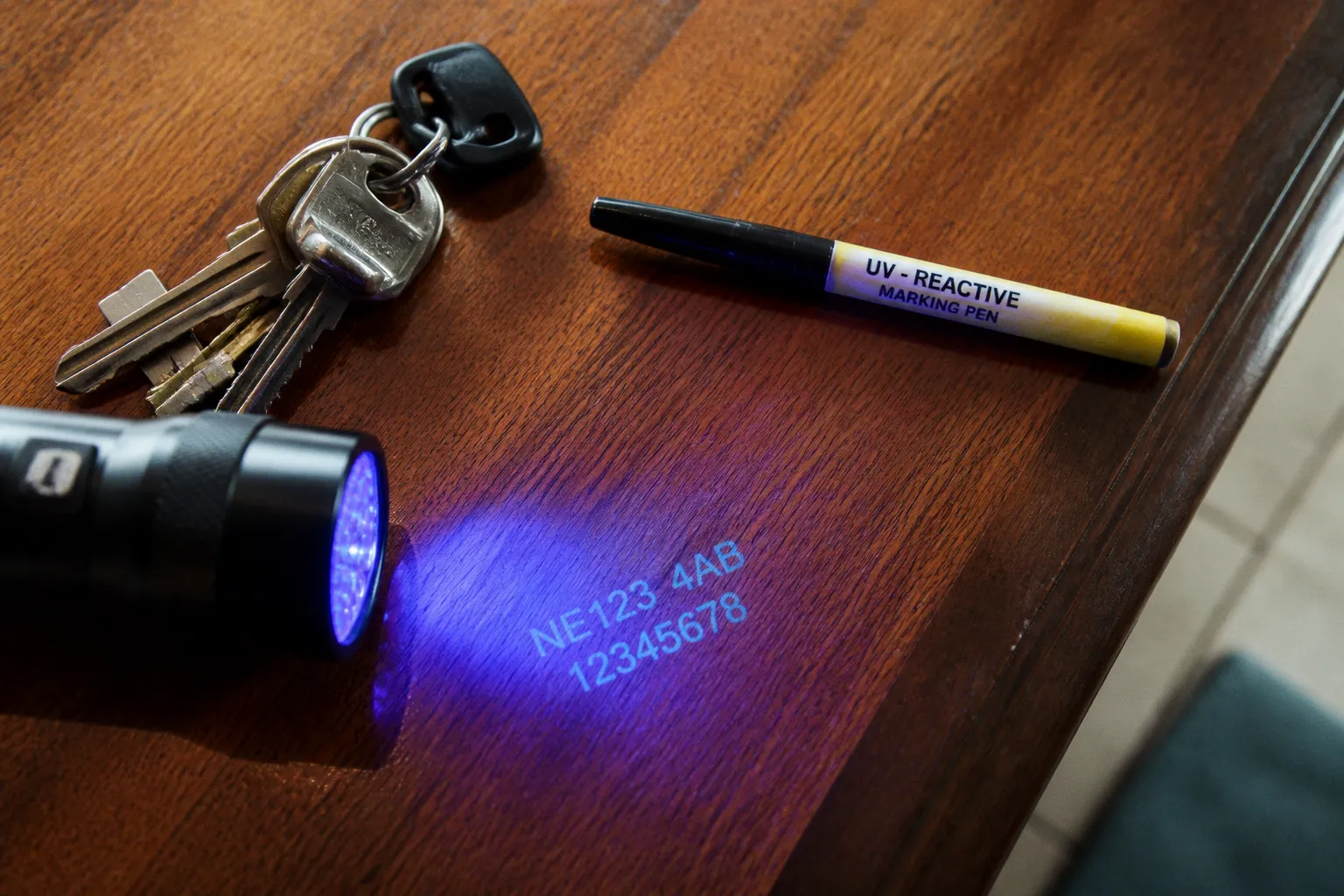
Covert marking is less visible during an ordinary inspection. UV ink becomes visible under ultraviolet light. Microdots are tiny identifiers that need magnification to read. Forensic marking solutions, including products such as SelectaDNA, combine a traceable chemical signature with microdots and, in some cases, a UV tracer.
Covert marking is not a guarantee that an item will be identified or recovered. Its value is that it can aid identification if the item is found and examined. A police officer may discover marked property during an investigation, a dealer may check an item entering second-hand stock, or an insurer may need evidence that a particular object belonged to you. In each case, the mark is useful only if it remains detectable and has been registered accurately.
Overt marking creates a visible reason to leave an item behind. Covert marking gives a recovered item a better chance of finding its way home.
The strongest arrangement is usually layered. Use a visible mark where it can be applied without damaging the item, add a covert mark for property that needs a less conspicuous identifier, and register the details in a database. None of those steps promises a particular outcome. Together, they remove some of the anonymity that makes stolen goods easier to move.
What marking can and cannot do
A property marking system can:
- make selected items less appealing to an opportunist;
- provide an identifier that may assist with ownership checks;
- support an insurance claim by documenting what you own;
- help distinguish your property from similar items;
- give police or other legitimate handlers more information if the item is recovered.
It cannot:
- prevent a determined burglary;
- guarantee that a stolen item will be found;
- guarantee that police will be able to examine every recovered item;
- replace good doors, windows, lighting, locks or sensible storage;
- turn an incomplete database record into proof of ownership.
That last point matters. Marking is part of a security routine, not a substitute for physical security. A marked lawnmower still needs to be stored behind a properly secured door. A registered laptop still needs a strong password and sensible data protection.
Choosing the Right Kit: From UV Pens to Forensic DNA
The right property marking kit depends on the objects being protected, the surfaces involved and how much maintenance you are prepared to do. There is no single method that suits every item in a home.
Some products are aimed at quick, inexpensive coverage. Others are designed for higher-value property or for situations where a more robust identifier is appropriate. The question is not simply which kit is most sophisticated. It is whether the method will remain legible, stay attached to the surface and be registered properly.
| Method | Visibility | Durability and maintenance | Useful for |
|---|---|---|---|
| UV pen | Hidden in ordinary light; visible under UV light | Can fade with light, cleaning and wear; inspect and refresh periodically | Labelling many items quickly as a supplementary measure |
| Chemical etching | Visible on the marked surface | Generally durable on suitable metal, plastic and glass surfaces | Bicycles, tools, garden equipment and other hard surfaces |
| Tamper-evident labels | Visible | Adhesive can be damaged or removed; check the label over time | Laptops, televisions, audio equipment and smooth casings |
| Microdots | Not normally readable without magnification | Designed to remain with the item, though the surface still needs checking | Higher-value property, machinery and selected equipment |
| Forensic marking solution | Usually covert, with a UV tracer or other detection aid depending on the product | Long-lasting, but applications exposed to weather or abrasion may need inspection | Broader home coverage and items that are difficult to etch |
UV pens: useful, but not permanent
UV pens are easy to use and can cover a large number of possessions without leaving an obvious mark. They are particularly useful when the surface is unsuitable for etching or when you want to label items quickly before completing a more considered marking plan.
Their weakness is maintenance. Ink can become harder to detect after exposure to light, cleaning products and ordinary handling. A mark that was clear when first applied may be faint later. That does not make UV marking pointless; it means the method should be treated as a supplementary layer rather than a permanent answer.
Write the mark somewhere that is difficult to remove accidentally but straightforward for you to locate later. Record where you put it. Otherwise, a year from now, you may remember that an item was marked but struggle to show anyone exactly where the mark is.
Chemical etching: a visible identifier for hard surfaces
Chemical etching is well suited to items that spend time in a shed, garage or outbuilding. A postcode followed by a house or flat number can be applied to suitable metal, plastic or glass surfaces. The mark is deliberately obvious: its purpose is to show that the item has an owner who has taken steps to identify it.
Secured by Design guidance specifically recommends postcode marking as a way of identifying property. That is not the same as a blanket endorsement of every chemical etching product on the market. Follow the instructions supplied with the kit, use it only on compatible surfaces and test an inconspicuous area if the material is uncertain.
The mark should be legible without compromising the item. Avoid placing it across moving parts, safety labels, serial numbers or areas where it could weaken a component. On a bicycle, for example, the frame may be suitable, while a delicate component or manufacturer’s identification plate may not be.
Chemical etching is especially practical for:
- bicycles and scooters;
- hand tools and power tools;
- lawn equipment;
- ladders and workshop equipment;
- garden furniture or machinery that is likely to be stored outside or in an outbuilding.
A visible mark may affect resale presentation, but that is part of the trade-off. If an item is valuable enough to be a likely target, making its ownership easier to establish is usually more useful than keeping every surface pristine.
Tamper-evident labels
Labels are useful when etching would be unsuitable or visually intrusive. A label can carry a protection message and may be designed to tear, fragment or leave evidence if someone tries to remove it.
They work best on clean, dry and reasonably smooth surfaces. A label placed on a dusty shed tool or a heavily textured casing is unlikely to remain secure. Labels should not cover ventilation slots, model information, serial numbers or controls.
A label is an overt signal, not a forensic identifier by itself. If the item is valuable, combine it with a covert method and a database record. Check the label during your regular maintenance inspection. A peeling corner, heavy scratching or a missing label is a reason to review the marking underneath and update your records.
Microdots and forensic marking solutions
Microdots are small identifiers carrying information associated with the registered owner or product system. They are intended to be difficult to notice during an ordinary glance and may require magnification or specialist equipment to read.
Forensic marking solutions such as SelectaDNA use a coded chemical formula with microdots and a UV tracer. A SelectaDNA home kit is designed to cover multiple household items, and the product information supplied with the kit sets out the number of items it is intended to mark. The solution is applied to the property, the unique code is registered and warning stickers can be used to make the protection visible from outside.
The important qualification is that a forensic mark aids verification; it does not guarantee identification downstream. The item must be recovered, the mark must still be detectable and the relevant database must contain accurate details. Application quality also matters. A thin or poorly placed coating on a frequently handled item will need more attention than a protected area that is rarely touched.
For many homes, a sensible combination is:
- visible chemical marking for bicycles, tools and outbuilding equipment;
- forensic or microdot marking for higher-value electronics and selected valuables;
- UV marking where a quick additional identifier is useful;
- registration of every marked item, with photographs and serial numbers where available.
Step-by-Step: Registering Assets on Immobilise and SAR
A mark that cannot be connected to an owner is much less useful than a mark supported by a current record. Registration is not administrative decoration. It is the part that turns an identifying code into an ownership trail.
Start with Immobilise
Immobilise is a free national property register used by police forces, including Humberside Police. Access it through immobilise.com and create an account using the current registration process.
For each item, record as much detail as you can:
1. Describe the item clearly. Include the type of property, colour, make, model and any distinctive features.
2. Add the serial number. This is often the most useful individual identifier on electronics, bicycles and power equipment. Photograph it if the number is difficult to transcribe.
3. Record the property mark. Note the etched postcode, the location of a UV mark, a label reference or the code associated with a forensic marking product.
4. Upload photographs. Take a general image and, where useful, a closer image showing the serial number or distinctive damage. Photographs help establish what the item looked like before it was lost or stolen.
5. Keep the information current. Add new purchases and remove items you no longer own. If a bicycle is sold, transferred or scrapped, update the record rather than leaving it attached to your household.
Do not wait until after a burglary to reconstruct the inventory. Serial numbers are hardest to find when the item has disappeared, the packaging has gone and the receipt is buried in an email account.
A useful approach is to work through the home by area. Start with the shed and garage, then move to laptops, tablets, cameras, televisions, games consoles, tools and other items that would be difficult to describe from memory. You do not need to mark every object in the house. You do need to mark the things that would cause financial loss, disruption or personal distress if they were taken.
Registering with the Secure Asset Register
The Secure Asset Register, or SAR, is associated with Selectamark and SelectaDNA products. If you use one of those products, follow the registration instructions supplied with the kit and record the relevant code against your details.
The supplied facts support SAR as a database approved for police and insurance use. That makes accurate registration important, but it still does not mean that every claim or recovery will automatically succeed. The database must contain the right owner information, the product must have been applied correctly and the item must be located and checked.
A standard SelectaDNA registration account may cover a limited number of items, while a home kit provides broader coverage. Check the current terms and the instructions supplied with your particular product rather than assuming that all kits offer the same registration capacity.
Where possible, keep the Immobilise record and the product-specific SAR record consistent. If an item has two identifiers, record both. The aim is to remove ambiguity: the description, serial number, photograph, visible mark and forensic code should all point to the same object.
Registration does not make recovery automatic. It gives a recovered item a documented route back to its owner.
Keep ownership evidence together
A database entry is strongest when it is supported by ordinary ownership evidence. Keep purchase records, warranty documents and photographs in a secure digital location. If you store them online, protect the account with a strong password and multi-factor authentication where available.
For inherited or second-hand property, write down where it came from and when it came into your possession. Sentimental items are often poorly documented because nobody expects to need a receipt. A photograph, a distinctive feature and a clear description can still help establish ownership.
If an item is stolen, report the theft promptly and provide the registration details, serial number, photographs and marking information. Do not rely on being able to remember the database login or the exact wording of the description under pressure. Keep access details in a password manager or another secure system.
Maintenance Cycles: Why UV Markings Require Regular Attention
The marking process does not end when the kit is opened. Different methods age in different ways, and a quick inspection can reveal whether your system is still doing what you expect.
UV marks need a schedule
UV pen markings can fade. Light, cleaning products, friction and handling all affect how easily the ink can be detected. A practical maintenance cycle is to inspect them about every six months and refresh marks that are no longer clear under the supplied UV torch.
That interval should not be treated as a promise that every mark will last exactly that long. A rarely handled item in a dark cupboard may remain legible for longer. A tool exposed to sunlight, oil and repeated cleaning may need attention sooner.
When refreshing a UV mark, do not simply write over a dirty or damaged area. Clean and dry the surface if the instructions allow it, check that the original mark is still where you recorded it and update your inventory if the item has moved.
Etched marks are more stable, but still worth checking
A properly applied etched mark on a suitable surface is generally durable and does not require the same repeated application as UV ink. It can still be obscured by repainting, corrosion, replacement parts or heavy damage. Inspect the mark during an annual review, particularly on garden equipment and bicycles that are used outdoors.
Do not deepen an existing mark without checking the product instructions. The aim is readability, not maximum penetration. If an item has been repaired or repainted, add a new identifier in a suitable location and update the photograph in your records.
Forensic applications and labels
Forensic solutions are intended to last longer than a simple UV pen mark, but long-lasting is not the same as maintenance-free. Applications on frequently handled, weather-exposed or abrasive surfaces deserve an annual inspection. If the coating has worn away, follow the manufacturer’s reapplication guidance.
Warning labels need their own check. Moisture, heat and cleaning can loosen adhesive. A label that is partly detached may no longer communicate a clear warning, and a missing label removes the visible deterrent even if the covert mark remains.
A straightforward household routine is enough:
- inspect UV marks roughly every six months;
- check labels and high-use forensic applications at least annually;
- update the register whenever an item is bought, sold, transferred or replaced;
- take new photographs after major repairs or changes;
- keep the marking kit and UV torch where they can be found when the inspection is due.
The maintenance task is small, but it protects against a common failure: believing that a mark applied once will remain equally useful forever.
Strategic Placement: Maximizing the Impact of Warning Decals
Warning decals are the visible part of many home marking systems. SelectaDNA home kits, for example, include warning stickers for windows and doors. That does not mean every property marking kit ships with decals, so check what is included before planning where to place them. Standalone UV pens, etching kits and some microdot products may have no warning stickers at all.
A decal works only if it can be seen before entry. Place it where someone approaching the property is likely to notice it without having to search:
- on or beside the front door, where it is visible from the approach;
- on a porch or front window that can be seen from the path;
- at the rear door or patio entrance;
- on a side gate leading to a yard, alley or shared access route;
- on the shed or outbuilding door if those structures contain marked equipment.
The aim is not to cover every pane of glass. A small number of clean, legible decals at sensible access points is more convincing than a collection of sun-faded or half-peeled stickers. Do not place them where they obscure house numbers, alarm information, safety notices or essential glazing.
A warning sticker should describe the protection accurately. If the property has been marked and registered through a particular system, use that system’s supplied decal rather than making a claim that the home is protected by a method you have not used. Overstatement weakens the message and can create confusion when the property records are checked.
The local layout also matters. A side gate may be more relevant than a front window on a terraced property with a long rear yard. A shed at the end of an alley may need a visible warning at the building itself, not only at the house. Walk the perimeter from the viewpoint of someone approaching the property and identify the points where a warning can be seen before access is attempted.
Neighbourhood action can reinforce individual measures. If a street has an alley-gating scheme or an active Neighbourhood Watch group, residents can discuss consistent, legitimate deterrence measures. A visible pattern of marked and registered properties may communicate more than a lone sticker, but every household still needs to maintain its own records. Collective visibility is not a substitute for individual registration.
Making the marking plan work in practice
The easiest way to start is with an inventory rather than a shopping list. Walk through the house, garage and outbuildings and identify the property that would be most difficult to replace or explain as yours. Include items with financial value, but do not ignore sentimental possessions or equipment that would disrupt daily life if stolen.
For each item, ask four questions:
- Is there already a serial number?
- Is the surface suitable for etching, labelling or a forensic solution?
- Would a visible mark affect its use or safety?
- Have I recorded the mark, photograph and ownership details?
Start with the objects that are portable and easy to resell: bicycles, tools, laptops, cameras, games equipment and garden machinery. Then add items that are less portable but still likely to be targeted. Jewellery and sentimental objects may not have serial numbers, which makes photographs and distinctive descriptions especially valuable.
Do not apply a product to a surface simply because it is nearby. Follow the instructions, particularly for chemicals and adhesives. Avoid marking electrical contacts, heat-sensitive components, moving joints and manufacturer plates. If you are unsure whether an item can be marked safely, document it thoroughly and use a compatible covert method instead.
Once the physical work is complete, register the assets immediately. Delaying the database entry creates the exact gap the system is meant to close. A kit in a cupboard is not protection; an applied mark with no record is only part of the protection.
The practical conclusion
Property marking is not a guarantee against burglary and it does not guarantee identification or recovery. Its value is more grounded than that. It makes selected possessions less anonymous, gives legitimate handlers a way to question ownership and creates better evidence for a police report or insurance claim.
For a typical home in North East Lincolnshire, the most useful plan is layered rather than elaborate: use visible postcode marking where it is suitable, add covert marking to higher-value or harder-to-etch items, register the details on Immobilise and, where relevant, on the Secure Asset Register, then maintain the marks and records.
The final step is the one people are most likely to postpone. Photograph the item, record the serial number, note where the mark is and save the registration details while the kit is still in front of you. That modest piece of administration is what turns a mark on a possession into an ownership trail that may still be useful if the possession leaves the house.