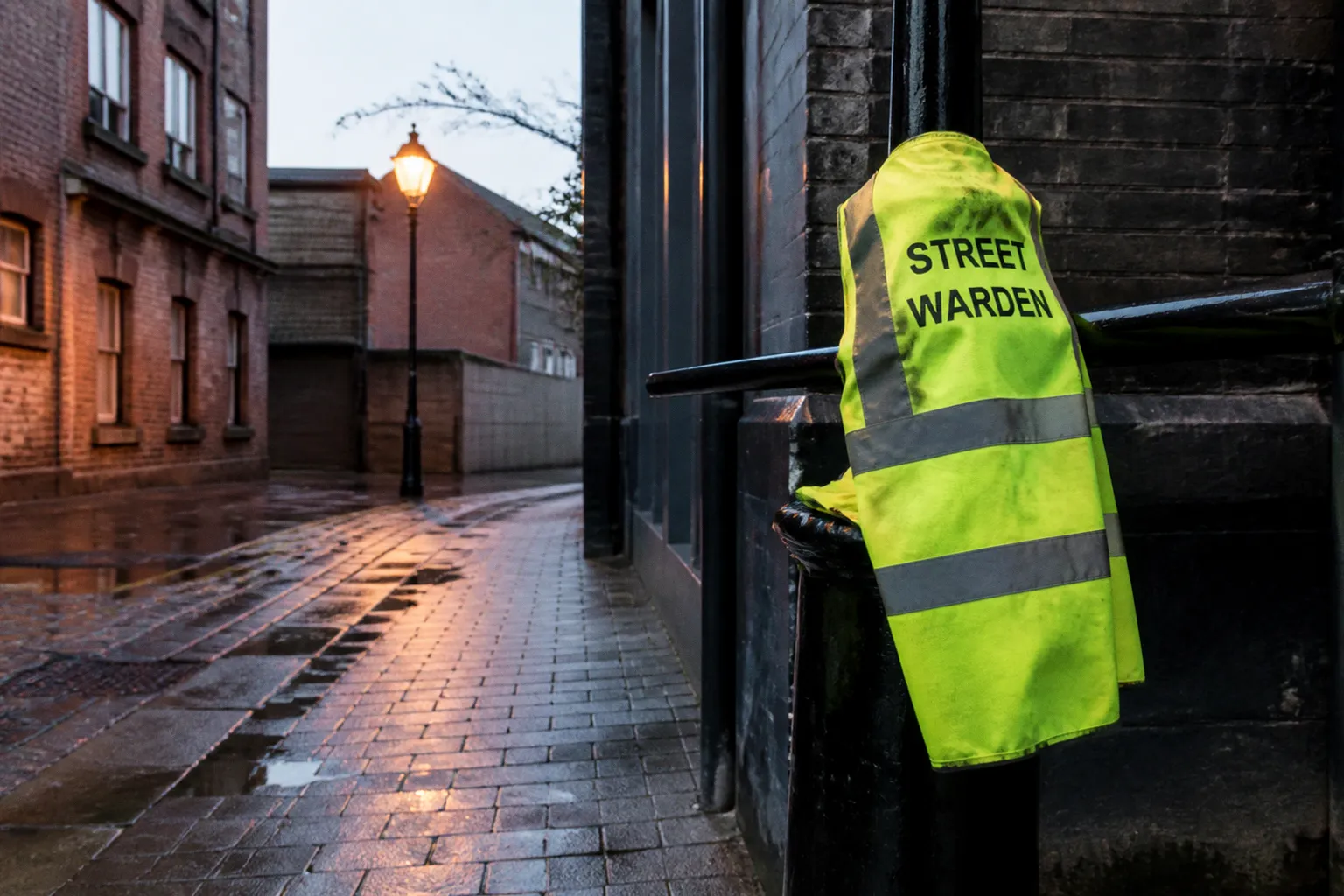
They are not PCSOs. But in Grimsby town centre they may still be able to ask for your details, confiscate alcohol from someone under 18, or issue a fixed penalty notice for a specific breach of a Public Spaces Protection Order.
That last qualification matters. A street warden does not have a general power to ticket people for anything that looks untidy, anti-social or inconvenient. The authority comes from a particular legal power, attached to a particular role, operating in a particular place. A warden, a WISE environmental officer, a civil enforcement officer and a PCSO may all be visible on the same patrol, but they do not carry the same toolkit.
So what are the powers of Grimsby street wardens, and where does that authority stop? The answer is less dramatic than the appearance of a large uniformed patrol, but more useful: it depends on the officer’s accreditation, the offence in question and the order or legislation being relied on.
The legal framework behind the high-vis jacket
Three parts of the legal framework do most of the work in North East Lincolnshire’s non-police enforcement.
The first is the Anti-Social Behaviour, Crime and Policing Act 2014. This gave local councils the power to introduce Public Spaces Protection Orders, commonly known as PSPOs. These are local orders applying to defined public areas and addressing specified behaviours. They are not a blanket set of rules for every public place, and they do not turn every council employee into a police officer.
In Grimsby, PSPO provisions cover relevant pedestrianised areas, town-centre hotspots and certain other public spaces. Where an order prohibits a particular activity and the officer has the necessary authority, a breach can result in a fixed penalty notice. Cycling in a pedestrianised area where the order gives pedestrians priority is one example of the kind of conduct covered in the supplied local facts. The legal basis is the PSPO and its enforcement arrangements, not simply the fact that the person issuing the notice is wearing a high-vis jacket.
A PSPO may also set conditions around activities that affect the use of a public space. The wording of the order matters. It is not enough for an officer or resident to describe conduct as anti-social in general terms; the behaviour must match a prohibition or requirement in the order, and the order must apply in that location.
The second is the Environmental Protection Act 1990. This underpins enforcement against offences such as littering and dog fouling. In practice, that is where the WISE teams and other environmental enforcement officers are especially important. Their delegated role is environmental enforcement, and they can issue fixed penalties for dropping litter or failing to clean up after a dog where the relevant powers apply.
That distinction is easy to lose in a busy town centre. A resident may see two officers working together and reasonably assume that they can do the same things. They cannot necessarily do so. Environmental and WISE officers have a defined enforcement function, while CSAS-accredited staff have a separate set of powers granted through the accreditation process.
The third is the Police Reform Act 2002, specifically the Community Safety Accreditation Scheme, or CSAS. This allows the chief officer of a police force to grant carefully defined police-style powers to accredited people who are not police officers. In this case, the relevant force is Humberside Police.
CSAS is not a general delegation of police authority. The powers are granted to named individuals and are subject to formal conditions. Depending on the accreditation, they may include requiring a person to give their name and address in defined circumstances, confiscating alcohol from a person under 18 in a designated public place, or seizing tobacco from a person under 16 where the relevant statutory power and accreditation apply.
That age distinction is not a technical footnote. Alcohol and tobacco are treated differently in this context. A broad description such as “confiscating tobacco from under-18s” gives the wrong impression about the statutory threshold. For the specific tobacco-confiscation power generally associated with CSAS, the relevant age is under 16. The exact scope still depends on the officer’s accreditation and the circumstances in which the power is being used.
A CSAS card is not a police warrant. It is a tightly written list of specific powers granted to a named individual, and its limits matter just as much as the powers printed on it.
A PSPO can therefore provide the basis for enforcement in an area, but the officer still needs the relevant authority to use that power. Likewise, CSAS accreditation can give an officer particular powers, but it does not give them every power available to a constable.
Who is who on the beat
The first practical problem is identifying which service is dealing with you. The second is understanding that a similar uniform does not mean identical authority.
CSAS-accredited street wardens
CSAS-accredited street wardens are council or partner-agency staff who have completed the formal accreditation process with Humberside Police. Their accreditation card identifies the powers available to them.
Those powers can include requiring a person’s name and address in circumstances covered by the accreditation. They may also include confiscating alcohol from someone under 18 in a designated public place and seizing tobacco from a person under 16 where the applicable legislation and accreditation permit it. Where the appropriate PSPO provisions and delegation apply, an accredited warden may also issue a fixed penalty notice for a specified breach, such as cycling in a pedestrianised zone where that conduct is prohibited.
The important words are where the appropriate provisions and delegation apply. CSAS accreditation alone does not automatically create an unlimited PSPO enforcement role. Nor does it automatically make the warden responsible for every kind of council penalty issued in the town centre.
An officer should be able to identify themselves and explain, at least in practical terms, the power being used. That does not mean a street-side conversation will always include a detailed legal lecture. It does mean that a person should not be left with the false impression that the officer can act simply because they have been told to do so by a colleague or because the area is known for anti-social behaviour.
WISE and environmental enforcement officers
The WISE teams and other environmental enforcement officers have a different focus. Their work covers offences such as littering, dog fouling, fly-tipping and related environmental problems, including the kind of evidence-gathering and enforcement that residents may see during town-centre patrols.
Their delegated authority is primarily council-led and supported by environmental legislation and relevant PSPO provisions. They are the officers whose toolkit should be associated with fixed penalties for dropping litter or failing to clean up after a dog.
That does not mean every WISE officer has every CSAS power. Environmental enforcement and CSAS accreditation are separate things. An officer may hold more than one form of authority, but residents should not assume that one role automatically includes the other.
The same caution applies in reverse. A CSAS-accredited warden should not be described as an environmental enforcement officer merely because they are working alongside a WISE team. The visible patrol may be joint; the legal powers remain personal and specific.
Civil Enforcement Officers
Civil Enforcement Officers deal mainly with parking and traffic restrictions. Their work is governed by a different set of rules and a different enforcement system. They may be present in the same streets as wardens and police patrols, but a parking-related interaction should not be treated as evidence of CSAS or PSPO powers.
A civil enforcement officer may be able to issue a parking penalty in circumstances where a street warden cannot, while having no role in enforcing littering, alcohol restrictions or a community-safety order. The uniform tells you that the person is performing an official function; it does not tell you which function.
PCSOs and police constables
PCSOs are employed by Humberside Police. They are not street wardens, even when their uniforms or public-facing role look similar. They have a broader, though still limited, set of police-style powers under the Police Reform Act 2002.
A police constable has a different legal position again. That difference is particularly important when the issue involves search, arrest, investigation or the use of force. A street warden’s role is not a substitute for a constable’s powers, and a partnership patrol does not merge the legal identities of the people taking part.
| Role | Main function | Examples of authority |
|---|---|---|
| CSAS-accredited street warden | Community safety and specified enforcement | May require a name and address in defined circumstances; may confiscate alcohol from a person under 18 or tobacco from a person under 16 where the accreditation and legislation allow it; may enforce specified PSPO breaches where authorised |
| WISE or environmental enforcement officer | Litter, dog fouling, fly-tipping and related environmental offences | Can issue relevant environmental fixed penalty notices where delegated authority and the applicable rules cover the conduct |
| Civil Enforcement Officer | Parking and traffic restrictions | Uses parking and traffic enforcement powers, not the general CSAS or environmental toolkit |
| PCSO | Police community support and limited police-style enforcement | Has powers granted through the police framework, which are broader than those of an ordinary warden but not identical to a constable’s |
| Police constable | Policing, investigation and public protection | Has the full range of constabulary powers, subject to the usual legal safeguards |
The practical question for a resident is therefore not simply, “Is this person a warden?” It is: which organisation are they from, what power are they using, and what conduct does that power cover?
What can street wardens do?
A CSAS-accredited street warden in Grimsby may be able to:
- Issue a £100 fixed penalty notice for cycling in a pedestrianised zone where the relevant PSPO prohibits it and the officer is authorised to enforce that provision.
- Require a person to give their name and address in the limited circumstances set out by the officer’s accreditation.
- Confiscate alcohol from a person under 18 in a designated public place where the relevant CSAS power has been granted.
- Seize tobacco from a person under 16 where the applicable legislation and accreditation permit it.
- Work with police, WISE teams, licensed premises and other partners during community safety patrols.
- Record an incident or enforcement interaction in accordance with the procedures and equipment available to their service.
The tobacco point deserves repeating because it is easy to misstate. A CSAS-accredited officer does not generally have a catch-all power to seize tobacco from anyone under 18. The specific statutory threshold for the relevant confiscation power is generally under 16, subject to the officer’s accreditation and the circumstances. If an officer relies on a different power, that should be identifiable from the legal basis being used rather than assumed from the uniform.
The last point about recording also needs care. Body-worn video may be used by officers, but there is no basis here for saying that a specific local policy requires recording every enforcement interaction. Whether a camera is activated, and when, depends on the applicable service policy, equipment and circumstances. Residents should not be told that every interaction must automatically have been recorded unless that requirement is established.
Street wardens cannot simply impose a penalty because they dislike someone’s behaviour or because a location feels like a town-centre problem area. The conduct must fall within a defined offence or order, and the person issuing the notice must have the authority to do so.
They also cannot generally:
- Stop and search a person or vehicle without a specific statutory power.
- Demand identification beyond the circumstances covered by their accreditation.
- Arrest someone as a police constable can.
- Enter private premises without consent or a specific legal power.
- Use force merely because a resident is uncooperative. Any use of force must remain within the legal limits applying to that situation, including the ordinary rules on self-defence and preventing crime.
The difference between refusing to answer a question and committing a further offence can depend on the exact power being used. That is why a resident should listen carefully to what the officer says, ask which power is being relied on and avoid turning a disagreement about authority into a confrontation on the street.
Asking for an officer’s name, organisation and the legal basis for an interaction is not the same as obstructing them. The sensible approach is calm and specific: ask what conduct is alleged, what order or legislation applies, and what the next step is if you disagree.
Fixed penalty notices are not all the same
The phrase “£100 ticket” makes the system sound more uniform than it is. The amount may be the same, but the legal route depends on the offence and the legislation behind it.
A notice for cycling in a pedestrianised area under a PSPO is not the same as an environmental notice for dropping litter. The person issuing it may be different, the delegated authority may be different and the appeal or payment instructions may be handled through different council processes.
The same applies to dog fouling. The supplied local facts support enforcement for failing to clean up after a dog. They do not establish a separate £100 offence for letting a dog off the lead near the market. An off-lead restriction would need to come from a specific local rule applying to that location. It should not be inferred simply because dog fouling is covered by environmental enforcement.
| Power or action | CSAS-accredited warden | WISE or environmental officer | Police constable or PCSO |
|---|---|---|---|
| £100 FPN for a specified PSPO breach, such as prohibited cycling in a pedestrianised zone | Where the officer is authorised to enforce that PSPO provision | Where the relevant delegation applies | Police may enforce relevant offences within their own powers |
| £100 FPN for littering or dog fouling | Not a default CSAS power; only where the officer separately has the relevant delegated environmental authority | Primary role where the environmental rules apply | Police may deal with related offences within their powers |
| Require a name and address | Yes, but only in the defined CSAS circumstances | Not as a general environmental enforcement power | Available under the applicable police powers |
| Confiscate alcohol from a person under 18 in a designated public place | Where granted by the CSAS accreditation | Not a default WISE power | Available to police within the relevant framework |
| Seize tobacco from a person under 16 | Where the relevant statutory power and accreditation apply | Not a default environmental enforcement power | Available to police within the relevant framework |
| Stop and search | No general power | No general power | A constable may do so where the legal conditions are met; PCSOs have only specified powers |
| Arrest as a constable | No; the ordinary citizen’s arrest provisions are a different and much narrower matter | No general constable’s arrest power | A constable can arrest where the legal conditions are met; PCSO powers are limited |
The table is not a substitute for reading the notice or asking for the officer’s authority. It is a guard against the most common mistake: treating every uniformed member of a partnership patrol as if they were interchangeable.
What happens if an FPN is wrong or unpaid?
A fixed penalty notice is not the same thing as a conviction. It is an offer to discharge the relevant liability by paying the specified amount within the stated process. The notice should explain the payment arrangements and, where available, how the recipient can challenge it.
If the notice is wrong, the sensible response is not to ignore it. Check the details:
- the date and time;
- the location;
- the conduct alleged;
- the legal basis or order mentioned;
- the identity of the issuing authority; and
- the instructions for making representations, challenging the notice or paying it.
A resident who believes the officer has applied the wrong rule should set that out through the stated route and keep copies of the paperwork. If the issue is about the officer’s conduct rather than the underlying offence, that may require a separate complaint to the council, the relevant contractor or the police, depending on who employed or accredited the person.
Non-payment does not normally mean that the notice is automatically converted into a civil debt and registered at court with costs. For PSPO and environmental fixed penalty notices, non-payment can instead lead to prosecution for the underlying offence. That is a different process, and the recipient should treat the notice seriously without assuming that enforcement follows an automatic debt-registration route.
In plain terms, an FPN is not something to throw on the passenger seat and forget. But neither is it a court judgment the moment it is handed over. The route after non-payment depends on the type of notice and the offence alleged.
The right question is not whether a ticket feels unfair. It is which rule is being enforced, who is authorised to enforce it, and what process is printed on the notice.
What Operation Mastery has actually changed
Operation Mastery is the clearest test in Grimsby of the partnership model behind town-centre safety work. Launched in April 2024, it brings together Humberside Police, North East Lincolnshire Council, WISE officers, civil enforcement teams and accredited wardens.
The reason for combining those services is practical. Police officers are needed for violence, investigations, safeguarding and situations requiring constabulary powers. Environmental officers deal with litter and dog fouling. Civil enforcement officers deal with parking. Accredited wardens can address specific community safety issues within the limits of their accreditation.
The model works only when those boundaries are understood and the services share information appropriately. A warden may identify a recurring problem, pass information to police or council teams and provide a visible presence that discourages low-level disorder. That can make a street feel more controlled without giving the warden powers that belong to a constable.
Operation Mastery should therefore not be judged by the number of uniforms visible on a patrol alone. The relevant question is whether the partnership is responding to the right problems with the right authority. A police officer dealing with a violent incident, a WISE officer enforcing against litter and a street warden engaging with people in a public space may all be part of the same operation, but they are not performing the same legal task.
The problem with reading too much into safety statistics
Claims about the impact of a town-centre operation need to be handled carefully. Crime figures can change for several reasons at once: reporting patterns, patrol visibility, seasonal activity, changes in licensed premises, police operations and how incidents are recorded. A fall in one category does not prove that every part of the partnership caused the change. A rise in recorded incidents may, in some circumstances, reflect better reporting or more active enforcement rather than a simple deterioration in safety.
That is particularly relevant when assessing the safer streets work associated with North East Lincolnshire. Patrol numbers, enforcement activity and recorded crime are different measures. A visible anti-social behaviour patrol may prevent incidents that never appear in the statistics, while an enforcement campaign may initially produce more recorded incidents because officers are finding and documenting conduct that previously went unreported.
The responsible conclusion is narrower: Operation Mastery brings together services that can address different parts of the town-centre safety problem. Its success should be assessed through properly defined local data and transparent reporting, not through an assumption that every improvement or setback can be attributed to street wardens.
For residents, the partnership has a more immediate value. They do not need to work out the entire structure of the operation before reporting a problem. They do, however, need to know that the person who takes the report, issues a notice or intervenes in the street may not be the person with power to investigate or arrest.
Where warden authority ends
The most useful way to understand street wardens is not to ask whether they are powerful or powerless. They have real powers, but those powers are narrow, conditional and linked to a specific purpose.
A warden may be able to require details in a defined situation, confiscate alcohol from a person under 18, seize tobacco from a person under 16 where the relevant power applies, or issue a notice for a specified PSPO breach. None of that creates a general authority to search people, enter homes, arrest suspects or enforce every council rule.
The limits protect residents, but they also protect the credibility of the scheme. If every high-vis patrol is treated as an informal police unit, people will misunderstand both their rights and the responsibilities of the officers. That confusion makes routine interactions more confrontational and makes it harder to identify genuine misuse of authority.
A resident stopped by a warden should:
1. Stay calm and avoid obstructing the officer.
2. Ask which organisation the officer represents.
3. Ask what conduct is alleged and which power or order is being used.
4. Provide details only where the officer has explained a power that requires them and the circumstances meet that power.
5. Read any fixed penalty notice carefully rather than relying on a verbal summary.
6. Use the stated challenge, payment or complaints process if they believe the action was unlawful or incorrect.
7. Contact the police if the situation involves immediate danger, violence or a crime requiring police intervention.
That is not a demand that residents accept every decision without question. It is a recognition that the street is a poor place to settle a technical dispute about delegated authority. The paperwork, the accreditation and the wording of the local order matter more than the impression created by a uniform.
The practical answer for Grimsby residents
Town centre wardens in Grimsby are best understood as part of a layered enforcement system. They can provide reassurance, deal with specified problems and use particular powers where they have the necessary CSAS accreditation or council delegation. WISE teams, civil enforcement officers, PCSOs and police constables add different capabilities to the same public-space operation.
The phrase “street warden powers” is therefore too broad on its own. The decisive details are the individual officer’s accreditation, the location, the conduct alleged and the legal instrument being relied on.
For anyone trying to work out what safer streets NEL wardens can do, the short version is straightforward: they may enforce, but only within the authority attached to their role. They may confiscate alcohol from someone under 18, and in the relevant circumstances they may seize tobacco from someone under 16. They may issue a fixed penalty notice for a defined PSPO or environmental offence where they are authorised to do so. They are not police officers with a general power to search, arrest or intervene in any behaviour they consider suspicious.
That distinction is the line between visible reassurance and lawful enforcement. In Grimsby, it is the line residents should keep in mind whenever several different services appear to be operating as one patrol.