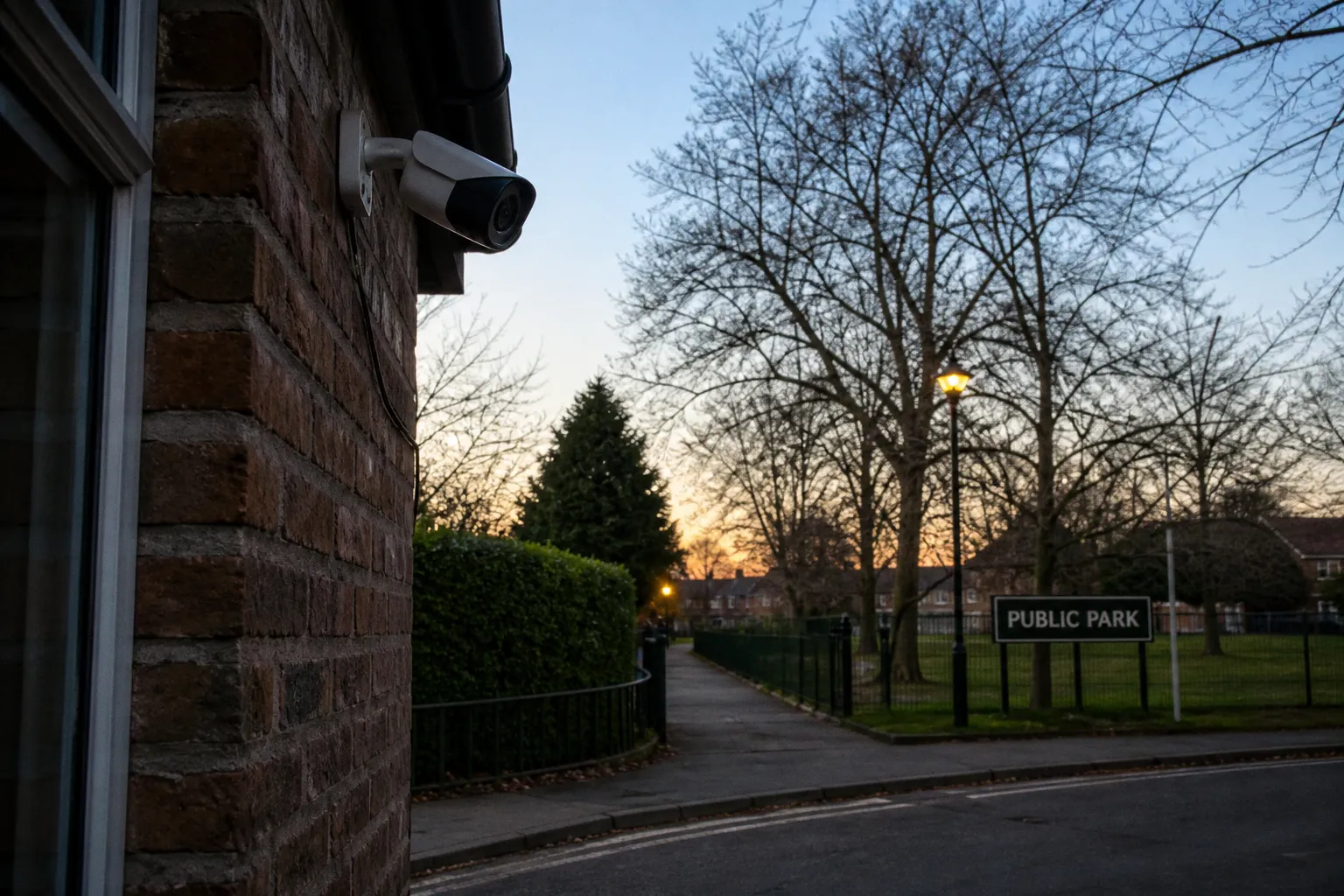
Private CCTV and Public Paths: The UK Privacy Rules Homeowners Cannot Ignore
If the system records only within the boundary of the property, the domestic exemption generally applies. Once the camera records a public footpath, shared driveway, neighbouring garden or adjoining property, the legal position changes.
The homeowner may then become a data controller under the UK General Data Protection Regulation and the Data Protection Act 2018. That creates operational duties: transparency, proportionate surveillance, controlled retention, responses to access requests and, in some cases, visible signage. The same threshold applies to smart doorbells from manufacturers such as Ring and Nest. A device does not receive a lower regulatory burden because it is marketed as a consumer product.
For residents considering CCTV installation in North East Lincolnshire, the practical question is therefore not simply whether a camera improves security. It is whether the proposed field of view is necessary, limited and defensible if challenged.
The legal threshold: when domestic CCTV becomes data processing
UK data protection law distinguishes between surveillance confined to a private domestic setting and surveillance that extends beyond it.
A camera aimed at a rear garden, enclosed yard or driveway entirely within the homeowner’s private boundary will normally remain within the domestic exemption. In that arrangement, the homeowner is not generally required to register with the Information Commissioner’s Office or install privacy notices solely because a camera exists.
That exemption is narrower than many installations suggest. Cameras are often mounted above entrance doors, garage roofs or first-floor windows. From those positions, the lens may capture:
- A section of pavement outside the property.
- A shared access route.
- The frontage of a neighbouring house.
- Communal areas in a terrace, block or converted property.
- Audio from people speaking near the entrance.
- Visitors approaching another address.
Once footage includes areas outside the private boundary, the homeowner is no longer dealing only with household activity. Images of identifiable people become personal data. The operator must then handle that information under the relevant data protection framework.
This is the central point in the home CCTV camera privacy laws UK framework. The physical ownership of the camera is not the legal test. The recorded geography is.
The regulatory boundary is drawn around the camera’s field of view, not around the walls of the house where the camera is installed.
The distinction also matters for enforcement and disputes. A homeowner may have a legitimate security objective, but a legitimate objective does not authorise unlimited recording. The surveillance must remain connected to that objective and avoid unnecessary intrusion.
Why the field of view matters more than the device
The technology is not the determining factor. A conventional wired CCTV camera and a wireless smart doorbell can create the same legal obligations if both record a public path.
The relevant questions are functional:
1. What area does the camera capture?
2. Does it record images beyond the property boundary?
3. Does it record sound?
4. How long is footage retained?
5. Who can access the recordings?
6. Is the recording proportionate to a defined security purpose?
A wide-angle lens can create compliance problems even when the installer has no intention of monitoring neighbours. Cloud storage can extend the number of people or companies involved in handling the footage. Motion detection can create a continuous stream of clips from a pavement that the homeowner does not own.
This is why a nominally small domestic system can become a regulated surveillance arrangement without any change in the owner’s stated intention.
What UK GDPR obligations mean in practice
When a private CCTV system records public or neighbouring space, the homeowner acts as a data controller. That does not make the installation impossible. It does, however, require a more disciplined operating model.
The first requirement is purpose. The owner should be able to state why surveillance is necessary. A general preference for seeing everything around the property is weaker than a defined security purpose, such as monitoring an entrance or protecting a vulnerable access point.
The second requirement is minimisation. The camera should record no more of the surrounding area than is reasonably required. This is not a technical detail to be addressed after installation. It is the basic preventative framework for avoiding unnecessary data collection.
A compliant setup may therefore require:
- Repositioning the camera towards the doorway rather than the full pavement.
- Using privacy masking to block neighbouring windows or garden areas.
- Reducing the angle of view.
- Disabling unnecessary motion zones.
- Turning off audio recording.
- Limiting cloud access to authorised users.
- Setting a retention period that reflects the security purpose.
- Reviewing the configuration when the surrounding environment changes.
Privacy masking is useful, but it is not a substitute for examining the whole system. Some devices process a wider image before applying a mask. Others retain metadata about motion events, timestamps or device access. The operator should understand what the system records and where that information is stored.
Signage is part of the surveillance arrangement
The ICO advises domestic CCTV users who record public paths or neighbouring areas to provide visible information explaining that recording is taking place. In practical terms, this usually means clear CCTV signage positioned where people can see it before or as they enter the monitored area.
A sign should not be treated as a decorative label. Its purpose is transparency. It should communicate that surveillance is active and identify the relevant purpose or operator information in an intelligible way.
The exact layout will depend on the installation, but a sign that is hidden behind a gate, obscured by vegetation or placed inside the property does not provide meaningful notice to people on the pavement. The visibility standard is operational, not symbolic.
The sign also does not cure excessive surveillance. If a camera records a neighbour’s bedroom window or captures conversations across a shared boundary, adding a notice does not make the intrusion proportionate. Transparency is one obligation; necessity and minimisation are separate obligations.
The twelve principles and domestic surveillance
The Surveillance Camera Code of Practice is built around 12 guiding principles. For domestic operators, the principles are a useful governance reference even where the installation is not part of a public authority’s surveillance network.
The practical themes are consistent:
- A clear reason for using surveillance.
- A demonstrable need for the system.
- Proportionate deployment.
- Appropriate system design.
- Controlled access to images.
- Retention and deletion arrangements.
- Accountability for how the equipment operates.
For a single household, that may sound more formal than necessary. The alternative is usually informal decision-making: a camera is installed, the default lens is left unchanged, clips accumulate indefinitely and access is shared through an app without a defined process. That model creates avoidable exposure.
Audio recording is a separate risk category
Many homeowners focus on the image and overlook the microphone. This is a material error.
The ICO treats audio recording as highly privacy-intrusive in domestic CCTV settings. A camera that captures conversations on a pavement or shared entrance can collect significantly more sensitive information than a device recording movement at a door. Speech may reveal personal circumstances, health information, relationships, work arrangements or other details unrelated to the security purpose.
For most home installations, audio should be disabled unless there is a strong and specific justification for retaining it. The presence of a microphone in a smart doorbell does not establish that recording sound is necessary.
The risk is amplified by sensitivity and range. A camera may be positioned to monitor a narrow entrance but still capture voices from people waiting outside the property. Two-way communication also creates a different operating question: whether the device merely transmits live audio to the resident or stores recordings for later retrieval.
The distinction should be documented in the device settings and privacy configuration. A system that has audio switched on by default should not be treated as compliant by default.
Smart doorbells follow the same rules
The market often presents smart doorbells as a low-impact alternative to CCTV. They are compact, convenient and usually connected to a cloud platform. Legally, the relevant analysis is less convenient.
If a smart doorbell records only within the private boundary, the domestic exemption may apply. If it captures a public pavement, shared driveway or another property, it falls within the same data protection considerations as traditional domestic CCTV.
The operating risks are sometimes greater because smart devices may include:
- Wide-angle video.
- Motion tracking.
- Audio recording.
- Cloud storage.
- Remote access from multiple phones.
- Automatic notifications.
- Continuous or frequent event recording.
- Integrated facial or object detection features.
The ICO smart doorbell guidelines therefore need to be read as part of the wider domestic CCTV position, not as a separate category of relaxed rules. A Ring or Nest device is still a surveillance system when it records people outside the owner’s boundary.
| Installation feature | Lower-risk configuration | Higher-risk configuration |
|---|---|---|
| Camera angle | Focused on the entrance or private garden | Wide view covering pavement and neighbouring frontage |
| Audio | Disabled | Continuously enabled |
| Motion detection | Limited to the doorway or gate | Activated across the whole street-facing area |
| Privacy masking | Neighbouring windows and property excluded | No masking despite adjacent homes being visible |
| Retention | Short period linked to a security purpose | Indefinite storage of all clips |
| Access | Restricted to the household or named users | Shared widely through cloud accounts |
| Notice | Visible sign where public space is captured | No sign or signage hidden from passers-by |
The table is not a legal safe-harbour. A lower-risk configuration can still be inappropriate in a particular setting, while a higher-risk feature might require a documented and defensible reason. It illustrates the direction of travel: narrow, purposeful surveillance is easier to justify than broad, indefinite monitoring.
Subject access requests change the homeowner’s responsibilities
When a system records public or shared space, people captured by it may have rights under data protection law. One of the most relevant is the Subject Access Request, commonly known as a SAR.
A person can request copies of footage containing their personal data. The homeowner must then identify whether relevant footage exists, locate it and consider how to provide it without improperly disclosing other people’s information. This can require redaction or other handling where third parties appear in the recording.
That process becomes difficult when the operator has no retention policy. A request made several weeks after an incident may be impossible to answer if the system overwrites footage after a short period. The opposite problem also exists: keeping every clip indefinitely creates a larger data management and privacy burden.
A proportionate domestic system should have a defined retention approach. The appropriate period will depend on the security purpose, the device’s operation and whether a specific incident has been reported. Footage connected to an incident may need to be preserved and shared with the police or another appropriate authority. Routine footage should not be retained merely because storage is cheap.
The operator should also know:
- Which device stores the footage.
- Whether the data is held locally or in the cloud.
- Who has account access.
- How footage can be exported.
- How clips are deleted.
- Whether the system records timestamps accurately.
- Whether a third-party provider processes the information.
These are not administrative extras. They determine whether the owner can respond coherently when a neighbour, visitor or delivery worker asks about recorded footage.
Neighbour disputes are usually configuration failures before they become legal disputes
A neighbour dispute over CCTV cameras commonly begins with uncertainty about what the device can see. A camera points towards a boundary, the resident assumes it is recording only the entrance, and the neighbour observes a lens directed towards their property. The resulting conflict is then managed through accusation rather than evidence.
A more reliable process starts with the equipment:
1. Identify the exact field of view.
2. Confirm whether public or neighbouring areas appear in live view.
3. Check whether those areas are also stored in recorded clips.
4. Disable audio.
5. Apply privacy masking.
6. Reduce motion zones.
7. Install visible signage if external areas remain within the view.
8. Record the reason for retaining any footage beyond routine security use.
The physical direction of the camera matters, but it is not conclusive. A device pointed downwards may still capture a broad section of pavement. A camera pointed towards a side gate may include a neighbour’s driveway through a wide-angle lens.
Communication can prevent escalation, but it should not be confused with a legal waiver. A neighbour’s informal acceptance does not necessarily resolve the rights of other people using a public path. Conversely, a complaint does not automatically mean the camera must be removed. The central assessment remains whether the surveillance is necessary, proportionate and properly managed.
The case of Fairhurst v Woodard demonstrates the potential consequences of intrusive domestic surveillance. The significance is not that home CCTV is prohibited. It is that excessive monitoring, particularly where neighbours and private spaces are captured, can create civil and harassment-related exposure.
A homeowner should not rely on the argument that the camera was installed for safety if the configuration goes materially beyond that purpose.
CCTV installation in North East Lincolnshire: the local security question
The local context matters because housing form and public-space design influence both security value and privacy risk.
In Grimsby, Cleethorpes and Immingham, street-facing properties may have short frontages, shared access routes, terraced layouts and pavements close to doors and windows. These conditions can make a camera useful for monitoring an entrance while also making it difficult to avoid recording public space.
The same applies to alley gating schemes, communal passages and rear access routes. A camera covering a private gate may also capture residents using a shared alley. Street lighting improvements can alter the practical need for a camera by improving visibility at night, while public CCTV installations and household systems may overlap in the same location without sharing the same legal controller.
This produces a resource allocation question for householders and local stakeholders. A camera should address a defined vulnerability rather than duplicate existing surveillance without a clear purpose. If the principal problem is poor visibility, lighting or access control may be more proportionate than a device that records every passer-by.
For property owners considering CCTV installation in North East Lincolnshire, the security assessment should include the surrounding street design:
- Is the entrance recessed, exposed or shared?
- Does a gate provide a meaningful access boundary?
- Is the rear alley private, communal or public?
- Does lighting provide usable facial visibility at the camera’s distance?
- Are neighbouring doors or windows within the lens angle?
- Will the system capture routine pedestrian movement?
- Can the camera be mounted lower, narrower or further inside the boundary?
- Does the property sit within a listed building or conservation area where separate planning questions may arise?
The final planning point requires local verification. Whether permission is needed for a specific domestic installation can depend on the property and its designation. It should not be assumed either that permission is always required or that it is never relevant.
Target hardening is broader than surveillance
Household security is more effective when CCTV forms one layer of a preventative framework rather than the entire response. A camera may provide evidence after an incident, but it does not physically prevent entry.
A more balanced arrangement may combine:
- High-quality door and window locks.
- Secured gates and controlled rear access.
- Exterior lighting positioned to reduce concealment.
- Property marking kits for bicycles, tools and other portable goods.
- Clear sightlines around entrances.
- Secure storage for bins and ladders.
- Alarm systems with controlled notifications.
- Neighbourhood-level measures such as alley management.
- CCTV limited to the points where it provides a defined benefit.
This is the principle of target hardening: reduce opportunity, increase visibility and improve the quality of evidence without creating unnecessary monitoring of ordinary public life.
In streets with dense frontage, defensible space architecture can be more relevant than additional camera coverage. A clearly defined boundary, visible entrance and controlled access route can reduce ambiguity about who should be present. Surveillance then supports the design instead of compensating for its absence.
A defensible operating model for homeowners
The most robust domestic systems are not necessarily the most expensive. They are the systems whose purpose, field of view and data handling can be explained without qualification.
Before installation, the owner should produce a simple record covering:
- The security problem being addressed.
- The areas the camera is intended to monitor.
- The areas that may be captured incidentally.
- The reason less intrusive alternatives are insufficient.
- Whether audio is disabled.
- The retention period.
- The people with access to footage.
- The location of the privacy notice.
- The process for handling requests from recorded individuals.
This record does not need to become an elaborate compliance manual. Its value is analytical. It forces the installation to be designed around necessity rather than the maximum capability of the device.
After installation, the owner should test the system in daylight and at night. Infrared illumination can change the effective field of view. Motion zones may behave differently when people walk along the edge of the frame. A setting that appears narrow in the app may still produce clips showing a neighbour’s entrance or a public pavement.
The device should also be reviewed after changes to the property or street. A new gate, extension, parked vehicle or lighting arrangement can alter what the camera captures. Security equipment is not a one-time decision; it is a configuration that remains proportionate only while its surrounding conditions remain stable.
Good domestic surveillance does not maximise visibility. It isolates the security problem and records no more than the problem requires.
The position for 2026 and beyond
The direction of UK privacy regulation is clear even where domestic technology continues to develop. More households now use connected cameras, cloud storage and smart doorbells. That increases the volume of recorded data while reducing the technical barrier to continuous monitoring.
The legal framework is therefore likely to be applied against a more complex factual background: multiple cameras, app-based access, automatic alerts, audio functions and systems that identify activity across public-facing spaces. The basic distinction will remain the same. Private household security is permitted within its proper boundary; surveillance extending beyond that boundary creates responsibilities.
For residents, the immediate policy is straightforward:
- Keep the camera’s view narrow.
- Exclude neighbouring homes wherever possible.
- Treat public pavements and shared routes as regulated space once recorded.
- Disable audio unless a specific justification exists.
- Use visible signage when external areas are captured.
- Retain footage for a defined reason and period.
- Be prepared to manage subject access requests.
- Do not assume a smart doorbell is legally different from CCTV.
- Treat neighbour complaints as a prompt to inspect the configuration, not as proof that either side is correct.
Home CCTV can contribute to crime prevention across North East Lincolnshire, but its value depends on placement, integration and restraint. A camera that records everything may produce more data, not better security. The stronger model is selective surveillance supported by physical target hardening, adequate lighting and clear boundaries.
That is the practical privacy ruling homeowners need to apply: security equipment remains defensible only when its intrusion is proportionate to the risk it is intended to manage.