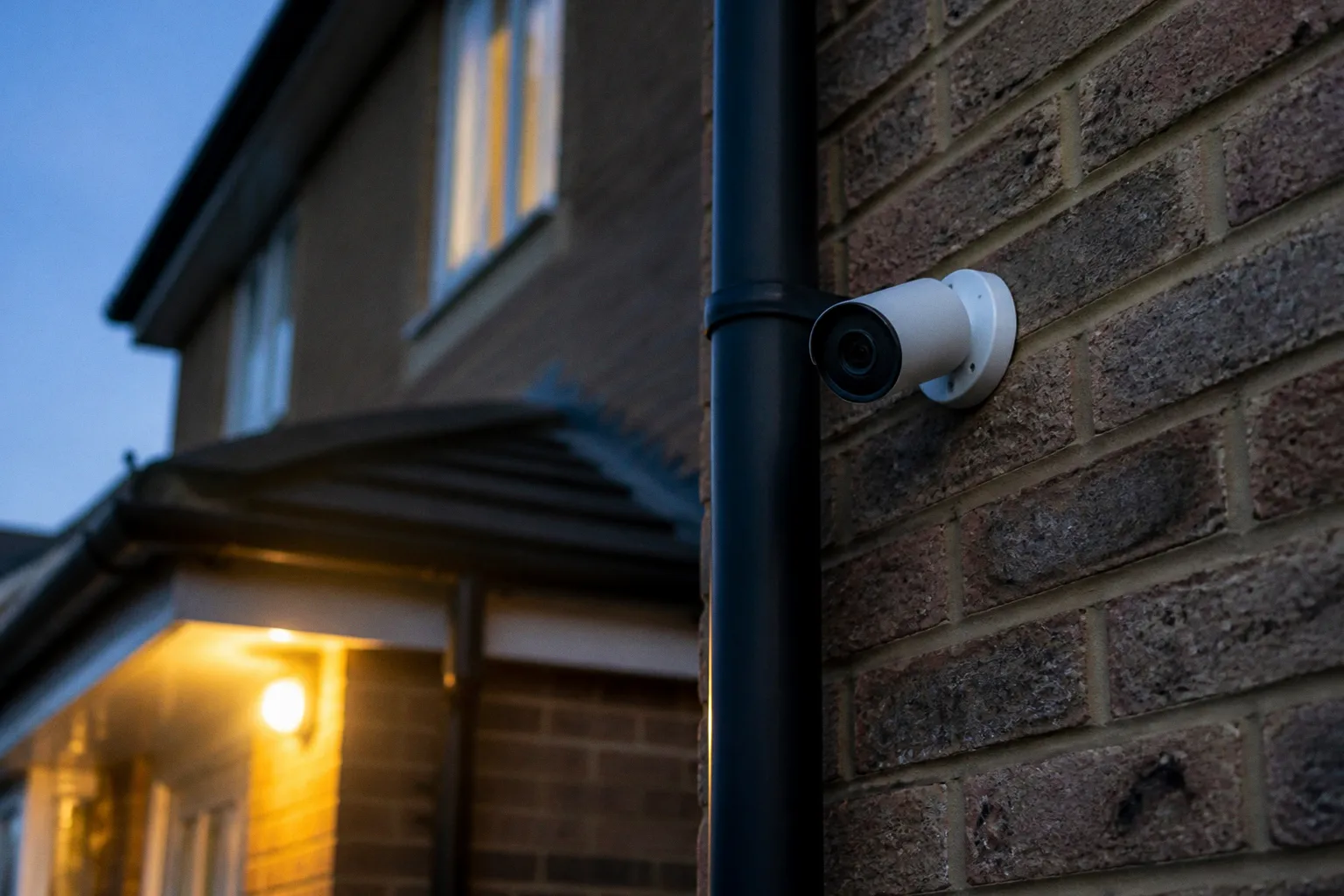
A visible lens on a terraced street in East Marsh or a semi-detached in Waltham sends a quiet, practical signal — and the technology has never been more affordable or easier to fit yourself. But there is a question that trips up plenty of well-meaning residents before they even open the box: do you actually need to ask North East Lincolnshire Council for planning permission first?
The short answer is that most domestic CCTV installations in England fall under what planners call “permitted development”, meaning you can fit standard household cameras without making a formal application. The longer answer matters just as much, because there are limits on size, placement and building type that can move an installation from the straightforward category into a conversation with the council’s planning team.
Those limits are not the only consideration. Listed-building consent can be a separate requirement, and some conservation-area properties have permitted development rights restricted by an Article 4 direction. In other words, a camera may fit comfortably within the ordinary size and height limits and still need approval because of the status or location of the building. Getting the planning position right from the start saves headaches later, while understanding the distinction between planning rules and privacy obligations keeps you on the right side of both systems.
Understanding permitted development for domestic CCTV
Permitted development rights are essentially a national shortcut built into the planning system. They acknowledge that certain modest changes to a property — putting up a satellite dish, replacing windows or, in this case, mounting a camera — are so routine and low-impact that asking the council to approve each one individually would be neither proportionate nor practical.
For domestic CCTV, the relevant provisions sit within the Town and Country Planning (General Permitted Development) Order. As long as an installation stays within the conditions set out for domestic surveillance equipment, there is normally no need to submit a planning application.
That is genuinely useful news for households across North East Lincolnshire that want to strengthen their home security. It means you can purchase a camera system, follow the manufacturer’s fitting instructions and have it up and running without waiting for a council decision or paying an application fee. For residents in neighbourhoods where collective vigilance and grassroots safety partnerships have been building momentum, this low barrier to entry is a real enabler.
For most households across Grimsby and Cleethorpes, fitting a standard CCTV camera is permitted development — but that does not override listed-building consent or a conservation-area restriction such as an Article 4 direction.
The important point is that permitted development is conditional, not a blanket exemption. It applies to qualifying properties and installations that stay within the relevant parameters. If a camera, mount or supporting structure exceeds those parameters, formal approval may be needed. The same can be true where the property has special heritage protection or where local restrictions have removed or limited the usual permitted development rights.
This is why a simple search for “home CCTV planning permission Grimsby” will not always provide a complete answer. The equipment itself is only part of the question. The building, the street and the way the camera is mounted can all affect the planning position.
The statutory limits: size, height and camera density
This is where the practical detail lives, and it is worth knowing these numbers before you buy rather than after you have drilled into the wall. The rules set out maximums for the dimensions and arrangement of domestic CCTV equipment. The intention is to keep household cameras as proportionate fixtures rather than allowing a residential installation to become something closer to surveillance infrastructure.
The main limits are:
| Requirement | Permitted development limit |
|---|---|
| Camera dimensions, including housing | Maximum 0.75 m × 0.25 m × 0.25 m |
| Protrusion from the wall | No more than 1 metre |
| Mounting height above ground | At least 2.5 metres |
| Total cameras per building | Up to 16 |
| Cameras on a single wall | No more than 4 |
| Spacing between cameras on the same wall | At least 10 metres apart |
For the vast majority of domestic installations — a doorbell camera, a pair of compact cameras covering the front and rear, or a small system covering side access — these limits are comfortably generous. Most mainstream residential equipment will not come close to the maximum dimensions, and most homes have no practical reason to install anything like 16 cameras.
The height rule is where residents can sometimes stumble. A minimum mounting height of 2.5 metres above ground level helps keep cameras out of casual reach, which is a sensible security consideration in itself. But it can become awkward on properties with low eaves, shallow porches or unusual extensions. A camera fixed to a low garage wall may fall below the threshold. The same issue can arise where a resident chooses to mount equipment on a garden fence or a short outbuilding rather than on the main building.
The measurements also need to be considered as a complete installation. A compact camera body may be within the limit while an oversized protective housing, bracket or projecting arm takes the finished arrangement beyond it. Manufacturers’ product descriptions are useful, but it is the installed dimensions that matter in practice.
Standalone poles and masts need particular care. A pole rising more than 4 metres above ground is treated differently from a camera attached directly to a house. If you are considering an elevated pole in a rear garden, shared accessway or area beside an alley, do not assume that the permitted development rules for a wall-mounted domestic camera will cover the structure supporting it.
Camera density is another point that tends to be overlooked during piecemeal upgrades. A household may begin with one camera at the front door, add one covering the driveway and later install others at the side and rear. That gradual approach can make the final total and the distribution across walls less obvious. If a full system is planned from the beginning, map out the positions before drilling and check both the overall number and the number fixed to any single wall.
These limits are not a recommendation to install as many cameras as possible. A system should cover the areas that genuinely need protection, without creating unnecessary privacy problems or a needlessly intrusive appearance. More equipment does not automatically mean better security; a well-positioned camera with good lighting and a sensible field of view is often more useful than several poorly aimed units.
When formal planning approval becomes mandatory
There is a clear difference between fitting a standard camera to an ordinary house and proposing a larger, more prominent or more sensitive installation. Crossing that line is not always as obvious as it sounds, because the trigger may come from the equipment, the supporting structure or the property’s planning status.
The most common situations requiring further planning attention are these:
1. The property is listed. Listed-building consent may be required before a camera, bracket or cable route is fixed to the exterior. This is separate from the ordinary permitted development limits.
2. The property is affected by a conservation-area restriction. Being in a conservation area does not automatically mean that every domestic CCTV camera needs a planning application. However, an Article 4 direction or another applicable local restriction can remove or limit permitted development rights, making approval necessary.
3. The equipment exceeds the permitted dimensions or arrangement. An oversized housing, a mount projecting more than 1 metre, too many cameras on one wall or a system exceeding the relevant total can take the installation outside permitted development.
4. The camera is mounted on a substantial standalone structure. A pole or mast above the relevant height threshold may require approval in its own right, even if the camera is intended only to protect a private home.
5. The proposed work affects more than the camera itself. New supporting structures, prominent external cable routes or alterations to a protected building may raise separate planning questions. The camera should not be considered in isolation if fitting it involves wider work to the property.
This is the qualification that matters most: the ordinary size, height and density limits are not the only triggers. A property can remain within those measurements and still require consent because it is listed or because an applicable conservation-area or Article 4 restriction changes the usual position.
For residents who are unsure, the sensible approach is to check before installation rather than relying on a general rule found online. North East Lincolnshire Council’s planning team can clarify whether the property is listed, whether it sits within a relevant designated area and whether any local direction affects permitted development rights.
Navigating listed buildings and heritage restrictions
The listed-building question deserves particular attention because it is where well-intentioned residents most often come unstuck. The protections around listed buildings carry real legal weight. An external alteration does not become exempt simply because the item is small, inexpensive or installed for a legitimate security purpose.
A camera bracket can affect the appearance of a façade, while fixings and cable routes can damage historic surfaces. On a traditional terrace in central Grimsby or a characterful property around Cleethorpes, the planning concern may be less about the camera’s technical specification than about where it is placed and how visibly it changes the building.
If you live in a listed property and want the reassurance of a camera, the process is not necessarily onerous, but it does require patience and engagement. You may need listed-building consent, and the council will assess the impact of the proposed installation on the building’s character. The correct route depends on the property and the work proposed, so it is worth confirming the position before ordering equipment.
Discreet, sympathetic placements tend to be easier to consider than large, conspicuous units bolted to a front elevation. A small camera in a less prominent position may have less visual impact. Carefully planned cable routing can avoid damage to historic masonry, decorative features and original joinery. In some cases, an alternative position on a later extension or another less sensitive part of the building may provide useful coverage with less effect on the property’s character.
A camera bracket on a listed building in Cleethorpes is not a trivial fix — heritage protection can apply even when the equipment itself is small and within the usual domestic dimensions.
Conservation areas require a slightly different analysis. They are designated because the character or appearance of an area is considered worth preserving, but designation alone does not mean that every household alteration requires permission. The key question is whether permitted development rights have been restricted in that location. An Article 4 direction is one mechanism by which a council can require certain changes that would otherwise be permitted to go through a formal planning process.
That distinction is important for anyone searching for “Grimsby council CCTV rules” or “residential CCTV regulations UK”. National permitted development rules provide the starting point, but local planning designations can alter the answer for a particular address. Two houses with identical cameras may face different requirements if one is listed or affected by an Article 4 direction and the other is not.
A brief early conversation with a planning officer can save a great deal of time. If consent is needed, the application will be stronger when it explains the security purpose, identifies the proposed fixing points and shows that the design has been kept as discreet as reasonably possible. A simple location plan, photographs of the elevation and product information may also help the council understand what is being proposed.
Planning rules are not privacy rules
There is a second regulatory framework alongside the planning system, and confusing the two is one of the most common mistakes householders make. Planning permission — or the lack of it — governs the physical act of installing a camera on your property. Data protection law governs what that camera records once it is switched on. They are separate regimes, enforced through different mechanisms, and satisfying one does not automatically satisfy the other.
Under the UK General Data Protection Regulation and the Data Protection Act 2018, a CCTV system that captures footage beyond the boundaries of your own property may be processing personal data. That can include a public footpath, the pavement outside your house, a neighbour’s front garden or a shared accessway.
The fact that the camera is installed lawfully does not remove those responsibilities. If the system captures people outside your boundary, you should have a clear reason for recording, keep footage only for as long as it is genuinely needed and be prepared to deal appropriately with requests from individuals whose images have been recorded.
The Information Commissioner’s Office provides guidance for domestic CCTV users. The practical implications depend on what the camera sees and why it is being used. A camera aimed narrowly at your own front door and driveway raises a different privacy question from one that records a wide section of the pavement or overlooks several neighbouring gardens.
The familiar “domestic purposes” assumption should therefore be treated carefully. A system used only within the private domestic sphere may have limited data protection implications. Once the field of view extends beyond the home boundary, the household may need to take additional steps. That does not automatically make the camera unlawful, but it does mean that responsible operation matters.
Useful measures include:
- Aim the camera as narrowly as possible. Cover the entrance, gate, vehicle or vulnerable access point rather than recording a whole street simply because the lens can do so.
- Use privacy masking or privacy zones. Many modern systems allow parts of the image to be blocked out so that neighbouring windows, gardens or sections of the pavement are not recorded.
- Review motion detection settings. A camera that records every movement on a public footpath may collect much more personal data than a system configured to respond only to activity near the boundary.
- Secure the recordings. Use strong account credentials, keep devices updated and restrict access to people who genuinely need to view the footage.
- Set a sensible retention period. Keeping recordings indefinitely creates additional risk without necessarily improving security.
- Explain the system where appropriate. Clear signage or a straightforward conversation with neighbours can reduce uncertainty, particularly where the field of view cannot avoid a small part of a shared or public area.
This is not a reason to avoid installing cameras. Across North East Lincolnshire, visible and carefully positioned security measures can contribute to residents’ sense of security and support wider community safety efforts. It is a reason to think about the camera angle as carefully as the bracket, and to treat the people recorded by the system as part of the installation’s practical impact.
| Aspect | Planning permission | Data protection and privacy |
|---|---|---|
| What it governs | The physical installation and its effect on the property or surroundings | The footage captured and the way it is handled |
| Main authority | North East Lincolnshire Council’s planning service | Information Commissioner’s Office |
| Typical trigger | Exceeding permitted development limits, or a listed-building or applicable local restriction | Recording areas or people beyond the private property boundary |
| Key concern | Size, height, appearance, location and heritage impact | Purpose, necessity, transparency, security and retention |
| Practical step | Check the property status and finished dimensions before fitting | Set the field of view carefully and use privacy features where available |
A sensible installation sequence
For anyone in Grimsby, Cleethorpes or Immingham considering cameras as part of a home security setup, the process is straightforward provided the right questions are asked before the drill comes out.
Start with the property, not the product
Before comparing image resolution or night-vision modes, establish whether the home is listed and whether it lies in a conservation area. If it does, check whether an Article 4 direction or another restriction applies. This is the point at which a council enquiry is most useful, because buying equipment first can leave you trying to make an unsuitable design fit a protected building.
Check the finished dimensions
Do not rely only on the camera body’s measurements. Include the housing, bracket and any projecting arm when considering the installation. Confirm the distance from the wall and the height above ground once the equipment is actually mounted.
The principal figures to keep in mind are a maximum camera size of 0.75 m × 0.25 m × 0.25 m, a projection of no more than 1 metre and a mounting height of at least 2.5 metres. If the proposed arrangement does not fit comfortably within those limits, ask the planning team before proceeding.
Plan the whole system
Count the cameras and map their positions. A standard home system will generally be well below the overall limit, but larger properties, outbuildings and extensive garden boundaries can make the layout more complicated. Remember the limit of four cameras on a single wall and the spacing requirement between cameras on the same wall.
This planning stage is also a chance to decide whether every camera is necessary. A camera covering a side passage may be valuable; another pointed at a neighbouring boundary may add little security while increasing privacy concerns. Security coverage should be deliberate rather than expansive for its own sake.
Consider poles and outbuildings separately
A camera fixed to the wall of a house is not the same planning proposition as a camera mounted on a pole in the garden. If the supporting structure is tall, prominent or close to a public route, treat it as a separate feature and check whether approval is required.
The same caution applies to garages, sheds and other outbuildings. Their height and position may make the 2.5-metre minimum difficult to meet, while a camera placed on a low boundary structure may have a different visual and privacy impact from one fixed to the main dwelling.
Adjust the field of view before switching on
Planning compliance does not settle the privacy question. Once the system is installed, use the camera’s physical adjustment, digital masking and motion-zone controls to limit unnecessary recording. A downward-facing camera may still protect a doorway or gate while excluding most of the pavement.
If the system records beyond the property boundary, consider what information is being captured, who can access it and how long it should be retained. The aim is not to make the camera ineffective. It is to keep the surveillance proportionate to the security problem it is meant to solve.
Speak to neighbours where the view overlaps
Talking to neighbours is not a substitute for planning permission or data protection compliance, but it is often good practice. A brief explanation of what the camera covers and why can prevent suspicion, particularly in terraces, semis and properties sharing a narrow access route.
The conversation can also expose a practical issue before it becomes a dispute. A neighbour may point out that a lens is aimed directly at a bedroom window or garden seating area when a small adjustment would provide the same protection without the intrusion.
Ask before installing unusual equipment
If the property is listed, affected by an Article 4 direction, within a sensitive conservation setting, or being fitted with a large system or standalone pole, ask the council before starting work. The purpose of that contact is not to make ordinary home security unnecessarily difficult. It is to establish which rules apply to the specific address and proposal.
Where the rules leave residents
For a typical modern, non-listed home, a modest camera fixed to the building will usually fall within permitted development. That is the practical answer behind most searches for “do I need planning permission for CCTV?” But it is only reliable when the installation remains within the relevant limits and no separate local or heritage restriction applies.
The phrase “permitted development” should not be treated as a universal pass. Size, height, projection and camera density matter, but so do listed-building status and applicable conservation-area controls. An Article 4 direction can change the position even where the equipment looks small and unobtrusive. A standalone pole can raise a separate planning issue. And once the lens captures beyond the home boundary, privacy and data protection responsibilities come into play.
The best approach is therefore modest and deliberate: check the property, measure the finished installation, limit the number of cameras to what the home actually needs and aim each lens with privacy in mind. For ordinary domestic systems, that is usually enough to keep the project simple. Where the building or installation is unusual, an early question to North East Lincolnshire Council is far cheaper than correcting an unauthorised alteration later.
Good home security is not just about adding more equipment. It is about placing the right equipment in the right position, understanding what it records and respecting the character of the street around it. That is how a private security measure can support — rather than undermine — the wider sense of safety in Grimsby, Cleethorpes and communities across North East Lincolnshire.