They are the primary inputs that flow into the Problem-Orientated Policing (POP) plans Humberside Police neighbourhood teams use to allocate resources, set patrol priorities, and design targeted interventions across North East Lincolnshire. For residents preparing to attend a local engagement event, the operational question is straightforward: how do you convert everyday observations into structured intelligence that officers can actually act on.
Neighbourhood policing in the borough is split into two main command areas — Grimsby, under Inspector Alisha Dixon, and Cleethorpes, under Inspector Kate Duffield. Within each area, teams run a rolling programme of drop-in surgeries, bike marking sessions, high-visibility patrols, and HumberTalking surveys. The entire architecture is built around a single premise: community intelligence, properly structured, narrows the gap between the published statistics and the actual pattern of incidents on the ground.
The data collected at a drop-in surgery only becomes useful when it is specific enough to be mapped against an incident, a time window, and a location.
How Community Intelligence Feeds Into POP Plans
Problem-Orientated Policing is a methodology rather than a slogan. At its core, it requires officers to move beyond reactive incident handling and instead identify recurring patterns of crime, anti-social behaviour, and disorder — and then design targeted interventions that address the underlying causes. The cycle is well-documented in policing literature: scan, analyse, respond, assess. The first two stages depend almost entirely on accurate, granular intelligence.
The scanning phase draws on everything the team already knows — incident reports, CCTV logs, council environmental records, housing complaints, and the feedback that trickles in from engagement events. The analysis phase imposes structure on that raw material: geographic mapping, temporal clustering, offender profiling, and victimology. Only then does the team respond, and only after the response does it assess whether the intervention has shifted the pattern. Each stage feeds back into the next, creating a continuous loop that refines itself with every cycle.
When a resident walks into a Grimsby or Cleethorpes surgery and describes a recurring issue — groups congregating in a particular alley at predictable times, or persistent damage to vehicles on a specific street — that description is logged into the local policing team's intelligence system. Officers then cross-reference it against incident reports, CCTV coverage, and known offender profiles. If the pattern holds, it becomes a POP project with a defined geographic scope, a defined time window, and a defined intervention set: high-visibility patrols, dispersal notices, partnership work with the local council, or signposting to wider support services.
The critical variable is specificity. A vague statement that "there's always trouble on the high street after dark" gives an analyst almost nothing to work with. A note that a particular group of four to six individuals congregates outside a named convenience store between 9pm and 11pm on Thursday and Friday evenings, and that residents have witnessed verbal abuse directed at passers-by on at least six occasions over a four-week period, gives an analyst a geographic pin, a time window, a frequency estimate, and a behavioural profile. That second description can be plotted, tested, and acted upon. The first cannot.
Without that initial structure, the same observation simply fades into the noise of general feedback. The difference between an effective POP plan and an unproductive one is almost always the quality of the underlying data.
Structuring Your Incident Log for Maximum Impact
Residents typically compile their own notes ahead of a surgery — the existence of an official Humberside Police template for pre-surgery documentation remains unconfirmed. In practice, the most effective logs are those built around a small, consistent set of fields. The objective is to make each entry independently verifiable by an officer reading it months after the fact.
There is no single format that fits every situation. A resident documenting recurring noise complaints on a residential street will need different emphasis from someone tracking a series of vehicle break-ins in a car park. What the two logs share is a common skeleton: enough structure that an officer can extract usable intelligence without needing to conduct a follow-up interview to fill in the gaps.
The table below outlines the core fields that consistently surface as the most actionable in neighbourhood intelligence work:
| Field | What to record | Why it matters |
|---|---|---|
| Date | Exact calendar date of the incident | Allows pattern detection across weeks or months |
| Time | Approximate time of day, including day of week | Recurring time windows indicate routine activity |
| Location | Specific street, address, or landmark | Enables geographic clustering in POP analysis |
| Incident nature | Brief factual description (e.g. verbal abuse, vehicle damage, broken glass) | Maps to Home Office offence categories |
| Description | Physical description of people, vehicles, or objects involved — no speculation | Supports identification and cross-referencing |
| Log reference | Any reference number from prior 101 reports | Links new observations to existing case files |
| Witnesses | Names or contact details if available | Provides follow-up leads for officers |
| Frequency | How often the incident has been observed | Distinguishes isolated events from recurring patterns |
A log does not need to be long. It needs to be consistent. A single page covering six months of observations, structured by these fields, will yield more actionable intelligence than several pages of narrative prose.
| Parameter | Narrative log | Structured log |
|---|---|---|
| Officer read time | High | Low |
| Pattern detection | Manual, slow | Comparatively straightforward |
| Cross-reference with 101 reports | Difficult | Direct via log reference |
| Suitability for POP planning | Limited | Strong |
A few things should deliberately stay out of the log. Speculation about the identity or motivation of individuals adds no value and undermines the entry's credibility. Records of unrelated domestic disputes, financial transactions, or personal grievances fall outside the scope of neighbourhood policing intelligence. Where behaviour is genuinely threatening or in progress, the appropriate channel is 999, not a written record.
One further practical point: dates and times should reflect what was observed, not what was recalled days later. An entry made from memory a week after the fact is less reliable than one written on the evening it occurred. Residents who make a habit of logging observations in near-real time — even in rough note form on a phone — consistently produce more precise and more credible records than those who attempt to reconstruct a timeline retrospectively.
Navigating Humberside Police Engagement and Drop-in Surgeries
Drop-in surgeries are the most visible element of the neighbourhood policing footprint in North East Lincolnshire. They are typically held in community venues — church halls, libraries, community centres, and occasionally mobile units set up in high-footfall areas. Attendance is informal: residents turn up, speak to a constable or Police Community Support Officer (PCSO), and submit their observations.
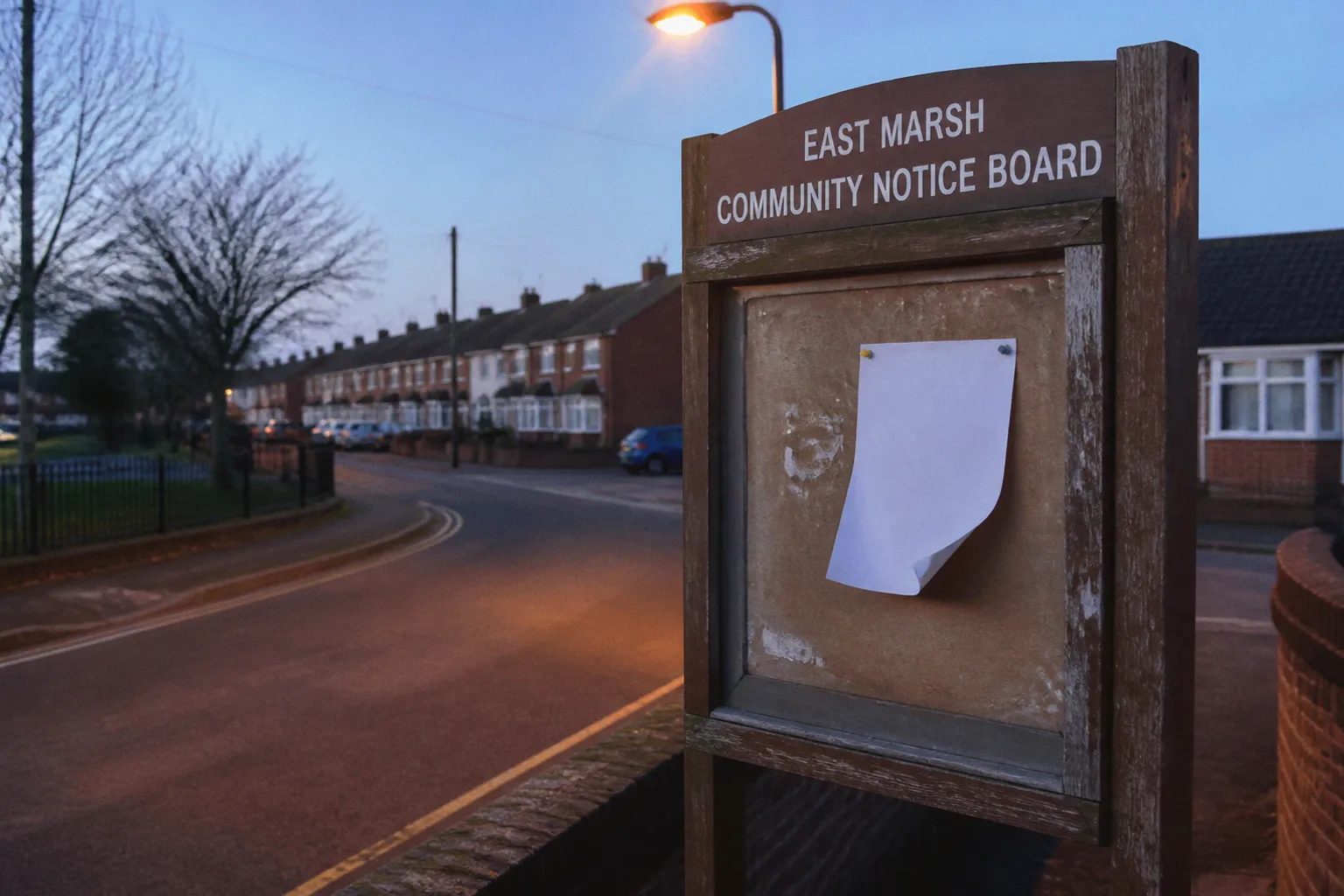
Inspector Dixon's Grimsby team covers the urban core and the surrounding wards, including East Marsh and West Marsh. Inspector Duffield's Cleethorpes team covers the coastal town and its adjoining residential areas. Both teams publish the dates and venues of upcoming surgeries through their online ward pages and through Humberside Police's official channels. The schedules are updated periodically rather than printed on a fixed calendar, so residents planning to attend should check the relevant ward page in the days leading up to the event.
Beyond the standard drop-in, the neighbourhood teams run a range of supplementary engagement formats. Bike marking sessions, for instance, serve a dual purpose: they offer a visible crime-prevention service and they create a natural opportunity for residents to raise concerns in an informal setting. High-visibility patrols in problem areas are themselves a form of engagement — officers on foot in a ward are far more approachable than officers in a patrol car, and the conversations that result often surface intelligence that would never make it to a formal surgery.
At the surgery itself, the typical interaction is brief. A resident presents a log of observations, the officer records the key points, and a follow-up plan is discussed. Where the issue is serious or active, the officer may escalate on the spot by phoning through to the local hub. Where the issue is low-level or recurring, it is added to the team's intelligence record for inclusion in the next POP planning cycle.
A drop-in surgery is an intelligence exchange, not a service counter. Residents who arrive with structured logs materially accelerate the planning cycle.
It is worth managing expectations here. A surgery is a snapshot of community concern at a single point in time. It is not a hotline, and the officer running it cannot deploy patrol resources during the event itself. What the officer can do is record, cross-reference, and escalate where necessary. The value of the surgery is cumulative: it is the pattern that emerges across multiple events, multiple logs, and multiple months that ultimately shapes the POP plan. A single visit, however well-prepared, is one data point among many.
Distinguishing Between Intelligence Gathering and Official Reporting
This distinction is the most commonly misunderstood element of the local policing structure. A drop-in surgery is not a substitute for reporting a crime. The two channels exist for different purposes, and confusing them undermines both.
For incidents that are ongoing, in progress, or pose an immediate threat to life, the correct channel is 999. For non-emergency crimes — incidents that have already occurred and where there is no immediate danger — the correct channel is 101, the Humberside Police non-emergency line. Each 101 report generates a crime reference number, which becomes the basis for any subsequent investigation and for insurance or legal purposes. For residents who prefer to remain anonymous, Crimestoppers operates on 0800 555 111.
Online reporting is also available through the Humberside Police website for certain categories of non-emergency crime. This channel generates the same crime reference number as a 101 call and follows the same downstream processing path. It is a practical option for residents who prefer to write their account rather than describe it over the phone, and it produces a written record at the point of submission.
The surgery serves a different function. It is a forum for passing on observations that may not yet meet the threshold of a formal report — recurring but minor incidents, patterns of behaviour, environmental issues, or contextual details that help officers interpret the data they already hold. A log of observations therefore complements the 101 process; it does not replace it. The most useful logs interleave new observations with the log reference numbers of prior 101 reports, allowing officers to connect the two streams.
| Channel | Purpose | When to use |
|---|---|---|
| 999 | Emergency response | Ongoing incidents, immediate threat |
| 101 | Non-emergency crime reporting | Crimes that have occurred, no immediate danger |
| Online reporting | Written non-emergency crime report | Same as 101, with written record at submission |
| 0800 555 111 | Anonymous tip line (Crimestoppers) | Reporting information without identification |
| Drop-in surgery | Intelligence exchange | Patterns, recurring issues, contextual detail |
| 01472 721 218 | Youth Engagement line (Community Safety Unit) | Youth-related concerns and signposting |
Residents should not attend a surgery expecting an officer to investigate an active crime on the spot. PCSOs and constables at these events are not equipped to dispatch resources in real time. Their role is to record, analyse, and feed into the next planning cycle — not to replace the operational response built around 999 and 101.
The practical implication is that the two channels reinforce each other. A 101 report that references a specific incident creates a case file. A log entry that references the same incident by its 101 reference number, and then records two subsequent observations at the same location on different dates, creates a pattern. The pattern is what triggers a POP plan. Neither channel alone produces the full picture.
Supporting Local Policing Through Surveys and Youth Initiatives
Beyond the surgeries, Humberside Police operates two complementary channels for community intelligence. The first is the HumberTalking survey programme, which collects structured feedback from residents across the force area on a rolling basis. The surveys are designed to capture broad sentiment — what residents perceive as the main issues in their area, whether they feel safe, and whether they believe the police are visible and responsive enough. The results feed into the force's strategic planning, informing the priorities that shape how resources are allocated across the entire Humberside area, not just individual wards.
The second is the Community Safety Volunteer scheme, established in April 2008 in partnership with Humberside Fire and Rescue Service. The scheme provides trained volunteers to support engagement events, visible-presence activities, and low-level outreach. Volunteers do not carry police powers and do not replace officers, but they extend the community-facing footprint of the policing service at a fraction of the cost of additional sworn personnel. In practice, they are often the first point of contact at a community event, directing residents to the right officer or the right reporting channel.
The Volunteer Police Cadets scheme runs alongside the Community Safety Volunteers, specifically for residents aged 15 to 16. Cadets take part in structured training, support public events, and provide a visible point of contact between young people and the policing service. The scheme is not a recruitment pipeline into policing — it is a civic engagement programme that builds familiarity and trust between a younger demographic and the neighbourhood team. For residents interested in youth engagement specifically, the Community Safety Unit operates a dedicated Youth Engagement line on 01472 721 218.
The combined effect of these channels is to widen the surface area of community intelligence. Surveys capture broad sentiment and longitudinal trends. Drop-in surgeries capture granular local detail. Volunteers extend the visible-presence footprint without consuming officer hours. Cadets create a structured pathway for younger residents to engage with the policing service in a non-confrontational setting, and over time they replenish the cohort of residents who understand how POP planning actually works.
What the Data Suggests Going Forward
The structural reality of neighbourhood policing in North East Lincolnshire is that the volume of recorded incidents vastly exceeds the operational capacity of any single team. East Marsh alone produced 280 recorded crimes in a single month at the most recent published point. Against that volume, the most valuable resource the policing teams have is not additional patrol hours — it is targeted, evidence-based deployment of the hours they already have.
That is the underlying logic of the engagement architecture. Drop-in surgeries, surveys, and volunteer programmes exist to refine the data that drives resourcing decisions. A resident who arrives at a surgery with a structured log is, in effect, contributing to the next round of resourcing analysis. The same resident who arrives with a vague recollection of some troubles down the road contributes far less, however accurate that impression may be.
The distinction matters because POP planning is a zero-sum exercise in practice. Every hour a team spends on one intervention is an hour it cannot spend on another. Intelligence that is specific, time-stamped, and cross-referenced allows officers to prioritise with confidence. Intelligence that is imprecise forces them to spend time on verification before they can act, or worse, to deprioritise the issue entirely because the data is insufficient to justify a targeted response.
Ward-level incident numbers will continue to fluctuate month by month, and priorities will shift accordingly. What does not change is the methodology. POP plans are built on specific, verifiable, time-stamped intelligence. Residents who invest the time to produce that quality of input are not merely documenting local conditions — they are shaping the operational response to them.