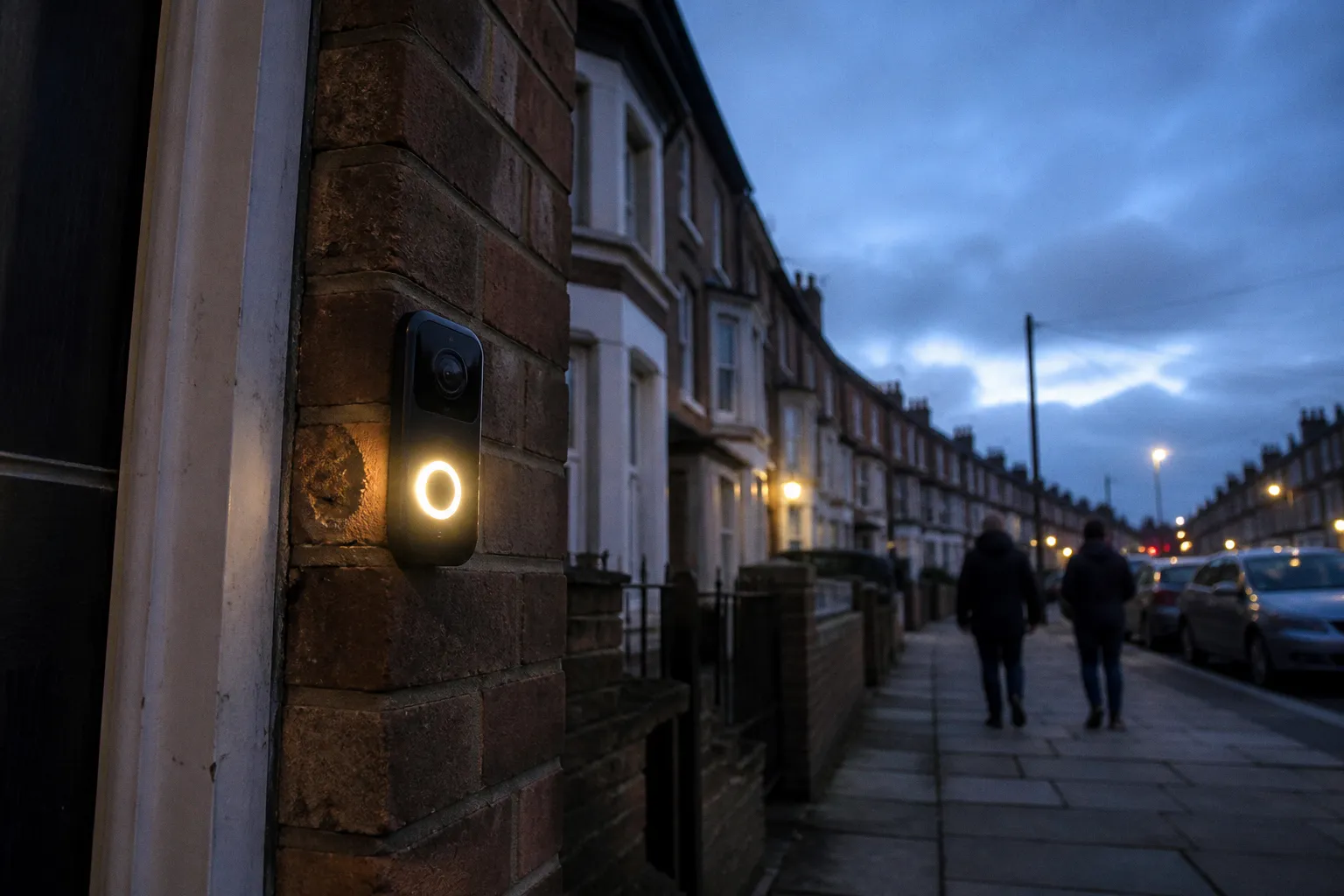
The ruling in Fairhurst v Woodard has since become the reference point that every terraced-street resident across Grimsby, Cleethorpes, and Immingham ought to know about — because the very layout that makes video doorbells so appealing is the same one that pushes the equipment out of its domestic exemption.
The good news is that the gap between "sensible piece of home security on the porch" and "you are now a data controller" is narrow, predictable, and entirely within your control to manage.
The boundary trap: when domestic exemption fails
The domestic exemption in Article 2(2)(c) of the UK GDPR is what lets us record freely inside our own homes — it covers household CCTV, baby monitors, internal smart cameras, and yes, the doorbell at the front of the house. The Information Commissioner's Office has long confirmed this carve-out exists, and it is genuinely broad for purely internal use.
What it does not cover is recording that extends beyond your property line. The moment a smart doorbell captures images or audio of a public pavement, a shared alleyway, or — most relevantly for our part of North East Lincolnshire — your neighbour's front door across a two-metre gap, the exemption falls away. You stop being a householder with a camera and become, in the ICO's language, a data controller.
That distinction sounds bureaucratic, but it carries real weight. A data controller is the person who decides what footage is captured, how long it is kept, and who can see it — and the law treats that responsibility seriously. The maximum statutory fine under UK GDPR runs to £17.5 million or 4% of global annual turnover, which is a figure aimed at corporations more than households, but it tells you the framework has teeth.
The same narrow-fronted, close-neighboured housing that makes video doorbells so useful is exactly the layout that pushes them out of the domestic exemption.
What Fairhurst v Woodard actually changed
Before 2021, the privacy risks of a smart doorbell on a terraced street were mostly theoretical. That changed when a court found in Fairhurst v Woodard that a homeowner's combination of three cameras and a video doorbell had produced a level of surveillance that amounted to harassment under the Protection from Harassment Act 1997, alongside breaches of data protection law. The damages and costs reported in that case ran to around £100,000.
The detail that matters for residents in East Marsh, the streets around Grimsby's older terraced rows, and the tighter plots in central Cleethorpes is not the headline figure — it is the pattern. The court took a dim view of continuous recording, of cameras angled to capture a neighbour's entrance and garden, and of footage being stored without any clear retention policy. Each of those on its own might have been defensible; stacked together, they painted a picture of intrusive surveillance that no reasonable household would want to be associated with.
You do not need to be obsessive about your doorbell to take the lesson to heart. The case is less about malice and more about accumulated carelessness — exactly the kind of pattern that grows when nobody reads the small print and the camera just quietly does its thing for years.
Becoming a data controller on your own doorstep
Once your smart doorbell captures beyond the boundary, three obligations land on you fairly quickly.
The first is transparency. Anyone whose image or voice you record has a right to know. A small, weatherproof sticker by the front door stating that video recording is in operation is the ICO's standard suggestion and, in practice, is the single cheapest piece of compliance you will ever pick up.
The second is retention. The ICO is clear that data protection law applies to stored images and audio; live-only footage, with nothing written to disk, sits outside UK GDPR. Most modern doorbells do not work that way — they buffer a few seconds before and after a press, then save to the cloud or to a local card. That saved material must be deleted once you no longer have a legitimate reason to keep it. A 30-day rolling deletion is the default in most mainstream apps and is a perfectly reasonable position to defend.
The third is accountability. A data controller is expected to respond when somebody asks to see the footage you hold of them — these are called subject access requests, and they are not optional. The neighbour who walks up your shared path has the right to ask for every clip you have of them, and you have a calendar month to provide it, with redactions for other identifiable faces if needed. The ICO does not expect perfection — it expects engagement.
Practical settings that keep you on the right side of the law
The technology itself is on your side here. Every mainstream smart doorbell now offers two settings that quietly do most of the compliance work for you, and both are worth switching on tonight rather than next weekend.
The first is the privacy zone. Most companion apps let you draw a black mask on the camera's field of view — typically a rectangular block covering the neighbour's door, the shared alley, or the strip of pavement you do not really need to see. Anything inside that mask is blocked at the device level before it ever reaches storage. Modern doorbells can see up to 180 degrees, which is generous for your own path but far too generous for the front room window three doors down.
The second is motion sensitivity and recording mode. Set the camera to record only when the bell is pressed, or only when someone approaches the door, rather than recording continuously to the cloud. The less you store, the less you have to manage, and the further you stay from anything resembling a Fairhurst-shaped problem.
A quick comparison of how the two main approaches stack up on a typical Grimsby terrace:
| Setting | Bell-press only | Continuous recording |
|---|---|---|
| Captures legitimate visitors | Yes | Yes |
| Captures passers-by on pavement | Rarely | Yes |
| Privacy zone effectiveness | Strong | Limited — metadata still generated |
| Subject access request workload | Low | High |
| Alignment with ICO guidance | Comfortable | Defensible only with strict retention |
The settings are not a moral judgement — they are simply a way of letting the equipment do what you actually bought it for, without sweeping up the street along with it.
Subject access requests, footage retention, and neighbour goodwill
Strictly speaking, the legal framework only catches up with you when somebody files a subject access request or the ICO opens an inquiry. In practice, across the lanes and tighter streets of North East Lincolnshire, the question usually comes up long before that — over the garden fence, in a polite note through the door, or in a conversation that begins with "could you turn that thing a bit the other way?"
Treating that conversation as a chance to reset rather than a confrontation is the spirit of the law even when it is not the letter. Reply promptly. Show the privacy zones in your app if the neighbour asks. Offer to adjust the angle. Agree on a retention window you can both live with. None of this requires a solicitor, and all of it builds the kind of neighbourhood resilience that keeps small disputes from escalating into Fairhurst-scale cases.
If a formal subject access request does land, the routine is straightforward: acknowledge it within a calendar month, search your stored clips, redact anyone who is not the requester, and hand over what is left. If you do not hold anything, say so plainly. The ICO's published guidance repeatedly emphasises cooperation over punishment, which is the kind of partnership residents tend to welcome.
Being a good neighbour with a camera is not about switching it off — it is about pointing it the right way.
A calmer doorstep, a stronger street
The wider picture is striking — there are estimated to be around 21 million CCTV cameras across the UK now, and the smart doorbell has become as ordinary as the porch light. For most of us on a Grimsby or Cleethorpes terrace, the equipment is doing exactly what we wanted it to do: deterring opportunistic callers, watching the parcels, and giving us a record when something does go wrong.
The privacy framework around that equipment was written for a different kind of camera, but it fits the doorbell era surprisingly well once you understand where the boundary sits. Set the privacy zones. Cut the continuous recording. Put up a sign. Delete what you do not need. Talk to your neighbour before they have to come and ask.
That small collection of habits is what turns a smart doorbell from a potential liability into the kind of community-level home security upgrade that holds a street together — quietly, lawfully, and with everyone on side.