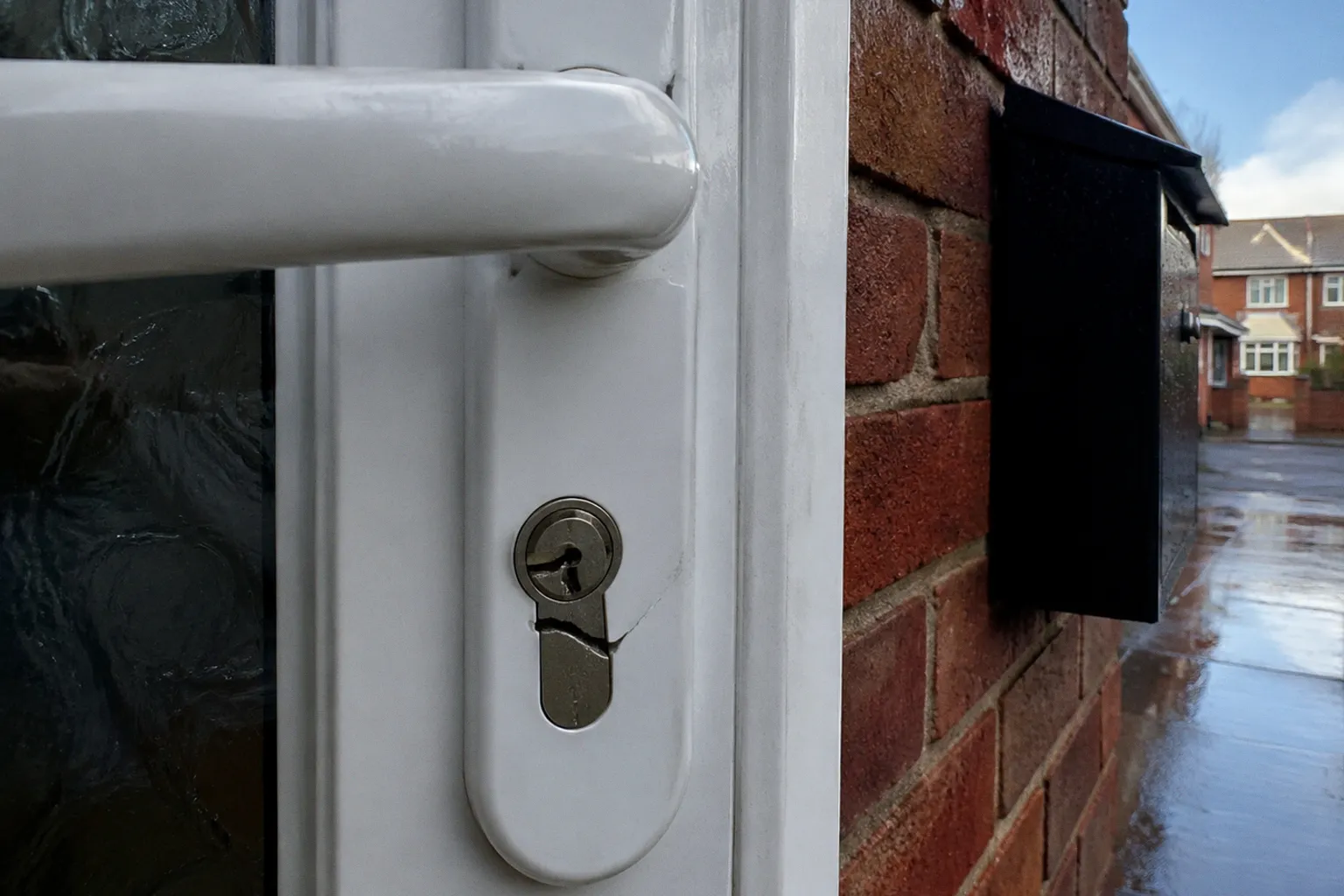
If the euro profile cylinder is a basic, unmarked model and projects too far from the door furniture, the entire locking system may depend on one exposed component.
Lock snapping is not a specialist burglary technique. It targets a known weakness in standard euro cylinders and can be carried out with common gripping tools. For residents in Grimsby, Cleethorpes and Immingham, the concern is especially relevant because uPVC and composite doors remain common across the local housing stock. The weakness is not hidden inside the wall or buried in the frame. In many cases, it can be identified by looking at the outside of the door and checking the cylinder specification.
The Mechanics of a 10-Second Breach: Why Standard Cylinders Fail
A euro profile cylinder is the barrel-shaped lock component fitted into many uPVC, composite and aluminium doors. It passes through the door and is secured by a central fixing screw. The cylinder operates the central cam, which in turn controls the door’s multi-point mechanism.
That relationship is the key to understanding the vulnerability.
When force is applied to an unprotected cylinder, usually with mole grips, pliers or a similar tool, the barrel can break across its weaker central section. Once the front portion has been removed, the cam may be exposed. The intruder does not need to defeat every hook, roller or deadbolt separately. By manipulating the exposed cam, they can operate the mechanism that controls those locking points.
The door may therefore look heavily protected while relying on a comparatively small and vulnerable component. The number of hooks in the frame is not the decisive factor if one standard cylinder controls them all.
The time involved is also important. A basic snapping attack is often described as taking only a few seconds, although the exact duration depends on the cylinder, the amount of protrusion, the tools used and the attacker’s experience. Even a longer attempt may not provide much protection on a quiet residential street. Noise, visibility and interruption remain possible deterrents, but a vulnerable cylinder does not create much physical resistance once the attack begins.
The method requires no electronic equipment and does not depend on bypassing an alarm system. It exploits the construction of the lock itself. That is why the issue has remained relevant even as door manufacturers have added more visible locking points and more elaborate handle designs.
The important question is not how many bolts the door has. It is whether the cylinder controlling them can be broken and manipulated from outside.
The presence of lock snapping risk does not mean every uPVC door is easy to open. Door condition, handle design, cylinder position, frame security and other factors all matter. But a standard cylinder can create a single point of failure that undermines the rest of the installation.
The Myth of Multi-Point Security: Why Your Hooks Aren’t Enough
A multi-point lock is a genuine security improvement over a single latch in several respects. When the handle is lifted, hooks, rollers and deadbolts can engage with the keeps in the frame. This helps resist attempts to force the door away from the frame and spreads the holding force along the door edge.
The problem is that these points are usually operated through the same central mechanism. They are not independent locks with separate keys and separate attack paths. The cylinder controls the cam; the cam controls the gearbox; the gearbox operates the hooks, rollers or bolts.
That makes the cylinder a security bottleneck.
A door described as having five-point or seven-point locking may still be exposed to lock snapping if the cylinder is a basic model. The additional points can make levering or direct attacks more difficult, but they do not automatically protect the cylinder from being broken. Once the central operating mechanism is reached, the apparent complexity of the door may count for very little.
This distinction is often lost in sales descriptions. Multi-point locking is a description of how the door secures into its frame. It is not, on its own, a statement that the cylinder has anti-snap protection. A homeowner needs to consider both parts of the system:
- the way the door locks into the frame;
- the way the cylinder resists attack;
- the amount of cylinder exposed outside the door;
- the protection provided by the handle or escutcheon;
- the certification or security rating of the replacement component.
The same principle applies to newer composite doors. A robust door slab and a well-designed frame are valuable, but the cylinder still deserves separate attention. A strong surrounding structure cannot compensate fully for a weak component that gives access to the operating mechanism.
Measuring Your Risk: The 3mm Rule and Cylinder Overhang
The first practical check requires no specialist equipment. Stand outside the property and examine how far the cylinder projects beyond the handle or protective plate.
Industry guidance commonly uses a maximum projection of around 3mm as a useful threshold. The cylinder should sit flush with the door furniture or extend only slightly beyond it. If a large section of the barrel is visible and easy to grip, the arrangement deserves attention even if the cylinder carries a security marking.
The reason is simple mechanical leverage. A protruding cylinder gives gripping tools more surface to hold. It can also make it easier to apply twisting or lateral force. The greater the exposed section, the less the attacker needs to work around the handle or protective plate.
Overhang can appear after an otherwise ordinary repair. Euro cylinders are available in different overall lengths, with different internal and external measurements. A replacement selected only because it fits the key or appears to be the right general size may still project too far on one side. Door thickness, handle dimensions, escutcheon design and the position of the fixing screw all affect the correct fit.
A rough visual inspection is useful, but it is not a substitute for proper measurement. Check the cylinder from the outside and inside, because a cylinder can be poorly centred and project excessively on one side while appearing acceptable on the other. The handle should not be removed unless the person carrying out the work understands how the lock is secured and how to measure the existing unit.
| Assessment factor | Vulnerable condition | More secure condition |
|---|---|---|
| Cylinder projection | Clearly protrudes beyond the handle or plate, particularly by more than about 3mm | Sits flush or only slightly proud of the surrounding furniture |
| Cylinder marking | Unmarked, generic or impossible to identify | Carries a verifiable TS007 3-star or SS312 Diamond specification |
| Handle protection | Little shielding around the cylinder | Security furniture helps restrict direct access to the cylinder |
| Door mechanism | Multi-point lock controlled by an unprotected central cylinder | Multi-point lock paired with a properly fitted high-security cylinder |
| Replacement fit | Cylinder selected by approximate size or price alone | Correct external and internal dimensions, fitted centrally and securely |
The visible face of the lock may show a brand, a Kitemark or another certification mark. An absence of markings does not prove that a cylinder is vulnerable, but it makes the specification difficult to verify. Where the cylinder is old, heavily worn or visibly projecting, replacement is usually more straightforward than trying to establish what model was installed.
Upgrading to TS007 and SS312: Understanding High-Security Standards
Two names appear regularly when homeowners investigate euro cylinder upgrades: TS007 and SS312. They are not marketing phrases for decorative handles. They refer to security testing and certification schemes intended to distinguish resistant cylinders from basic models.
TS007 3-star cylinders
TS007 uses a star rating system. A 3-star cylinder is the highest standalone rating within that scheme and is designed to resist forms of attack including snapping, drilling, picking and bumping. The relevant marking should be present on the product and supported by the manufacturer’s certification information.
The rating matters because it gives the buyer something more useful than a general claim that the lock is strong. It identifies a tested level of resistance against specified attack methods. A 3-star cylinder also avoids relying on the rest of the door furniture to achieve the highest combined rating.
However, certification does not remove the need for correct installation. A high-security cylinder fitted with excessive external projection may still present avoidable risks. The cylinder must be the correct size, secured properly and used with suitable door furniture.
SS312 Diamond
SS312 Diamond is a high-security standard associated with Sold Secure testing. Sold Secure is an independent testing organisation established by the Master Locksmiths Association. Its certification is used across the security industry for products subjected to controlled attack testing, including euro profile cylinders.
A cylinder carrying an SS312 Diamond rating has been assessed against a range of physical attack methods. As with TS007, the value of the marking is that it identifies a tested product rather than relying solely on the manufacturer’s description.
TS007 3-star and SS312 Diamond are commonly treated as leading specifications for euro cylinders. They are not interchangeable labels, and the testing routes are not identical, so anyone comparing products should check the actual certification and the product model rather than assuming that every cylinder described as anti-snap has passed either standard.
The 1-star cylinder and 2-star handle route
There is also a combined approach in the TS007 system. A 1-star cylinder can be paired with 2-star security handles designed to protect the cylinder from direct attack. Together, the components can provide the equivalent overall three-star level under the scheme.
This arrangement may be appropriate where the existing handle needs replacing or where the door furniture offers poor protection. It is not simply a matter of buying any attractive handle and assuming that the combination qualifies. The handle and cylinder need to be compatible, correctly rated and installed as intended.
For most homeowners, the practical decision is less complicated than the terminology suggests:
1. Identify the existing cylinder and measure its dimensions.
2. Check how far it projects beyond the door furniture.
3. Decide whether to use a TS007 3-star cylinder, an SS312 Diamond cylinder or a certified combined handle-and-cylinder arrangement.
4. Make sure the replacement is fitted centrally, with the correct fixing and adequate protection from the handle or escutcheon.
5. Test the door with it open before closing it, then check that the key turns smoothly and the multi-point mechanism operates without excessive force.
A security rating is useful only when it belongs to the part actually controlling the door, and when that part is fitted correctly.
Sacrificial Engineering: How Anti-Snap Technology Stops Intruders
Anti-snap protection does not mean that the cylinder cannot be damaged. Its purpose is to control what happens when someone tries to break it.
Many anti-snap cylinders use a deliberately engineered sacrificial section near the outer end. Under the type of lateral force used in a snapping attack, that section is designed to break along a controlled line. The outer portion may be removed, but the central operating mechanism remains protected inside the door.
The result is a controlled failure rather than a complete security failure. The attacker may damage the cylinder, but does not gain the exposed access needed to manipulate the cam and retract the multi-point locks. A replacement cylinder may still be required, yet the immediate objective of opening the door is denied.
This is an important distinction when discussing lock strength. A cylinder that breaks in a predictable place can be safer than one that remains intact until the force exposes its internal mechanism. The engineering objective is not to make the lock indestructible. It is to ensure that the part most useful to an intruder stays out of reach.
A damaged cylinder should not be ignored. If the outer section has been attacked, the lock may no longer provide dependable protection, even if the door still opens and closes. The cylinder should be replaced and the surrounding handle, escutcheon, fixing and door alignment checked for secondary damage.
What the upgrade does — and does not — solve
Replacing a vulnerable cylinder is a focused improvement, not a complete security survey. It reduces the risk associated with one specific attack path. It does not automatically protect against every form of forced entry.
A sensible assessment should also consider:
- whether the door closes firmly into the frame;
- whether the keeps and hinges are secure;
- whether the handle is loose or damaged;
- whether the cylinder is centred and protected by suitable furniture;
- whether ground-floor windows and rear access points have comparable weaknesses;
- whether the door is routinely left unlocked while occupants are elsewhere in the property;
- whether lighting, gates and visibility make the approach easy or difficult to observe.
The local setting matters because a security weakness is not experienced in isolation. A poorly protected front door may sit on a visible main road, a sheltered passage or a shared access route. The surrounding environment changes the opportunity, but it does not change the mechanical weakness of the cylinder itself.
In Grimsby and the wider North East Lincolnshire area, many homes have doors installed during earlier replacement cycles. The fact that a door was fitted as part of a modernisation project does not prove that its cylinder meets current high-security expectations. A cylinder may have been serviceable when installed and still be a sensible candidate for upgrading now, particularly if it is unmarked, worn or visibly proud of the handle.
The intervention is usually less disruptive than replacing the complete door. A correctly sized cylinder can be changed without removing the door slab or replacing the multi-point gearbox. That makes the upgrade relevant to homeowners, landlords and residents’ groups looking at practical community safety measures. It is a small component, but it sits at a critical point in the door’s defensive structure.
Community prevention should not be reduced to a single product recommendation. Good lighting, secure rear access, neighbour awareness, reporting suspicious activity and maintaining doors and windows all have a role. The cylinder upgrade is valuable because it addresses a clear and inspectable weakness. It gives residents a concrete question to answer: can the lock controlling this door be identified, and is it designed to resist snapping?
The most useful starting point is therefore not the number of hooks advertised on the door. It is the cylinder itself. Measure the projection, look for the specification and examine the condition of the surrounding furniture. If the barrel extends too far or carries no meaningful security rating, an anti-snap upgrade is a proportionate step towards closing the vulnerability.
For a uPVC-fronted home in Grimsby, that is the difference between assuming the door is secure and checking the component that actually makes the decision.