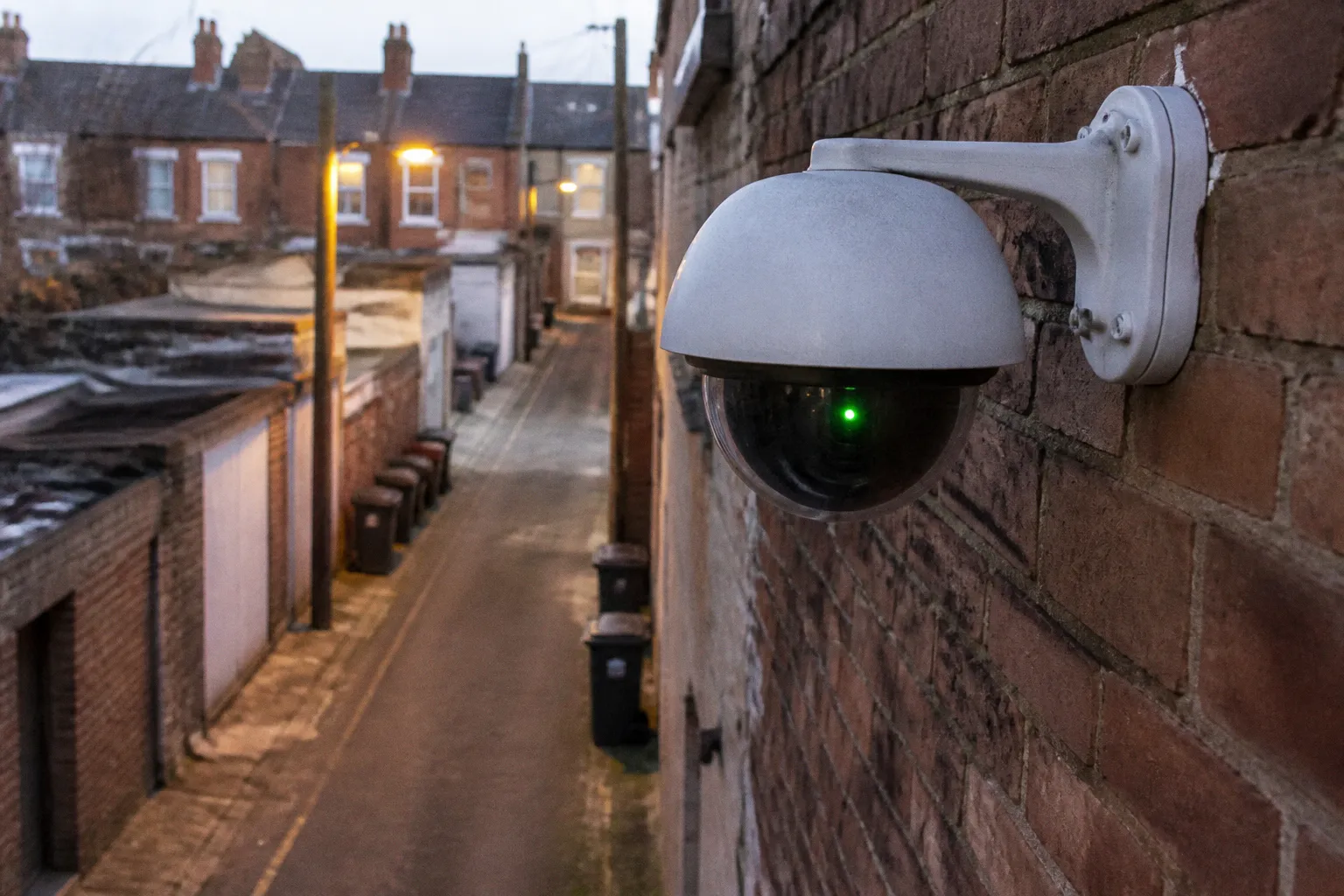
It is a decision about what should happen when something moves across the garden, approaches the back door or appears in an alley beside the property.
A passive system records what happened. An active CCTV monitoring service is designed to notice an event while it is still unfolding and, depending on the provider, respond through a live operator, an audible warning or a verified escalation process. Both approaches have a place in home security, but they solve different problems.
The distinction matters because a camera that stores excellent footage may still leave a household waiting until morning to discover that a shed has been opened or a vehicle has been entered. Conversely, a fully monitored system may offer a faster response but bring monthly fees, installation requirements and a more involved relationship with the service provider.
For residents considering CCTV installation in North East Lincolnshire, the sensible starting point is not the camera brand. It is the question of whether the priority is evidence after an incident, intervention during one, or a carefully balanced combination of the two.
The fundamental difference: evidence collection versus intervention
Passive CCTV is primarily a recording system. Cameras capture video continuously or when triggered by movement, then save it to a local recorder, memory card or cloud platform. If a burglary, criminal damage or nuisance incident occurs, the owner can review the footage and potentially provide it to the police, an insurer or a property manager.
That can be valuable. Clear footage may show a person’s route through a side passage, the time a vehicle arrived, the direction in which someone left or the point at which a gate was forced. In a neighbourhood where several households are dealing with related problems, recordings can also help establish a pattern rather than leaving every incident as an isolated suspicion.
But passive recording is retrospective by design. The system does not, by itself, challenge an intruder, contact a monitoring centre or arrange an immediate response. It records the event for later review.
Active CCTV monitoring works differently. A live feed is watched by human operators, analysed by software or handled through a combination of both. When the system identifies a defined event, the operator or automated platform may assess what is happening and take an agreed action. Some monitored systems include loudspeaker functions, allowing an operator to issue a live voice warning through equipment installed at the property.
That intervention can interrupt behaviour before a person reaches a door or removes property. It does not guarantee that a crime will be prevented, and no responsible security plan should promise that. Its value lies in shortening the gap between detection and response.
| Feature | Passive recording | Active CCTV monitoring |
|---|---|---|
| Main purpose | Preserve footage for later review | Detect and respond to an event in real time |
| Who watches the footage | Usually the homeowner or property manager after an alert or incident | A human operator, AI analytics or both, according to the service |
| Typical response | Review, download and share evidence | Live warning, event verification and agreed escalation |
| Ongoing cost | Generally lower after installation, although storage and maintenance may apply | Usually includes a recurring monitoring fee |
| Best suited to | Evidence gathering, household awareness and low-risk areas | Properties needing rapid intervention or additional reassurance |
| Main limitation | It may document a burglary without stopping it | It costs more and depends on reliable communications and a clear response plan |
Passive CCTV tells you what happened. Active monitoring is built around the more urgent question: what can be done while it is happening?
What passive recording does well
The strongest case for passive recording is often practical rather than dramatic. A household may want visibility over a front path, driveway, garage, rear garden or shared access route without committing to a monitored service. A well-positioned camera can provide useful information, particularly when combined with good lighting, secure doors, controlled access and sensible property marking.
The quality of that information depends on the system’s design. A camera aimed too far across a public pavement may capture movement but not a usable face. A bright security light placed directly behind a person can turn them into a silhouette. A camera mounted high on a wall may be difficult to tamper with, yet provide a poor angle for identifying someone at a door.
For household target hardening, the useful question is not whether a camera is present, but whether it covers the approach that a person would actually use. In many homes, this means looking beyond the front elevation:
- A side passage may need coverage because it provides access to the rear garden.
- A garage or shed may require a dedicated view rather than relying on a distant house-mounted camera.
- A front-door camera should show the threshold and the face of a visitor, not just the top of their head.
- A driveway camera should be positioned to capture vehicles without unnecessarily recording neighbouring gardens or rooms.
- A rear camera should work with lighting and physical security, rather than being treated as a replacement for either.
Passive systems can also support a calmer response after an incident. Instead of relying on memory, residents can establish when a gate was opened, whether a light was triggered and how long someone remained on the property. That evidence may be especially helpful where incidents occur overnight or where a number of nearby homes are affected.
There are, however, two common misunderstandings. First, a recording system is not the same as a live response service. An alert arriving on a phone is still dependent on someone seeing it, understanding it and being able to act. A resident may be at work, asleep, travelling or unable to contact the police safely at the moment an alert appears.
Second, more footage does not automatically mean better security. Continuous recording can create large volumes of video that are difficult to search. Event-triggered recording may be easier to manage, but it depends on accurate detection settings. Overly sensitive motion alerts can fill a phone with notifications until the genuinely important one is lost among passing cats, moving branches and headlights.
The role of recording after an incident
Passive CCTV is best understood as one layer in a wider security arrangement. It can strengthen the record of an incident, but it should sit alongside measures that make access slower, noisier and more visible.
For a typical home, that may include:
- doors with suitable locks and reinforced frames;
- secured windows and accessible rear entries;
- gates that close properly and are not easily lifted from their hinges;
- lighting that avoids creating deep shadows around entrances;
- property marking on bicycles, tools and other portable items;
- a visible house number so emergency services and visitors can identify the address quickly;
- a clear boundary between private space and public access.
This is the practical meaning of defensible space: designing the home and its edges so that legitimate visitors can approach easily, while unauthorised movement is more noticeable and less convenient. A camera becomes more useful when the surrounding environment helps it see.
How active monitoring changes the security picture
The appeal of live CCTV monitoring is straightforward. If an alarm or camera event is detected, the response does not depend entirely on the resident checking a phone. A monitoring centre may review the feed, distinguish between an expected visitor and a person behaving suspiciously, issue an audible challenge and follow the response procedure agreed with the customer.
Some systems rely heavily on artificial intelligence or video analytics. These tools can classify movement, identify a person entering a defined zone or filter out certain types of activity. Other services place greater emphasis on human operators. In practice, the most useful arrangement may be a combination: analytics draw attention to an event, while a trained operator assesses what the cameras are showing.
This distinction is important because the phrase live CCTV monitoring can cover very different services. One provider may offer a video feed that the homeowner can open at any time. Another may operate a 24/7 monitoring centre with trained staff and a formal escalation pathway. A third may send alerts to an app but describe the system as smart monitoring even though no one is watching the feed continuously.
Before signing a contract, a household should establish:
1. What triggers a response?
Is it any movement, a person crossing a virtual line, a verified alarm, a door contact or a combination of signals?
2. Who reviews the event?
Find out whether alerts go to an algorithm, a human operator or directly to the homeowner.
3. What can the operator actually do?
A live voice warning may be available, but it is not universal. The provider should explain whether the operator can speak through an external speaker, activate lights or contact nominated people.
4. What happens when the connection fails?
Broadband outages, power cuts and damaged equipment can interrupt a system. Ask about battery backup, cellular communication and notification of faults.
5. What does escalation mean?
A provider may describe verified dispatch or police notification, but the precise conditions, local arrangements and customer responsibilities need to be understood rather than assumed.
6. How are recordings stored and supplied?
A live intervention does not remove the need for evidence. Residents should know how long footage is retained and how it can be exported if an incident proceeds to an investigation.
A system that can issue a clear audible challenge may deter someone who is testing a gate or trying a door. The person may leave because they believe they have been seen, not because the equipment has physically prevented entry. That is still a meaningful intervention, particularly when it is paired with lighting and secure access points.
Yet active monitoring is not magic. An operator may not be able to see clearly because of poor camera placement, darkness, rain, glare or an obstructed lens. A person may conceal their face or move outside the camera’s field of view. The system also needs a response plan that is proportionate and lawful, avoiding unnecessary confrontation and ensuring that residents do not place themselves in danger by going outside to investigate.
The financial choice: lower commitment or ongoing reassurance
The cost difference between active CCTV monitoring and passive recording is usually felt in the service model. Passive systems generally involve an upfront purchase and installation cost, followed by expenses for storage, equipment replacement, software or occasional maintenance. Active services add a recurring monitoring charge because a provider is operating infrastructure and, in some cases, staffing a 24/7 alarm and video receiving centre.
Published industry figures commonly place professional monitoring fees in the range of $15 to $60 per month, depending on the provider and service level. Those figures are not a local North East Lincolnshire price list, and residents should not treat them as a quotation for a property in Grimsby, Cleethorpes or Immingham. They are useful only as an indication of the way monitored security is normally priced: the ongoing service is part of the product.
Insurance is sometimes included in the financial calculation. The Electronic Security Association has reported potential home insurance premium reductions of 5–20% for professionally monitored systems, but this should not be treated as an automatic UK entitlement or a guaranteed saving. Policies differ, and an insurer may require particular equipment, installation standards, maintenance arrangements or certification before offering any reduction.
The monthly fee should therefore be considered alongside the actual response capability. A system that costs less but only sends an app notification may be entirely reasonable for a household seeking evidence and reassurance. A monitored service may be more appropriate where residents are frequently away, where a property has valuable equipment, or where a business premises and home are managed together.
The financial calculation should include the less visible costs as well:
- cloud storage and additional camera subscriptions;
- replacement batteries or backup equipment;
- SIM or cellular connection fees;
- installation and future call-out charges;
- contract length and cancellation terms;
- upgrades required when a camera or recorder becomes unsupported;
- the cost of professional installation if the layout is difficult.
A cheaper system that leaves blind spots may offer less protection than a smaller, well-planned installation covering the vulnerable approaches. In community safety work, the quality of the security plan matters more than the number of devices attached to a property.
The right comparison is not cheap camera against expensive camera. It is evidence alone against evidence plus a defined response.
Choosing a system for homes across North East Lincolnshire
Local housing patterns make the physical layout of the property particularly important. A terraced home with a narrow rear access presents a different challenge from a detached property with a driveway, garage and open frontage. Flats, converted buildings and homes beside shared alleys raise additional questions about communal responsibility, privacy and who is permitted to install equipment.
In East Marsh and other densely settled parts of Grimsby, a camera aimed at a rear access route may need to work alongside alley gating, improved lighting and cooperation between adjoining households. An individual camera cannot control a shared passage. Where residents are considering an alley gating scheme or improvements to a communal route, the security benefit comes from the whole design: fewer uncontrolled entry points, better visibility and clear responsibility for maintenance.
In Cleethorpes, properties near busy pedestrian routes may need a careful balance between useful coverage and privacy. A camera should be directed towards the home’s entrance, boundary or private parking area rather than casually overlooking neighbouring windows or gardens. In Immingham, homes and properties close to industrial or commercial activity may have different patterns of vehicle movement and out-of-hours access, making reliable detection zones and clear lighting especially important.
These are not reasons to choose one technology automatically. They are reasons to begin with the site.
A practical deployment approach
For most households, the following sequence produces a more reliable result than buying equipment first and finding a location for it afterwards.
1. Map the approaches to the property.
Walk the boundary in daylight and, if possible, after dark. Identify doors, gates, low walls, shared paths, garages, sheds and areas hidden from the street.
2. Separate detection from identification.
One camera may show that someone entered the garden, while another closer to the door is needed to identify the person. These are different jobs and may require different lenses and positions.
3. Decide which events require immediate action.
A side gate opening at midday may call for a notification. A person entering a locked rear garden at night may justify a monitored response. The system should reflect that difference.
4. Design lighting with the cameras.
Illumination should support faces and movement without creating glare or harsh backlighting. Motion-activated lights can complement cameras, but their position should not allow a person to remain hidden in the shadow beyond the beam.
5. Keep recording usable.
Set detection zones and retention periods sensibly. Footage that cannot be found, exported or understood is a weak form of protection.
6. Agree the human response.
Every resident should know what to do when an alert arrives. No one should be encouraged to confront an intruder. A clear process for contacting emergency services, neighbours or the monitoring provider is safer than improvised action.
7. Review the arrangement after installation.
Check the view from the actual camera, not the diagram on the packaging. Test notifications, night images, audio, backup power and the process for retrieving footage.
For anyone comparing home security camera options, the strongest arrangement is often layered rather than absolute. Passive recording may cover the front and rear elevations, while active monitoring is reserved for a garage, vulnerable side access or property where rapid intervention is particularly valuable. In a row of homes, neighbours may also coordinate lighting, boundary improvements and property marking, creating a collective effort that works beyond a single address.
Where each option makes the most sense
Passive recording is usually a reasonable choice when the household:
- mainly wants evidence after criminal damage, theft or nuisance;
- has someone able to review alerts and footage promptly;
- can combine cameras with strong doors, windows, gates and lighting;
- wants to avoid a continuing monitoring contract;
- has a straightforward property layout with limited vulnerable access points.
Active CCTV monitoring is more compelling when the household:
- needs a response while an event is in progress;
- is often unoccupied during the day or overnight;
- has a vulnerable side entrance, garage, outbuilding or shared access route;
- wants the possibility of an operator issuing a live warning;
- is prepared to pay for a monitoring service and maintain the required connection.
Neither approach replaces neighbourhood partnership. A monitored camera at one house will not repair a broken communal gate, light a dark alley or resolve repeated problems affecting several properties. Likewise, a passive camera can become much more useful when residents share lawful, relevant information and report patterns through the appropriate channels.
There is also a wider design lesson. Safer streets are not created by surveillance alone. They emerge from visible maintenance, functioning lights, secure boundaries, active residents and spaces that make unauthorised behaviour harder to conceal. CCTV is one tool within that revitalization work, not the whole answer.
A considered decision for your property
The phrase active CCTV monitoring vs passive recording sounds like a contest in which one option must win. In reality, the better choice depends on what the household needs the system to do at the decisive moment.
If the priority is a reliable visual record, passive recording may provide an affordable and useful foundation. If the priority is immediate awareness and the possibility of intervention, active monitoring offers capabilities that an unmonitored camera cannot provide. The additional service cost is justified only when the response is clearly defined, the equipment is properly positioned and the household understands the contract.
For residents planning CCTV installation in North East Lincolnshire, begin with the property’s access points, not with a product catalogue. Talk with neighbours where a route or boundary is shared. Ask installers how the system will perform at night, how footage will be retrieved and what happens during an internet or power failure. If a monitored service is under consideration, ask exactly who watches the feed and what they are authorised to do.
The most resilient security plans are built through this kind of steady, grassroots attention: a locked gate that is actually maintained, a light that reaches the right corner, a camera that captures a useful view and residents who know how the pieces fit together. Active monitoring can add speed. Passive recording can add evidence. Together with sound household security and local partnership, they can make homes and streets across North East Lincolnshire less inviting to opportunistic crime and more confident in their collective response.