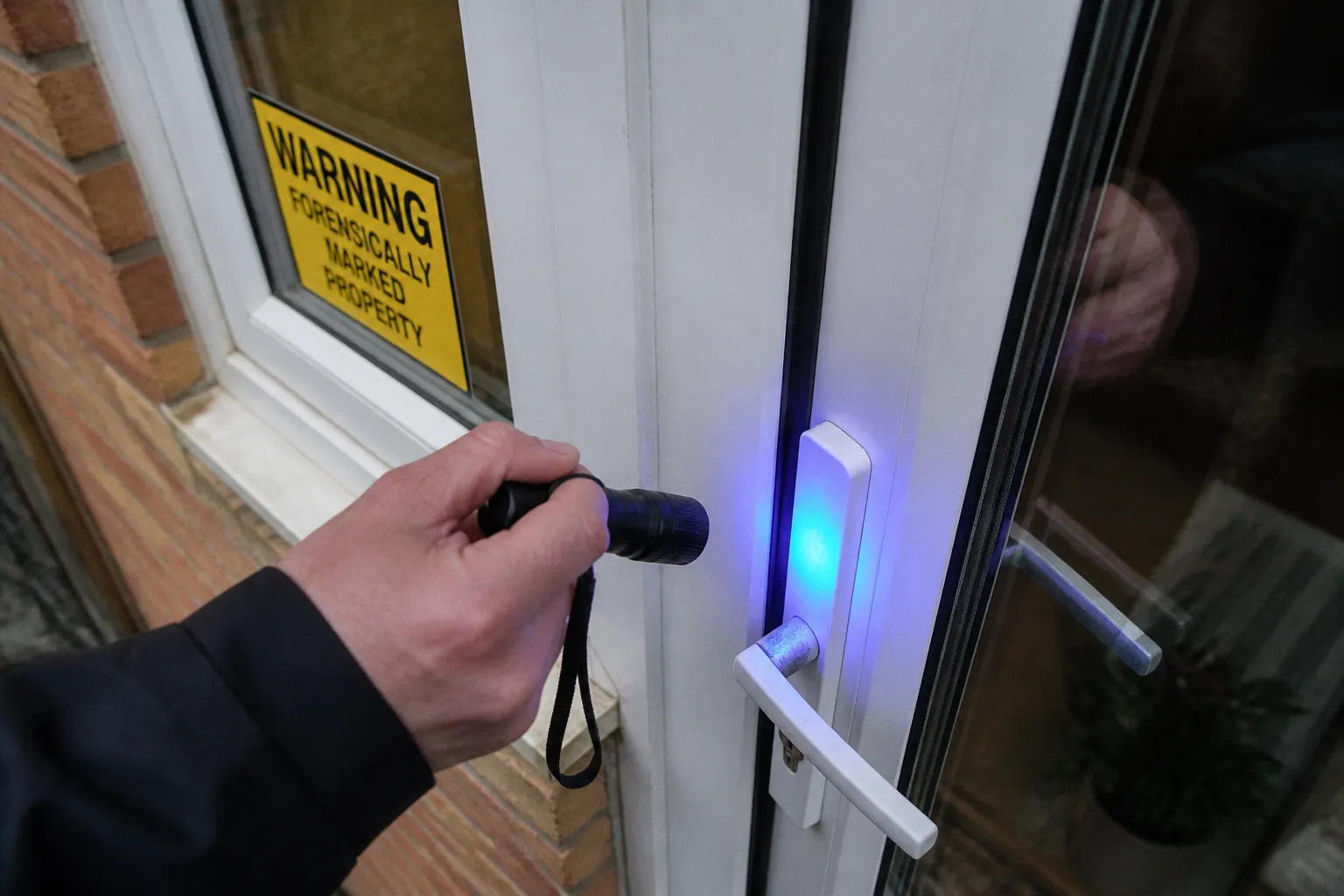
Forensic property marking kits used in Grimsby and across North East Lincolnshire work best when three things are present at the same time: the item is marked, its identifier is registered, and the property displays a clear warning that stolen goods can be traced.
That distinction matters. SelectaDNA, SmartWater and similar systems do not stop a door being forced or a window being lifted. They do not replace a sound cylinder, a locked side gate, an alarm or a lighting plan. Their value begins after an item has been handled, removed or recovered. Used properly, they make household goods harder to sell and easier for police to link to their owner or to a crime scene.
The strongest case for forensic marking kits in Grimsby is therefore not that they create an invisible shield around a house. They add traceability to the physical security already protecting the access points.
What forensic property marking actually does
A domestic property marking kit normally contains a covert liquid or microdot system carrying a unique identifier. The solution is applied to selected possessions and can be detected under ultraviolet light. Depending on the product, the marking may also contain microscopic elements that identify the specific kit or registration.
The practical purpose is straightforward:
1. A valuable item is marked with a unique code.
2. The code and the item’s serial number are registered on a recognised database such as Immobilise or BikeRegister.
3. Warning stickers are placed where an offender can see them before entering.
4. If the item is recovered, police or another authorised party can examine it under UV light and connect it to the registered owner.
The system has two different security functions, and confusing them weakens the whole arrangement.
The first is deterrence. A sticker on a front window, door or marked item signals that the property is not an easy source of anonymous goods. The message is aimed at the decision made before the theft: whether the item will be simple to sell, strip down or pass to another handler.
The second is forensic recovery. The covert marking becomes useful when an item is found after the event. Without registration, the liquid or microdots may show that an item has been marked, but they may not provide a reliable route back to the owner. A serial number that has never been recorded creates the same problem.
The visible sticker does the deterrent work before the theft. The covert marker does the identification work afterwards. You need both.
A standard household kit is typically designed to cover around 50 items. That is enough for the main portable targets in an ordinary home: televisions, laptops, cameras, tools, bicycles and similar equipment. It is not a reason to apply the solution randomly to every object in the property. Start with goods that are portable, valuable and easy to pass on.
The Grimsby context: useful, but not a magic local statistic
Forensic property marking kits have appeared within wider crime prevention work in North East Lincolnshire and the Humberside policing area. Humberside Police and the Office of the Police and Crime Commissioner have supported property marking alongside broader target-hardening measures, including work connected with Safer Streets schemes and retail crime prevention.
The West Marsh Safer Streets project in Grimsby received a £432,000 Home Office Safer Streets 2 grant. More than 100 homes were targeted for home security upgrades under that programme, which concluded in March 2022. The significance is not the grant figure by itself. It is the way the measures were combined: household security improvements, environmental changes and interventions aimed at reducing opportunities around the perimeter and access points.
A forensic kit is most credible when it sits inside that wider arrangement. Alley gating, improved lighting, better door and window protection, CCTV where it has a defensible field of view, and property marking all address different stages of the same vulnerability.
The available evidence should also be described accurately. SelectaDNA reports police trials in which forensic marking, when combined with warning signage, was associated with burglary reductions of up to 83% to 85%. That is a supplier-reported figure from general police trials. It should not be presented as a specific Grimsby or East Marsh result, and it does not isolate the effect of the marking from the signage or other measures used in those trials.
There is no sound basis for claiming that the exact same percentage applies to every street in Grimsby. Local outcomes depend on the physical layout, levels of use, offender behaviour, the quality of the registration process and the strength of the surrounding security. The useful conclusion is narrower: visible forensic marking can increase the perceived risk of handling stolen goods, but it performs best when supported by physical security and clear ownership records.
Start with the property, not the kit
When I audit a house, I do not begin inside the lounge looking for the most expensive television. I begin outside and read the property as an opportunist would. The question is not simply, “What is worth stealing?” It is, “Which route allows access with the least exposure and the least resistance?”
In Grimsby, Cleethorpes and Immingham, the same basic vulnerabilities recur across different property types:
- A side passage is open from the pavement to the rear garden.
- A gate has a latch but no proper lock.
- A rear door is hidden from the road by a high fence or dense planting.
- Wheelie bins or garden furniture provide a step to a low window.
- A shed contains tools that can be used against the main house.
- External lighting illuminates the wall but leaves the approach in shadow.
- A camera points at the front path while the real access point is the side alley.
- A warning sticker is displayed, but there is no evidence that high-value goods are registered.
These are access-point failures. Property marking does not correct them.
I work through the perimeter in a fixed order:
1. Establish the likely approach
Stand at the pavement and look for the route that allows someone to reach the rear or side of the property without crossing an overlooked open area. Check the line of sight from neighbouring windows, the street and any nearby public route.
A high fence can improve privacy while reducing natural surveillance. That is not automatically good security. If it conceals a gate, rear door or window from every neighbouring property, it may also conceal an intruder.
2. Inspect the gates and side access
A side gate is an access point, not a decorative boundary. It should close properly, resist casual lifting and be secured with a suitable lock. Check the gap beneath and around it. A weak hinge, loose post or short latch may provide less resistance than the gate’s appearance suggests.
The gate should also support the wider deterrent system. If a property has forensic marking, the warning sign should be visible from the approach where possible. The aim is to communicate before someone reaches the rear garden.
3. Check doors and windows from the outside
Look at the rear door, patio doors, ground-floor windows and any opening that could be attacked without immediate observation. Identify concealed positions where an offender could work on a lock or frame.
A marked television inside the house is of limited value if an unprotected rear door gives easy access. Upgrade the physical barrier first: sound locks, properly secured frames, effective window hardware and, where appropriate, an alarm that creates an immediate response to entry.
4. Remove tools and climbing aids
A property can undermine its own perimeter. Ladders, pry tools, garden spades and unsecured bins should not be left where they help someone reach a window or defeat a barrier. Sheds and garages need their own locking arrangement. A tool shed with a weak hasp is not secure storage; it is a supply point for the next stage of the attack.
5. Test the lighting and camera view
Lighting should reveal the approach, gate and door without creating deep contrast around the edge of the property. A bright fitting aimed at a wall can leave the person approaching in darkness. Adjust the line of sight, not merely the wattage.
CCTV is useful only when it captures a usable view. Check whether the camera sees faces, hands at the lock and the route away from the property. A wide image of a driveway may look comprehensive but provide little identifying detail. Avoid treating a camera as a substitute for a locked access point.
Why the warning sticker is part of the security equipment
The covert element attracts most of the attention because it sounds technical. The visible warning is at least as important for prevention.
An offender deciding whether to take a laptop or television is assessing effort, exposure and resale risk. A marked item may still be taken if the property is easy to enter and the goods are immediately accessible. But visible signage changes the perceived consequences. It indicates that the goods may carry an identifier, that the owner has taken deliberate precautions and that resale could be more difficult.
The sticker needs to be placed where it can be seen before entry. Suitable locations may include:
- The front door or adjacent glazing.
- A visible ground-floor window.
- A side gate facing the approach.
- The entrance to a garage or shed where tools and bicycles are stored.
- The display area of a retail premises participating in a marking scheme.
Do not hide every sign inside the property. That defeats the deterrent function. Equally, do not assume that a sticker alone proves an item is protected. The marking must be applied correctly, the identifier must be registered and the item must have an identifiable record.
A useful household record includes the make, model, serial number, distinctive features and approximate location of the item. Photograph the goods where practical. Keep the record somewhere separate from the equipment itself. If a laptop is stolen, the information should not disappear with the laptop.
Selecting items: target vulnerability, not just price
The most expensive item is not always the first target. Portability and resale are just as important.
A practical marking order is:
1. Portable electronics — laptops, tablets, cameras, games consoles and televisions are easy to remove and commonly have serial numbers.
2. Power tools and specialist equipment — these are compact, valuable and often stored in garages or sheds with weaker perimeter protection.
3. Bicycles — mark the frame and register the bicycle through the appropriate database. A bicycle should also be secured to a fixed anchor or robust storage point.
4. Cameras and other small high-value goods — these can be removed quickly and concealed easily.
5. Items that are distinctive but difficult to identify without records — marking becomes more useful when supported by photographs and serial numbers.
Do not apply forensic liquid to a surface without checking the product instructions. Some finishes, fabrics or electrical components may be unsuitable. The objective is not to cover an item visibly or damage it. It is to create an identifier that remains available for examination while preserving the equipment’s normal use.
Registration is the part most likely to be skipped. That is a procedural vulnerability, not a technical one. Once the kit is applied, complete the registration immediately. Record the database, identifier, serial number and date. If the item changes ownership, update the record rather than assuming the old entry will remain accurate.
Forensic marking compared with other layers of security
Property marking is often discussed alongside SmartWater security kits, SelectaDNA home security deterrents and Secured by Design principles. These are related, but they do different jobs.
| Security layer | Main function | What it does well | What it cannot do |
|---|---|---|---|
| Forensic marking kit | Traceability and post-theft identification | Links marked property to a registered owner or crime scene; supports visible deterrence | Does not physically resist entry or stop an item being removed |
| Warning signage | Pre-entry deterrence | Makes the perceived resale and recovery risk visible | Has little value if the property has obvious, unaddressed access-point failures |
| Door and window security | Physical resistance | Increases the effort and time required to enter | Does not identify property after theft |
| Alarm system | Detection and response | Creates noise or notification when an intrusion occurs | Cannot compensate for an open gate, weak lock or poor perimeter design |
| CCTV | Observation and evidence | Records approaches, faces and movement when correctly positioned | May provide poor evidence if the line of sight is wrong |
| Lighting and natural surveillance | Environmental deterrence | Reduces concealed approaches and improves visibility | Can create glare or shadow if badly placed |
| Registration and inventory | Ownership proof | Gives police and insurers usable identifying information | Does not protect the item physically |
This is why the phrase “property marking kits burglary prevention” needs some qualification. They are a burglary prevention measure, but not a standalone barrier. Their contribution is strongest at the point where an offender weighs the value of an item against the chance of identification and resale difficulty.
A step-by-step home audit for North East Lincolnshire properties
A small amount of disciplined work will reveal more than buying another device without checking the perimeter.
Walk the property in daylight
Start at the public footway. Note every route to the rear, every concealed corner and every object that could assist climbing. Do not focus only on the front elevation. Many houses present a tidy front boundary while leaving a side or rear access point exposed.
Repeat the walk after dark
Check what can actually be seen from the street and from neighbouring properties. Identify whether the front door is visible, whether the gate disappears into shadow and whether lighting creates glare. A security arrangement that works in daylight may have a serious night-time vulnerability.
Look from inside the house
Stand at the windows that face the approach. Can a neighbour see someone at the gate? Can occupants see the front path? Are curtains, fencing or planting blocking the natural line of sight? Security is not only about what the resident sees; it is also about what an approaching offender believes may be seen.
Separate delay from detection
A lock delays. A gate controls access. A light exposes movement. An alarm detects. A camera records. A forensic marker assists recovery. Write down which function each measure provides. If every measure in one area performs the same function, another vulnerability may be untouched.
Mark and register the priority items
Use the kit on the most portable and valuable goods. Photograph them, record serial numbers and complete database registration. Keep the inventory current when equipment is sold, replaced or moved between a home, garage and outbuilding.
Place signs at the decision point
A warning should be visible before an intruder reaches the main building. Front windows, doors, side gates and garages are more useful locations than a hidden sticker behind a curtain.
Correct the simplest physical weaknesses first
Fit or repair the side gate lock. Secure the shed. Move bins away from windows. Improve the light at the access point. Close gaps in the perimeter. These are unglamorous tasks, but they often remove more opportunity than another smart-home subscription.
Where smart security fits
Smart cameras, app-connected alarms and door sensors can add useful information, particularly when a property is empty. They should not be allowed to distort the audit.
A notification is not a barrier. A camera is not a lock. A smart device may tell a resident that someone has entered the rear garden, but by then the physical vulnerability has already done its work. Use technology to improve detection and evidence, then use physical measures to control the route.
Forensic marking fits neatly into this layered approach. If a camera records an offender carrying a marked bicycle or television, registration and the UV identifier provide an additional route to establish ownership. If the equipment is later recovered elsewhere, the same marking may remain useful even when the original camera footage is no longer available.
The sensible order is basic: secure the access points, improve visibility, add detection, then mark and register the goods that remain attractive to steal.
The limits of a kit, and the value of using it properly
The strongest claim that can be made for forensic property marking kits in Grimsby is also the most practical one. They raise the risk attached to stolen goods and improve the chance of proving ownership. They are particularly useful for portable items that can move quickly through informal resale channels.
The weaker claim is that a kit prevents burglary by itself. It does not. Invisible liquid cannot stop a forced lock, and a registered serial number cannot stop a person entering through an unsecured side gate. The marking becomes valuable only when the household has completed the less interesting work around it.
For local schemes, distribution also matters. Where kits are supplied through Safer Streets activity, police crime prevention drives or retail initiatives, residents should treat them as one component of a broader target-hardening programme rather than as a complete package. The same applies to property marking funded through wider rural crime equipment projects in the Humberside area.
The question to ask is not, “Have I got a kit?” It is, “Can an offender see that the property uses one, and will the identifier still lead back to me if the item is recovered?”
Immediate actions that cost little
Before buying additional equipment, complete these tasks:
- Lock and inspect every side gate, rear gate and shed door.
- Remove ladders, tools, bins and furniture that create climbing opportunities.
- Check the line of sight from the street and neighbouring windows.
- Reposition lighting so it reveals the approach rather than producing glare.
- Mark the priority portable goods in accordance with the kit instructions.
- Record serial numbers, photographs and distinctive features.
- Register every marked item on the relevant database.
- Display warning stickers on doors, windows, gates and garages where they can be seen.
- Review cameras from the angle of the access point, not from the angle that looks best in the app.
- Reassess the perimeter after dark and after any change to fencing, planting or storage.
Forensic property marking kits are neither a gimmick nor a substitute for locks. Their real deterrent value is conditional, visible and operational. In Grimsby, the most defensible use is to combine the warning sign and the covert identifier with a controlled perimeter, a clear line of sight and properly secured doors and windows.
That is the standard worth applying: make entry harder, make approach more visible, make goods less attractive to handle, and make ownership easier to prove if the physical barrier is defeated.