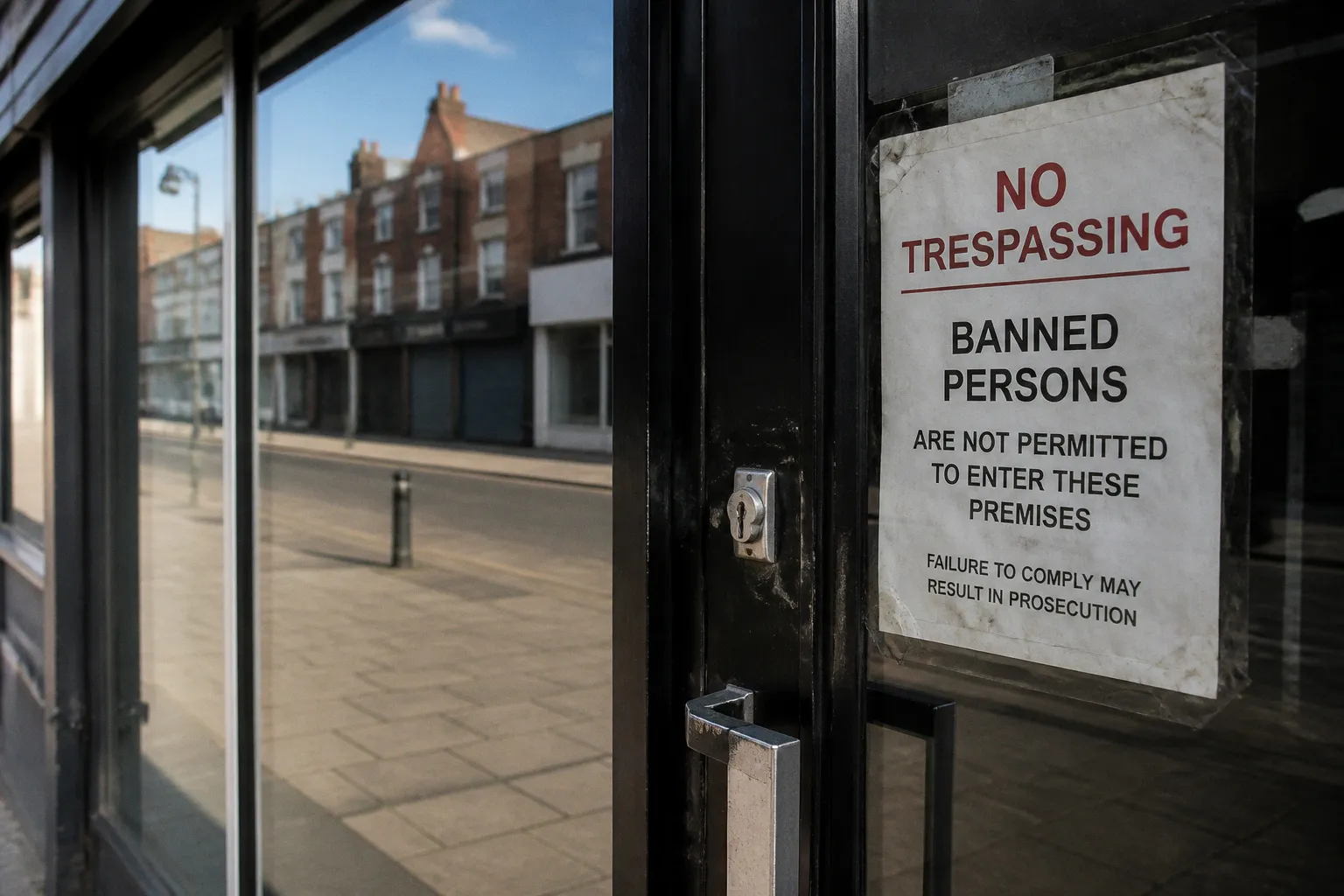
The manager spots them from behind the till, a short message goes out over the two-way radio, and within minutes an officer is on the beat outside the front door. That is not a hypothetical. That is the day-to-day pattern magistrates in North East Lincolnshire have been authorising through Criminal Behaviour Orders, and it is the mechanism that retailers, neighbourhood coordinators, and Humberside Police keep coming back to when they talk about getting retail crime under control.
The question residents keep putting to me at the watch meetings, though, is the straight one: do these bans actually deliver, or are we simply moving the same handful of individuals from one shop front to the next while the underlying drivers carry on regardless? It is a fair question, and it deserves straight answers rather than reassurance. So here is what is actually happening in Grimsby, what the new legislation changes, and where the gap still is.
How CBOs and PSPOs Actually Work on the Ground
The basic toolkit in Grimsby is not complicated, but it is worth walking through it because too often residents only hear about these things when something goes wrong, by which point the detail has already been muddled.
A Criminal Behaviour Order is a post-conviction order. It is handed down by magistrates after someone has been found guilty of an offence, and it imposes conditions designed to prevent further offending. In the retail cases that come out of our town centre, those conditions typically include a ban from named premises — B&M and Home Bargains are the two that surface most often in the local reports — alongside exclusion from broader town centre zones. Where addiction is part of the picture, magistrates in Grimsby have also been attaching mandatory treatment provisions to the orders. Breach a CBO and you are looking at a separate criminal charge, one that the courts do not treat lightly.
Then there are Public Spaces Protection Orders, or PSPOs. These are civil powers rather than criminal ones, and they are enforced across much of Grimsby town centre and the seafront. Officers can issue Fixed Penalty Notices on the spot for things like prohibited cycling, public alcohol consumption in restricted areas, and other anti-social behaviour that feeds into the wider retail crime picture. A PSPO breach is a quicker intervention — a fixed penalty rather than a court appearance — but it depends on officers being visibly present, and on a quiet weekday morning in parts of the town centre that is not always the case.
The distinction matters. A CBO is a hammer. A PSPO is a slap on the wrist. Both have their place, but neither replaces the other, and confusing the two is how expectations get mis-set.
A banning order is only as good as the officer on the other end of the radio when it gets breached.
Intelligence-Led Deterrence: GRIP, the Radios, and DISC
Tools on their own are not enough. The reason GRIP matters is that it is the glue holding the rest of the response together.
Grimsby Retailers In Partnership operates as the town centre's Business Crime Reduction Partnership, coordinating between independent shops, the chains, Humberside Police, and North East Lincolnshire Council. Its job is to make sure that when something happens on the high street, it does not disappear into a single store's incident book. Two pieces of funding did the heavy lifting. The first was £30,000 from the Police and Crime Commissioner's Community Safety Fund, which paid for two-way radios and the DISC information-sharing application for retailers in Grimsby town centre and Freeman Street. The second was a further £26,500 secured by GRIP, which extended the same kit out along Grimsby Road and St Peter's Avenue. That second grant is the one residents tend to miss, because it pulled in shops that were previously outside the loop and therefore outside the deterrent.
What that means on the beat is straightforward: an offender who has just been barred from one store cannot simply cross the road and start again in the next, because the next store already knows they are coming. That is what community intelligence looks like in practice — not glamorous, not high-tech, but effective because the deterrent stops being abstract. The shoplifter is no longer gambling on whether the store has bothered to report them; they are gambling on whether the radio is working.
It also makes the police's job easier. Officers on patrol in the town centre can be told, before they arrive, who they are looking for and where they have already been barred. That cuts response time and improves the chance of a clean enforcement.
What the Crime and Policing Bill Actually Changes
Retail crime is not only a Grimsby problem, and Westminster has finally started to legislate as if it takes the issue seriously. The Crime and Policing Bill — the UK Government factsheet for which was published on 5 June 2026 — contains two changes that retailers across North East Lincolnshire have been pushing for, and both deserve to be understood in plain terms rather than left as Whitehall jargon.
The first is a new standalone offence of assaulting a retail worker. At the moment, an assault on a shop worker is charged under the general criminal law, and sentencing depends on the injury sustained. The new offence would carry a maximum penalty of six months' imprisonment or an unlimited fine on summary conviction, and crucially, the courts would be presumed to impose a Criminal Behaviour Order on a first conviction. That presumption is the part that matters, because it strips out the discretion that has historically let some offenders walk away with a conditional discharge and a shrug.
The second change is the repeal of section 22A of the Magistrates' Courts Act 1980. That is the provision that allows low-value shop theft — anything under £200 — to be treated as a summary-only offence with a sentencing cap attached. Removing it means all shop theft, regardless of the value of the goods stolen, is treated as general theft under the Theft Act 1968, carrying a maximum custodial sentence of seven years.
Side by side, this is what shifts:
| Situation | Current position | Under the Crime and Policing Bill |
|---|---|---|
| Assaulting a retail worker | Charged under general assault offences; CBO at court's discretion | Standalone offence; CBO presumed on first conviction; up to six months / unlimited fine |
| Shoplifting under £200 | Summary-only under s.22A Magistrates' Courts Act 1980 | Treated as general theft under Theft Act 1968; up to seven years custodial |
| Repeat offender entering a banned store | Breach of CBO; treated as a separate offence | Unchanged, but pre-empted by the new assault offence where force is used |
For shop workers in Grimsby who have been shoved, spat at, or threatened over the price of a few pounds of goods, that is not an abstract legal tidy-up. That is a long-overdue signal that the law considers them worth protecting on the same footing as any other worker.
Beyond the Ban: Why Enforcement Alone Will Not Solve It
Here is the part the press releases tend to skip, and where the watch job gets uncomfortable.
The bulk of the repeat offenders who come before Grimsby magistrates on shoplifting charges are not career criminals. They are people in the grip of addiction — often opioids, often crack cocaine — who are stealing to fund the next hit. The local CBO pattern reflects that. Alongside the store exclusion conditions, magistrates routinely attach mandatory addiction treatment provisions. That is the right call, because sending someone back onto the street with a banning order and no support is simply a way of guaranteeing that the next breach is six weeks down the line.
You cannot ban your way out of a public health crisis. You can only enforce your way around the edges of one.
That is also why the multi-agency days of action matter. Operations like Op Mastery, reported to North East Lincolnshire Council at the end of May 2025, pull together police, council enforcement, health partners, and outreach workers, and they target the same handful of individuals with a combination of enforcement, treatment offers, and accommodation support. They are not glamorous. They do not generate the headlines a dawn raid does. But they are the closest thing we have to a serious attempt at breaking the cycle rather than just managing it.
The shops have had to adapt too. Not all theft is opportunistic. Some of it is organised, with individuals working a circuit of stores and offloading goods quickly for cash. PSPO enforcement and DISC intelligence have made that harder, but the trade has not disappeared. It has simply drifted towards stores that are not yet on the radio, which is why the GRIP extension along Grimsby Road and St Peter's Avenue was so important — it pulled the less-connected shops into the network before they became the obvious next target.
Measuring Success: The Honest Gap in the Data
This is the part where I have to give residents the answer that officials often dodge.
We do not have reliable long-term re-offending data for offenders issued with CBOs in Grimsby compared with those dealt with under ordinary shoplifting procedures. That comparison is the single most important question we could ask, and the data is not in the public domain. We also do not have an authoritative count of how many active civil shop banning orders are currently being enforced across independent retailers in North East Lincolnshire. The chains tend to know their own figures, but the picture across the sector is patchy at best.
What we do have is the visible presence of fewer repeat offenders in stores signed up to GRIP, fewer reports of the same faces turning up shift after shift, and a stronger appetite from magistrates to use the full range of conditions available to them. That is meaningful, but it is anecdotal, and we should be honest about that.
The honest summary is this. Shop banning orders work best when three things happen at once: the order is in place, the police have the intelligence to enforce it, and the offender has access to treatment for the underlying problem. Remove any one of those three and the system starts leaking. Retailers, the council, and the police have spent the last few years building the first two. The third — treatment capacity, particularly for the substance misuse cases that sit behind most of these CBOs — is the one that still lags, and it is the one residents should be pushing hardest on.
What Residents Can Actually Do
None of this is theoretical, and none of it works without community intelligence on the ground.
If you run a shop, or work in one, and you are not yet part of the GRIP network, look into it. If you see the same individuals cycling through the same stores day after day, report it. The DISC system only works if the information goes in, and the information only goes in if shop staff actually use it. If you have been the victim of retail crime or have witnessed it, report it to Humberside Police — every report builds the picture that justifies the next CBO application and the next round of funding.
And if you are a resident who has noticed the visible presence thinning out in parts of the town centre, say so. The Police and Crime Commissioner, the local force, and the council all claim to listen. Let us hold them to that, because the alternative is the slow drift back to the days when shoplifting was treated as a cost of doing business and the staff paid the price.