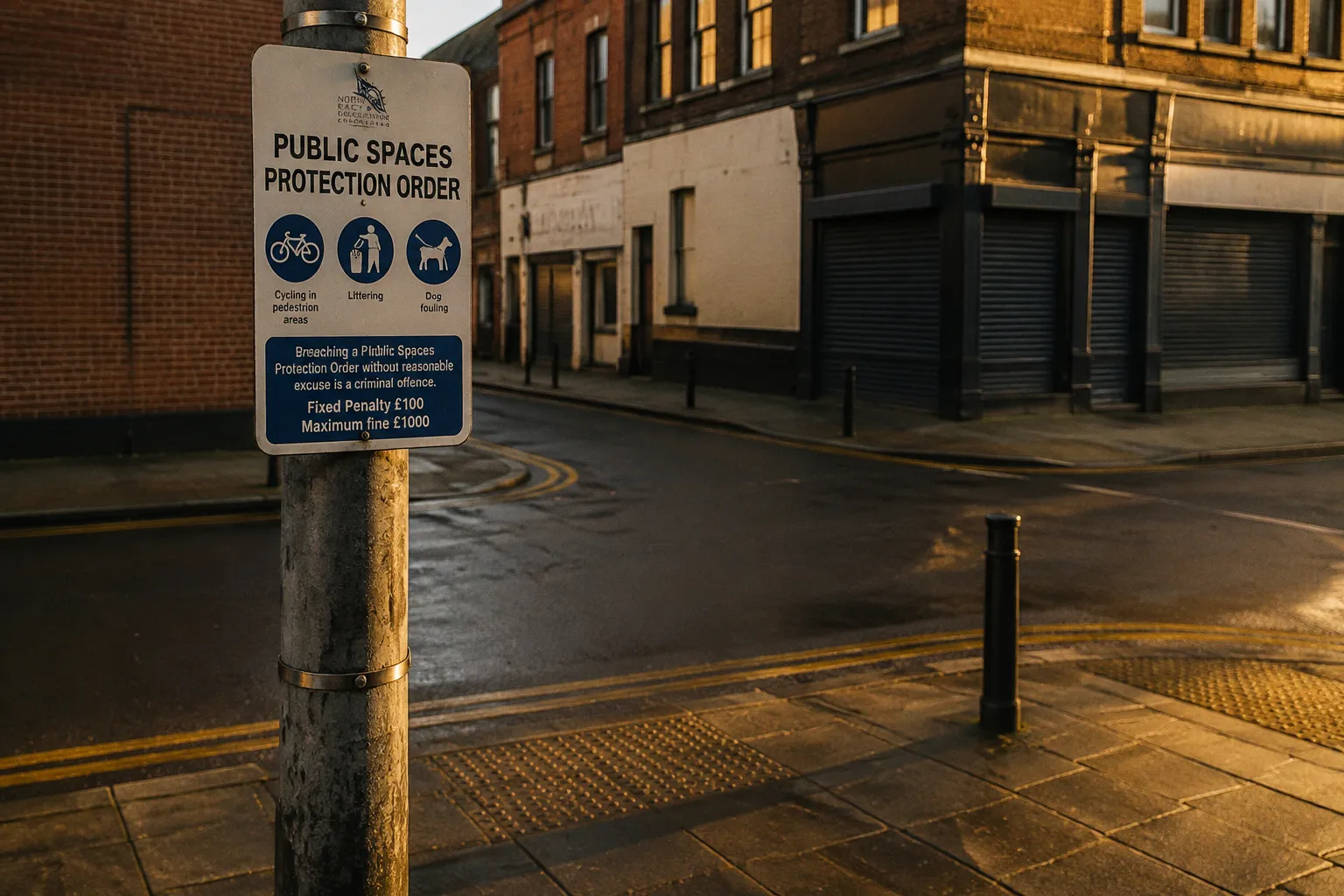
Those examples describe how the system is intended to work; they are not accounts of specific incidents. The important question is whether that routine enforcement is making a measurable difference.
Between 2023 and 2025, Grimsby town centre recorded a 51% reduction in alcohol-related anti-social behaviour, a 14% drop in overall ASB, and a 23% fall in violence causing injury. Bicycle theft fell by more than 45%, while overall crime declined by 5%.
Those numbers deserve a closer look. Not because they are headline-grabbing — they are not — but because they show what can happen when a legal tool, consistent enforcement and multi-agency coordination are applied to a defined area. They also show the limits of what the data can prove. A Public Spaces Protection Order is part of the mechanism, not the whole explanation.
This is the practical picture of grimsby town centre pspo enforcement: how the framework developed, what the available evidence actually measures, who is responsible for enforcement, and what could change if dispersal powers are extended into borough parks.
How Grimsby's PSPO Framework Took Shape
The foundation was laid in July 2019, when North East Lincolnshire Council introduced nine PSPOs across the borough under powers granted by the Anti-Social Behaviour, Crime and Policing Act 2014.
A PSPO allows a local authority to impose specific conditions on the use of a defined public space. The conditions can address conduct that has a persistent or continuing detrimental effect on the quality of life of people in the area. The order must describe the restricted behaviour and the geographical area covered. It is not a general power to prohibit anything that an officer finds irritating or inconvenient.
That distinction matters. The legal force comes from the wording of the order and the boundaries shown in it. A person can breach a condition only where the relevant restriction applies and where the statutory requirements are met. A reasonable excuse may also be relevant to whether an offence has occurred.
In practical terms, the Grimsby public spaces protection order rules turn broad concerns about disorder into specific, enforceable conditions. Depending on the order and location, those conditions can cover matters such as drinking alcohol in a controlled area, cycling in pedestrian zones, littering or dog fouling. The value of that specificity is operational: an officer does not have to rely solely on a general judgement that conduct looks antisocial when a clearly drafted condition applies.
But the order itself is only the framework. A sign stating that a restriction exists will not change behaviour if people believe no one is monitoring it and no consequence will follow a breach.
A PSPO without consistent enforcement is just signage. The order is the framework; daily presence is what gives it practical force.
From a police-led model to a shared operation
Since 2019, enforcement in Grimsby town centre has developed beyond a primarily police-led model. Visible council patrols, Humberside Police officers and WISE enforcement staff now occupy different positions within a broader operational structure.
The division is not absolute, but the basic responsibilities are distinct:
- Humberside Police deal with criminal enforcement and incidents requiring police powers.
- WISE enforcement staff, working on behalf of North East Lincolnshire Council, address specified environmental and behavioural breaches within their remit.
- Council staff and town centre marshalls contribute observation, reassurance, liaison and information about emerging problems.
- Business networks, including the DISC crime-reporting platform, provide another route for sharing intelligence about incidents affecting the town centre.
This is the key change in the enforcement model. The question is no longer simply whether a police officer is available to respond to an incident. It is whether several organisations are seeing the same pattern, sharing information and directing the appropriate resource towards it.
The shift became more formal in April 2024 with the launch of Operation Mastery under Safer Streets 5. The operation brought Humberside Police, North East Lincolnshire Council and local business networks together under a coordinated plan focused on town centre disorder and retail crime.
That does not mean the PSPO suddenly acquired new legal powers in April 2024. It means the existing enforcement tools were placed within a clearer operational arrangement. Before that point, the different parts of the response could still be effective, but they were more vulnerable to fragmentation. Operation Mastery was intended to align them around the same priorities.
The Numbers Behind the Decline
Raw data does not tell you everything, but it tells you where to look. The available figures for Grimsby town centre between 2023 and 2025 are as follows:
| Measure | Change between 2023 and 2025 |
|---|---|
| Overall crime | Down 5% |
| Anti-social behaviour, all types | Down 14% |
| Alcohol-related ASB | Down 51% |
| Violence causing injury | Down 23% |
| Bicycle theft | Down by more than 45% |
The figures are strongest when read as a pattern rather than as isolated proof of a single intervention.
Alcohol-related ASB
The 51% reduction in alcohol-related ASB is the clearest connection to the PSPO framework. Restrictions on street drinking and alcohol consumption in controlled public spaces address precisely the type of conduct captured by that category.
The order gives enforcement staff a defined threshold. If the relevant condition applies and the required circumstances are present, the issue is more concrete than a general argument about whether someone appears troublesome. That can make early intervention easier. Officers can explain the restriction, require compliance where the law allows it, and use an FPN or another response where a breach is established.
However, the figure does not demonstrate that PSPO enforcement alone caused the reduction. A fall in alcohol-related ASB may also reflect more visible patrols, changes in footfall, policing activity, partnership work, support referrals, changes in reporting behaviour or other local factors. The PSPO is best understood as one part of the control system.
Violence causing injury
A 23% reduction in violence causing injury is significant because it concerns more serious harm than low-level environmental breaches. It also shows why a town centre safety strategy cannot be reduced to the question of whether an FPN was issued.
PSPO enforcement can provide an early point of contact, but it is not a substitute for investigating violence, protecting victims or managing an escalating incident. Those responsibilities remain with the police and the wider criminal justice system. The reduction therefore sits within the broader effect of patrols, intelligence sharing, business reporting, targeted operations and interventions that may prevent disputes from becoming more serious.
Bicycle theft and overall crime
The fall of more than 45% in bicycle theft is notable because bicycle theft is not the same behaviour as the conduct directly regulated by the town centre PSPO conditions described in the enforcement model.
The most cautious interpretation is that a stronger visible presence may have wider deterrent effects. Officers, council patrols, marshalls and other staff create more observation in a defined area. That can make opportunistic offending more difficult, even when the conduct being prevented is not the specific subject of a PSPO condition.
But again, the number should not be turned into a simple causal claim. A reduction in bicycle theft could involve changes in security practices, reporting, target availability, policing or other local circumstances. It is evidence of a broader improvement in the measured environment, not proof that a PSPO directly prevents bicycle theft.
The 5% decline in overall crime is less dramatic, but it provides useful context. Large percentage reductions in a few categories can look impressive while overall harm remains unchanged if offending moves elsewhere. The town centre figures indicate a modest reduction across crime as a whole rather than a clear rise offsetting the targeted improvements.
The Operational Layers: Who Does What
Public confusion about PSPOs often comes from treating every person in a uniform as having the same authority. They do not. The legal power available to an officer depends on the organisation, the wording of the order, the nature of the conduct and the circumstances of the incident.
Humberside Police
Police officers retain their normal criminal enforcement powers. Where a PSPO breach is established, they may issue an FPN where the law and local arrangements permit it. If an incident escalates, police can use other powers appropriate to the circumstances, including arrest or dispersal powers where the statutory conditions are met.
A PSPO can make an initial engagement more straightforward, but it does not turn every breach into an arrestable matter. Nor does it remove the need for officers to act proportionately. The response should reflect the behaviour, the evidence available and any relevant vulnerability or safeguarding concern.
WISE enforcement staff
WISE enforcement contractors operate on behalf of North East Lincolnshire Council and handle the environmental and behavioural layer within their authority. In the Grimsby town centre model, that includes matters such as cycling in pedestrian areas, littering and dog fouling.
Their role is important because police resources are limited. Lower-risk, higher-volume breaches can be addressed by an enforcement service that is present in the area without requiring a police officer to deal with every incident. That leaves police better placed to respond to violence, threats, theft, safeguarding concerns and other matters requiring police powers.
This division does not make WISE staff a replacement for the police. It makes the system more specialised. The effectiveness of the arrangement depends on staff understanding the limits of their authority and passing matters to police when the circumstances go beyond their remit.
Council staff and town centre marshalls
Council staff and town centre marshalls provide the observational and liaison layer. Their value is not limited to issuing or witnessing enforcement action. They can notice changes in a location, identify recurring patterns, reassure visitors and businesses, and pass information to the agencies responsible for a formal response.
That information flow is where the three-tier structure either works or fails. A report of repeated disorder may be more useful when combined with police intelligence, business reports and observations from staff working nearby. The objective is not to create more records for their own sake. It is to identify where a problem is developing and direct the right response before it becomes entrenched.
The role of business networks
Retailers and other town centre businesses often see incidents before they become visible in official statistics. A reporting platform such as DISC can help share information about theft, disorder and linked activity across businesses.
That intelligence is not automatically proof of a criminal offence, and it should not be treated as a substitute for evidence. Its value is earlier visibility. If several businesses report related problems, agencies have a better basis for considering patrol patterns, communication and targeted action.
The strongest part of the model is not any single uniform or notice. It is the information moving between people who see different parts of the same town centre.
Fixed Penalty Notices: The Mechanism and Its Limits
The financial deterrent is straightforward but limited. A person who breaches a PSPO condition without reasonable excuse may face a Fixed Penalty Notice of £100. If the notice is not paid, the matter may proceed, and a court conviction can carry a maximum fine of up to £1,000.
The FPN is designed to resolve a lower-level breach without requiring every case to go through a full court process. Payment discharges criminal liability for the offence to which the notice relates. In that sense, it is an immediate compliance mechanism rather than a conventional sentence imposed after prosecution.
That does not mean an FPN is informal or consequence-free. The recipient should understand what conduct is alleged, which condition applies and what the payment deadline is. A person who believes the notice was wrongly issued should use the available process rather than assume that ignoring it will make the matter disappear.
The most important practical limits are these:
- A condition must apply to the place and conduct in question. PSPOs are geographically defined. A restriction in one area cannot automatically be assumed to apply across the borough.
- The breach must be properly established. The presence of a sign or the existence of an order does not remove the need for an enforcement decision based on the facts.
- Reasonable excuse can matter. The legislation does not treat every departure from a condition as identical, and circumstances may affect the legal assessment.
- An FPN is not the response to every incident. Serious violence, threats, safeguarding concerns and suspected criminal offences may require a police response.
- Payment and challenge are different routes. Paying resolves the FPN in the manner provided by the scheme; disputing it requires following the relevant procedure and meeting any applicable requirements.
The available public information does not provide a recent Grimsby town centre breakdown showing how many FPNs were issued by WISE compared with Humberside Police. Nor does it publish a town-centre collection rate for those notices. Both measures would help distinguish activity from outcome.
A high number of notices could indicate active enforcement, but it could also reflect a concentration of breaches in a particular period. A low number could mean that behaviour has improved, that officers are using warnings or other interventions, or that enforcement activity is limited. Without the surrounding context, the number alone is difficult to interpret.
The same applies to collection rates. If notices are issued but rarely paid, their revenue contribution may be limited. That would not necessarily mean they have no deterrent value, but it would raise questions about follow-up, affordability, compliance and the most effective use of enforcement resources.
An FPN is meant to make the consequence of ignoring a public-space condition immediate. Its value is not measured by the notice alone, but by what happens to behaviour afterwards.
What the Evidence Can and Cannot Prove
The reduction in alcohol-related ASB is consistent with a PSPO doing useful work. The reduction in violence, bicycle theft and overall crime is consistent with a wider improvement in town centre conditions. None of those findings, taken alone, can isolate the effect of the PSPO.
That distinction is not academic. Public safety programmes often combine several measures at the same time. In Grimsby, the relevant package includes:
- the legal conditions created by PSPOs;
- visible patrols and enforcement;
- Humberside Police activity;
- council staff and town centre marshalls;
- Operation Mastery;
- Safer Streets 5;
- intelligence sharing through business networks such as DISC;
- substance misuse referrals and homelessness outreach;
- diversion and support services for people willing to engage.
If all of those elements operate together, trying to assign the full reduction to one order produces a misleading result. The PSPO creates a legal route for intervention. Operation Mastery provides a coordinated plan. Patrols make the response visible. Business reporting adds information. Support services address some of the circumstances that bring people into repeated contact with enforcement.
The evidence also needs to be read carefully because recorded crime and ASB are not a perfect measure of lived experience. Reporting patterns can change. A more visible enforcement presence may increase reporting in one period and reduce it in another. Residents and businesses may experience improvement before the statistical picture catches up, or continue to feel unsafe even when recorded incidents decline.
That does not make the figures useless. It means they should be combined with operational information, resident feedback and transparent reporting about enforcement activity. A credible assessment needs to ask not only whether incidents fell, but where they fell, whether problems moved elsewhere and whether the response was proportionate.
What's Coming: Borough-Wide Dispersal and Park Coverage
The current enforcement perimeter is concentrated on defined zones, particularly the town centre and other high-footfall areas. The scope is now under review.
As of mid-2026, work is underway on a potential borough-wide PSPO covering parks. The proposed approach would give police the power to issue 24-hour dispersal directions within park spaces, extending the enforcement conversation from commercial areas into recreational ones. It has not yet been enacted and remains at the scrutiny and development stage.
The operational logic is understandable. Anti-social behaviour does not stop at a town-centre boundary. If enforcement changes the conditions in one place without addressing connected spaces, activity may move to a nearby park or another less visible location. A broader order could close part of that gap.
But expansion also changes the character of the enforcement challenge. A compact town centre is easier to patrol consistently than a borough-wide network of parks. A wider order therefore creates a risk of promising more coverage than available staff and police resources can deliver.
Several issues will need careful treatment.
Scale of patrol coverage
Town centre enforcement benefits from concentrated footfall, established patrol routes and relatively short distances between agencies and businesses. A park-based order would cover a much larger and more varied geography.
If patrol capacity does not increase with the area covered, the order may be visible on paper but inconsistent in practice. That undermines public understanding and can produce complaints about arbitrary enforcement. A PSPO should not be judged only by how wide its boundary is. The relevant question is whether the restriction can be explained, monitored and enforced fairly.
Proportionality and discretion
Parks are shared spaces. Families, dog walkers, teenagers, sports groups and vulnerable people may all be present at the same time. A power aimed at disorder must distinguish between harmful conduct and ordinary use of public space.
Dispersal powers are particularly sensitive because they can move people without necessarily resolving the underlying problem. Officers need clear guidance about when a direction is justified, how long it lasts, what information must be given and how vulnerable people should be treated.
Displacement and support
Removing someone from one location does not necessarily reduce harm. It can move the behaviour to a less visible place, or move a vulnerable person away from services and familiar support.
The proposed park approach will therefore need to connect enforcement with homelessness outreach, substance misuse support and other services. That is not an optional extra. If the town centre model depends partly on diversion and support, extending the geographical perimeter without extending those links would create an incomplete system.
Public communication
People cannot comply with a restriction they do not understand. Any new order would need clear information about the area covered, the prohibited conduct, the circumstances in which enforcement may occur and the consequences of non-compliance.
The distinction between a PSPO condition and a dispersal direction should also be made clear. They are related tools, but they are not interchangeable. Residents should not have to infer the legal position from informal warnings or social media posts.
Assessing the System as a Whole
Grimsby's PSPO enforcement model has produced measurable reductions in several crime and ASB categories over the 2023–2025 period. The strongest movement is in alcohol-related ASB, which fell by 51%. Violence causing injury fell by 23%, overall ASB by 14%, bicycle theft by more than 45% and overall crime by 5%.
That is a meaningful result, but it is not a clean laboratory test of the PSPO. The available figures show what happened while a package of enforcement, policing, partnership and support measures was operating. They do not show precisely how much of the change came from the order itself.
The model's strengths are visible:
- responsibilities are divided between organisations with different capabilities;
- the town centre has a defined operational focus;
- WISE can address specified lower-level environmental and behavioural breaches;
- police remain available for serious or escalating incidents;
- business reporting improves the flow of local intelligence;
- Operation Mastery provides a coordinated structure rather than a set of disconnected interventions;
- support services offer a route beyond repeated enforcement for people willing to engage.
Its weaknesses are also clear. Public reporting does not yet provide a detailed breakdown of FPN issuance and collection. The contribution of the PSPO cannot be separated from the wider Operation Mastery framework. And the proposed extension into parks creates a difficult balance between coverage, proportionality and available resources.
For residents, businesses and anyone concerned with how North East Lincolnshire manages public space, the practical conclusion is measured rather than dramatic: the system appears to be working because several parts are operating together. The legal framework gives officers a defined basis for intervention. Visible presence makes that framework credible. Intelligence sharing helps identify patterns. Support services offer a chance to reduce repeat contact with enforcement.
Remove one of those components and the system becomes weaker. Expand the perimeter without maintaining consistency and the same problem appears in a different form.
The evidence from 2023 to 2025 supports continued, coordinated enforcement in Grimsby town centre. It does not justify treating every reduction as proof that a PSPO alone caused the improvement, nor does it remove the need for scrutiny as dispersal powers move towards the borough's parks. The next test is whether North East Lincolnshire can preserve the clarity, proportionality and multi-agency discipline of the town centre model while managing a much larger public-space footprint.