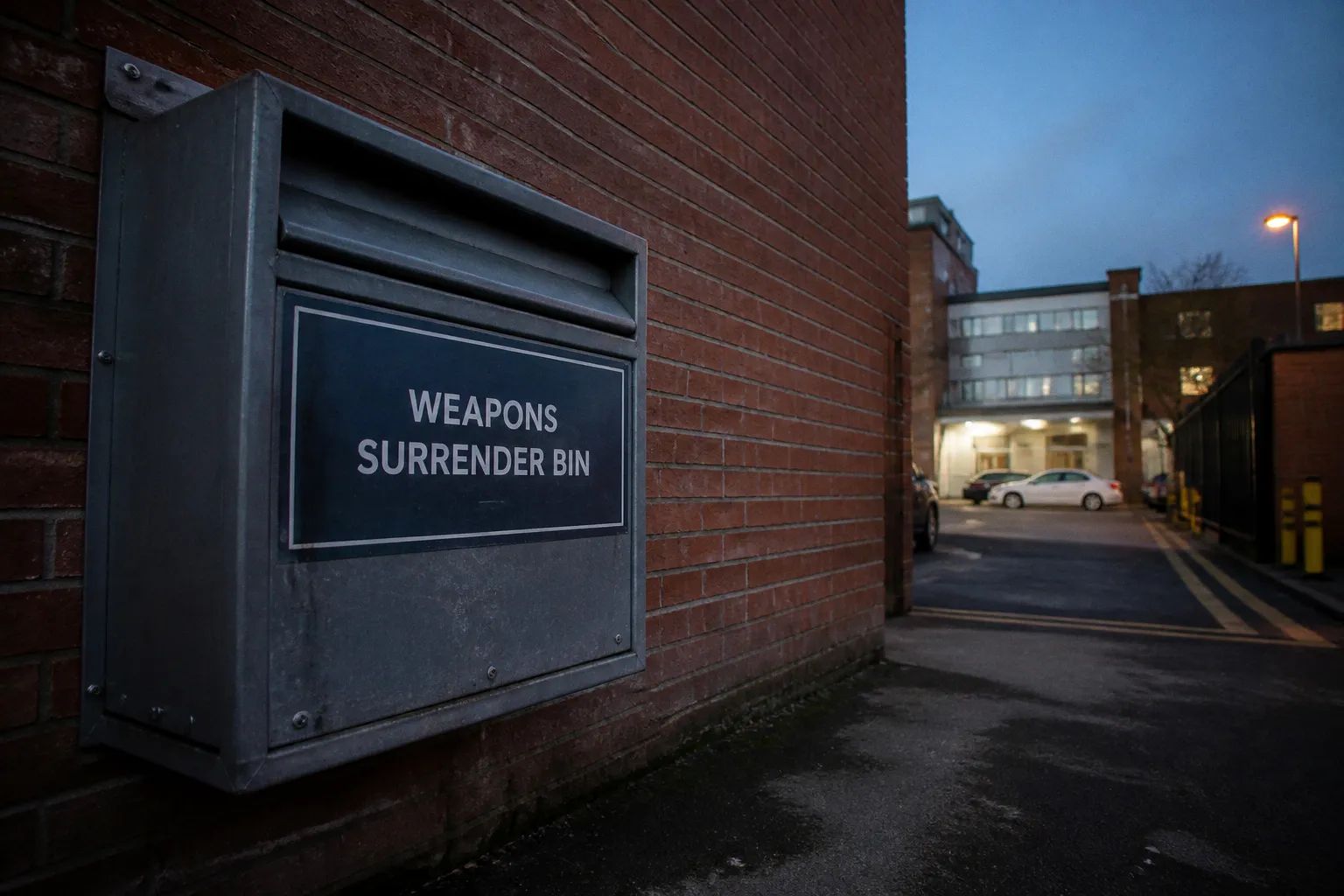
A voluntary knife surrender in Grimsby can remove an unwanted weapon from circulation, but only if the handover is carried out without creating a separate offence on the journey.
Humberside Police use Operation Sceptre and similar national campaigns to provide designated amnesty bins at selected police stations. Grimsby Victoria Police Station on Victoria Street, DN31 1PE, has been used as one of those locations. The arrangement is campaign-based rather than a guarantee of a permanent, year-round drop-off service.
The practical rule is straightforward: do not carry a blade openly to a police station. Wrap it securely, place it inside a sealed bag or box, and follow the current instructions for the amnesty location.
A knife amnesty reduces risk only when the disposal process itself is lawful, controlled and proportionate.
How voluntary knife surrender works in Grimsby
Operation Sceptre is a national programme focused on reducing knife crime through enforcement, prevention, education and weapon surrender schemes. During designated weeks of action, police forces deploy amnesty bins at participating stations and other authorised locations.
The purpose is not to investigate every person who hands in an unwanted knife. During the relevant Humberside Police amnesties, people have been able to place knives and offensive weapons into designated bins anonymously, without completing forms or answering questions. That does not turn every type of possession or transport into lawful conduct. It simply provides a controlled route for removing weapons from circulation.
The local metric that demonstrates the scale of these campaigns is the number of items surrendered. During a nationwide Operation Sceptre week in November 2025, Humberside Police recovered 263 knives from surrender bins across ten police stations in the force area. The figure is not a measure of all knife possession in the borough, nor does it establish a long-term trend by itself. It does show that amnesty bins can produce a measurable volume of weapons that would otherwise remain in homes, vehicles, workplaces or public spaces.
For residents in Grimsby, the first operational question is whether a surrender bin is active at the intended police station. Amnesty schemes run during specified periods. A location used during one campaign should not be treated as a permanent disposal facility outside that campaign.
Before travelling, check the current Humberside Police or Operation Sceptre instructions for:
- Whether an amnesty is active and which locations are participating.
- Whether the item is accepted under the particular scheme.
- Whether the station is taking handovers at the time you intend to attend.
- Whether special arrangements apply to unusually large, damaged or heavily contaminated items.
- Whether any compensation is available, which depends on the specific national scheme rather than ordinary voluntary surrender.
The last point is routinely misunderstood. Standard knife surrender is not generally a paid service. Financial compensation has applied to particular government buyback arrangements, such as the 2024 zombie knife surrender scheme, but that does not mean that every knife placed in an amnesty bin attracts payment.
Safe knife disposal in Grimsby starts before the journey
The most consequential part of the process may occur before the knife leaves the property. A blade can become a legal and safety problem during transport if it is carried in a way that exposes the public to risk.
UK government guidance for weapon surrender schemes requires bladed items to be securely wrapped and placed in a sealed bag or box. They must not be carried openly in public. Carrying a bladed article in a public place without good reason or lawful authority is a criminal offence under UK law.
That creates a practical distinction between possession at home and movement through the street. A person may decide to surrender an unwanted knife, but the decision to surrender it does not itself provide a licence to walk around with an exposed blade.
A controlled transport method should follow this sequence:
1. Do not handle the item unnecessarily. If the knife is loose, unstable, rusted or damaged, avoid testing, cleaning or dismantling it. The objective is controlled containment, not restoration.
2. Wrap the blade securely. Use suitable protective material so that the cutting edge and point cannot break through the packaging. The wrapping must remain stable during normal movement.
3. Seal the package inside a bag or box. The item should not be visible or accessible while being transported. The outer container should be closed securely rather than held together by a loose covering.
4. Take the most direct practical route. Avoid unnecessary stops, public events and situations where the package could be opened, dropped or accessed by another person.
5. Do not carry the knife openly at the station. Follow the instructions given for the designated amnesty bin. If the arrangement is unclear, ask police staff for directions rather than opening the package in a public area.
6. Do not place an item into an ordinary public bin. A household or street waste container is not designed for offensive weapons and may expose refuse workers, members of the public or emergency responders to injury.
The packaging requirement is not administrative detail. It is a control measure covering the highest-risk part of the process: the transition from private storage to an authorised disposal point.
Transport method and risk profile
| Method | Assessment | Reason |
|---|---|---|
| Exposed knife carried by hand | Unacceptable | It may constitute unlawful carrying in public and creates an immediate injury risk. |
| Knife wrapped but not sealed | Poor control | The blade may become accessible or visible during transport. |
| Knife securely wrapped and sealed in a bag or box | Appropriate route for an amnesty | This follows the stated safety protocol for transporting surrendered bladed items. |
| Knife placed in a household or street bin | Inappropriate | The container is not a controlled weapon-disposal route and can endanger waste handlers. |
| Knife taken to a police station outside an active scheme without checking arrangements | Uncertain | Amnesty bins and campaign procedures may not operate continuously. |
The table does not replace the instructions for a specific campaign. It identifies the underlying risk controls: containment, concealment, direct transport and authorised handover.
Which items can create a legal problem?
The phrase “unwanted knife” covers several different categories. A standard kitchen knife, a modified blade and a prohibited weapon are not treated as identical under the law. The item’s design and intended use can affect the legal position.
Since legislation that came into effect on 14 July 2021, private possession of certain prohibited offensive weapons has been illegal even inside a private dwelling. Examples include knuckle dusters, zombie knives and throwing stars. Keeping such an item in a bedroom, garage or storage box does not make possession lawful simply because it is not being carried in public.
This is why a surrender scheme should not be treated as a general amnesty from all criminal liability. The term describes the disposal arrangement, not a universal immunity covering possession, acquisition, manufacture, sale or transport of every weapon.
A person who discovers a potentially prohibited item should avoid moving it around the property or taking it to a police station without first obtaining current instructions. The correct operational response may depend on the item’s condition, location and immediate risk. If there is an urgent danger—for example, a weapon is accessible to a child, involved in a threat, or connected to an active incident—the appropriate response is emergency contact with police rather than an unplanned journey to a surrender bin.
For less urgent cases, the safer approach is to obtain guidance before moving the item. Do not attempt to establish its legal category by carrying it to a public counter. Do not photograph or display it in public merely to seek informal opinions. Evidence of the object’s design may be useful when contacting the relevant authority, but the item itself should remain contained.
The difference between an amnesty and ordinary disposal
A police knife amnesty is a targeted crime-prevention intervention. It exists to increase the rate at which weapons are removed from circulation during a defined period. It is not the same as routine waste disposal, and it does not answer every question about old household cutlery or tools.
This distinction matters in North East Lincolnshire because residents may have several different disposal situations:
- A household knife that is simply no longer wanted.
- A blade discovered in a loft, shed, vehicle or inherited property.
- A knife that may have been modified or designed as an offensive weapon.
- A weapon found in a public place.
- An item linked to threats, violence or suspected criminal activity.
- A blade that is damaged, contaminated or unsafe to handle.
The risk profile changes in each case. A dull kitchen knife stored safely at home is not the same operational problem as a weapon found in a park. Nor is either situation equivalent to an item prohibited by design.
Where a police amnesty is active, its published instructions should govern the handover. Where no amnesty is active, residents should not assume that the same police-station bin remains available. The available research does not establish a permanent 24-hour surrender facility at Grimsby Victoria Police Station outside campaign periods. It also does not establish a single council recycling-centre procedure for all standard knives in North East Lincolnshire.
That uncertainty is a reason to verify the route, not to improvise one.
What happens after a knife is surrendered?
The immediate public-safety benefit is removal. Once a knife enters a designated amnesty bin, it is no longer available for casual possession, intimidation or impulsive use in the community. Police then manage collection and processing through the campaign’s operational arrangements.
The surrender data also has a policy function. Recoveries indicate the level of latent weapon ownership that can be reached by a short, low-friction disposal scheme. They do not, on their own, prove that knife crime has fallen. That conclusion would require a wider set of metrics, including recorded offences, injury severity, repeat locations, age profiles, hospital data and enforcement activity over time.
The 263 knives recovered across ten Humberside Police stations in November 2025 therefore represent an input measure: weapons removed through the intervention. The figure should not be presented as a reduction in crime incidence. It is better understood as evidence of participation and disposal capacity.
This distinction is central to rational resource allocation. Amnesty bins are relatively visible and straightforward to measure. Their effect is more difficult to isolate. A preventative framework based only on surrender totals risks mistaking activity for outcome.
A broader knife-crime strategy requires parallel work:
- Youth diversionary activity that reduces the likelihood of weapon carrying becoming normalised.
- Education on the legal and physical consequences of carrying a blade.
- Targeted work around retail crime, transport routes and repeat anti-social behaviour locations.
- Substance-abuse support services where intoxication and disinhibition contribute to violence.
- Domestic abuse interventions where weapon access increases the severity of household incidents.
- Intelligence-led enforcement against those who supply, threaten with or repeatedly carry weapons.
The amnesty is one component in that system. It is not a substitute for prevention, safeguarding or enforcement.
The surrender total is an activity metric. The public-safety outcome must be measured separately.
Compensation, special schemes and common errors
Some national surrender schemes have included compensation, but eligibility has been limited to specified weapon categories and defined dates. During the August–September 2024 zombie knife surrender scheme, the standard compensation rate was £10 per knife, with a minimum threshold of three knives and a £30 value threshold for a claim. Those terms applied to that specific scheme.
They should not be generalised to current or ordinary voluntary surrender. Unless a live scheme expressly provides compensation, residents should assume that surrender is unpaid.
Several avoidable errors recur in public guidance and informal discussions:
1. Treating every police station as a drop-off point. A force-wide campaign may involve selected stations, not every station. The Grimsby location must be confirmed for the relevant period.
2. Carrying the weapon visibly because the destination is a police station. The destination does not remove the public-carrying offence or the safety risk during transit.
3. Assuming an amnesty means immunity. Surrender arrangements facilitate disposal. They do not rewrite the law governing prohibited weapons or offences connected with violence.
4. Expecting payment for any knife. Compensation is scheme-specific and may not apply to ordinary kitchen knives or routine amnesty bins.
5. Moving a suspicious weapon unnecessarily. An item found in circumstances suggesting a crime may require police direction rather than self-transport.
6. Using an ordinary waste route without checking the rules. A council recycling centre may have its own restrictions and handling procedures. Those rules should be confirmed directly rather than inferred from a police amnesty.
The correct process is deliberately unglamorous: establish whether the scheme is active, contain the item, transport it lawfully, and use the designated facility. That is the full preventative logic.
A proportionate public-safety measure
The case for knife amnesties is strongest where they lower the practical barrier to safe disposal. A person who no longer wants a weapon should have a clear route to remove it without placing the public, police staff or waste workers at unnecessary risk. Designated bins and anonymous handovers can provide that route.
The limits are equally clear. Amnesty schemes cannot measure every weapon retained in the community, cannot explain every change in knife-crime incidence, and cannot replace targeted prevention. Their value depends on campaign visibility, location coverage, lawful transport instructions and reliable collection arrangements.
For Grimsby and the wider North East Lincolnshire area, the sensible position is therefore neither alarmist nor dismissive. A knife surrender bin is a practical intervention with a defined purpose. Used correctly, it removes weapons from circulation and produces useful participation data. Used casually, it can create a transport offence or expose other people to harm.
Future campaigns are likely to remain part of the wider Operation Sceptre framework, but their local effect will depend on continuity: whether residents know when bins are available, whether instructions are accessible, and whether surrender activity is linked to longer-term prevention work. The relevant question is not simply how many knives are collected. It is whether the intervention forms part of a coherent reduction in weapon carrying, repeat violence and avoidable injury across the borough.