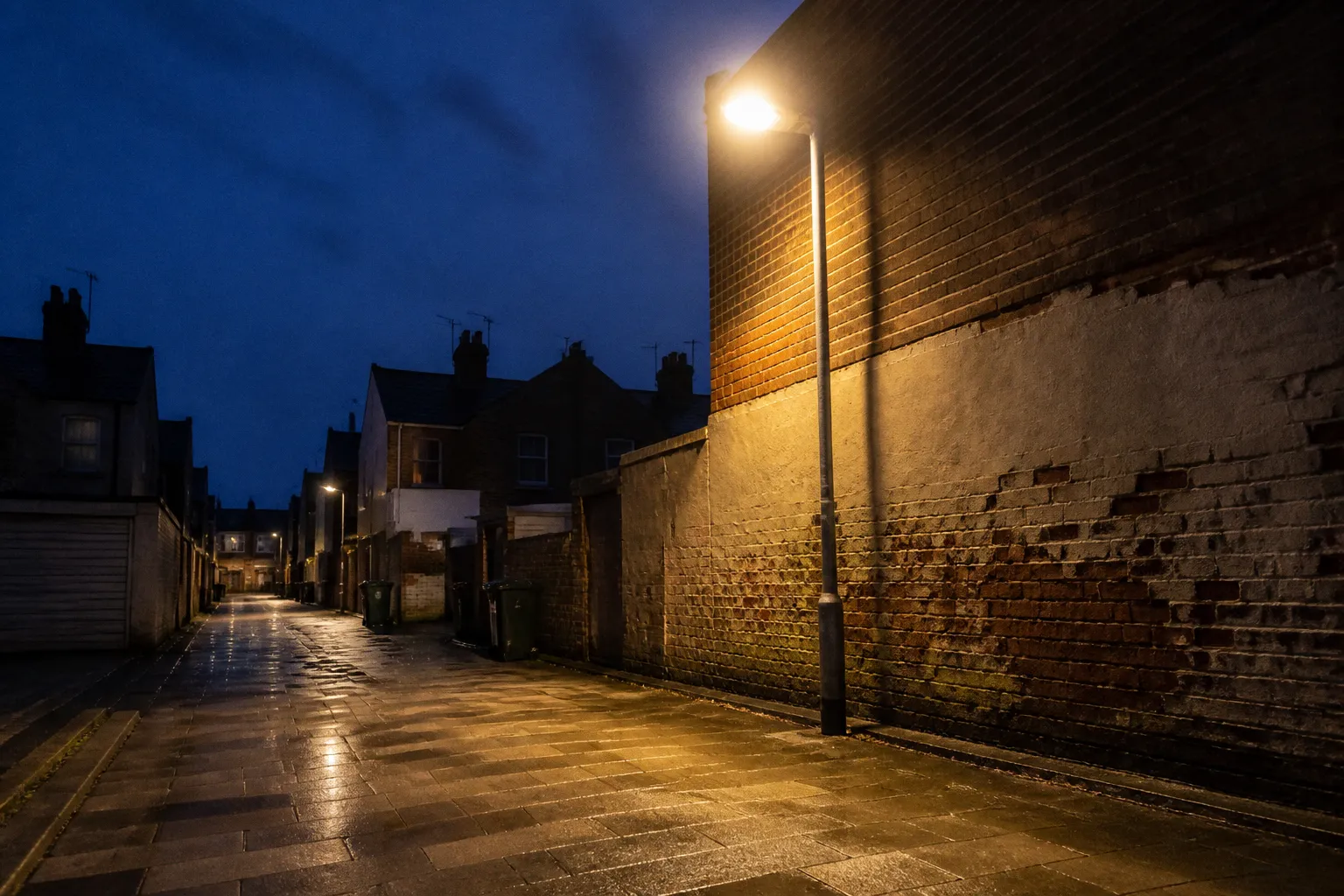
The physical arrangement matters: where the light falls, what it leaves in shadow, whether residents can see an approach, whether CCTV can identify movement, and whether an offender has a concealed route away from the property.
That is the practical lesson from the latest East Marsh safety data. The Safer Streets Round 4 programme produced a reported 23% reduction in crime and a 27% reduction in anti-social behaviour after a package of measures that included street lighting improvements, new CCTV, alley gating and home security upgrades. The figures are significant. They also need to be read accurately: the data describes a combined intervention, not a lighting project operating in isolation.
The £749,500 East Marsh intervention was never just about lamps
The East Marsh programme was awarded £749,500 through the Home Office Safer Streets Round 4 fund. Delivery involved North East Lincolnshire Council and the Office of the Police and Crime Commissioner for Humberside, with local organisations supporting the practical work in homes and public spaces.
The project began rolling out in late 2022. By October 2023, the reported impact was:
- Crime down by 23% in East Marsh.
- Anti-social behaviour down by 27%.
- Approximately 500 pieces of home target-hardening equipment distributed and installed.
- New CCTV cameras introduced as part of the wider public-space security response.
- Alley gating and street lighting improvements added to the physical security measures.
This is a target-hardening model. It does not rely on one deterrent. It makes access more difficult, increases the chance of detection, reduces concealment and gives residents better control over vulnerable entry points.
From the ground, that is how I would assess the scheme. I would not begin by asking whether a lamp is bright enough. I would begin by asking what a person can see from the pavement, what they cannot see, where a person can stand without being observed, and which rear access routes lead directly to houses.
Lighting is a security control only when it improves observation. Brightness without visibility, coverage or access control is expensive decoration.
What the intervention changed at street level
Street lighting improvements can address several physical vulnerabilities at once.
First, they can improve line of sight along a footpath, road edge or alley entrance. A resident approaching a doorway may be able to identify a person, vehicle or obstruction sooner. A camera may capture a more useful image. Neighbours may see movement from windows that previously looked into darkness.
Second, lighting can reduce the number of concealed positions around access points. A recessed doorway, side passage or bin store does not need to be completely hidden to be useful to an opportunist. Partial concealment can be enough to approach, test a gate, force a lock or wait without being noticed.
Third, properly placed lighting can support territorial control. A street that is visible from homes is easier for residents to monitor. A gated alley with a clear entrance and controlled access communicates that it is not an unrestricted route through the area.
But these effects depend on design. A lamp shining directly into a bedroom may cause residents to close blinds permanently. A fitting aimed down a wall can create deep contrast at the edge of the beam. Glare can reduce the ability to identify a face or read movement. A brighter fitting can also leave adjacent areas looking darker by comparison.
The question is not whether East Marsh received more light. The question is whether the intervention improved useful visibility at the points where people enter, exit, gather and move unseen.
Reading the 23% crime reduction properly
The headline figure is straightforward: the East Marsh project reported a 23% reduction in crime. The accompanying reduction in anti-social behaviour was 27%.
Those results matter because they indicate that a coordinated environmental approach can change conditions in a defined area. They do not establish that street lighting alone caused the reduction. The project included CCTV, alley gating, lighting and home security equipment, alongside the wider operational work associated with the Safer Streets programme.
There is no isolated figure in the available data showing how much of the reduction came from lighting alone. That distinction is not academic. It changes how residents, landlords and local decision-makers should spend money.
If a rear alley has poor lighting but also unsecured gates, broken fencing, hidden bin areas and direct access to several gardens, replacing the lamp is not a complete security treatment. It may improve the situation, but the access points remain vulnerable.
If the light is improved while the camera has no useful view of the gate, the system still has a surveillance gap. If a home has a new alarm but the side gate is loose and the rear window lock is defective, the alarm is being asked to compensate for a basic physical weakness.
I assess these as linked layers:
1. Visibility: Can residents, passers-by and cameras see the relevant route?
2. Access control: Can a person move from the public space into a garden, yard or rear passage without crossing a secured boundary?
3. Detection: Is there a reliable way to identify movement at the point of approach?
4. Delay: Does the door, gate or window resist casual forced entry long enough to create noise, attention or abandonment?
5. Response: Once suspicious movement is detected, can residents, neighbours or services act on usable information?
Lighting mainly supports visibility and detection. It does not replace a lock, a gate, a camera position or a secure boundary.
Why anti-social behaviour figures are relevant
The 27% reduction in anti-social behaviour is also useful when considering lighting. ASB is not the same as burglary, and the physical controls that influence it may operate differently. Better lighting can make gathering points more observable. CCTV can increase the chance that repeated nuisance behaviour is recorded. Alley gates can restrict movement through spaces that previously allowed people to pass between streets without being seen.
A reduction in ASB may therefore reflect a change in how public space is used, not simply a change in the number of offences recorded at private properties.
This is why street lighting improvements in East Marsh should be treated as part of an environmental security system. Public space and household security overlap at the boundary: the pavement, the alley entrance, the side gate, the front path and the view from the front room all affect one another.
Beyond the bulb: how I audit a street or property
When I assess a property, I work from the outside in. The mistake is to start with the most visible product—a camera, alarm or smart doorbell—and ignore the route a person would actually use.
1. Start at the public approach
Stand on the pavement or at the nearest alley entrance. Look towards the property as a person would approach it after dark.
Identify:
- The first point at which a person can leave the public route.
- Any side passage leading towards gardens, yards or rear doors.
- Doorways, recesses, walls and parked vehicles that interrupt the line of sight.
- Areas where a person can stand without being visible from nearby homes.
- Whether the property number and entrance can be identified without walking close to the door.
- Whether lighting helps you see movement or simply shines into your eyes.
This is not a theoretical exercise. A property is vulnerable where the approach is easy, the destination is clear and observation is poor.
In East Marsh, alley gating is relevant because rear routes often create the same problem repeatedly across a row of properties. One unsecured passage can provide access to several gardens. Securing that route can be more effective than giving every individual house a larger light.
2. Follow the perimeter
Walk the boundary and examine the points where the public side meets the private side.
Look for:
- Loose or low side gates.
- Gaps beneath or beside gates.
- Fence panels that can be lifted or removed.
- Trellis or furniture that provides a climbing aid.
- Bins positioned next to gates or windows.
- Rear paths that remain hidden from neighbouring properties.
- Lighting that leaves the latch, hinges or approach side in shadow.
A perimeter does not need to resemble a fortress. It needs to define where legitimate access begins and where unauthorised movement becomes conspicuous.
A side gate should close firmly and resist being lifted from its hinges. The latch should be positioned so it cannot be reached easily through a gap. If the gate opens directly into a dark passage, install lighting to cover the approach and the gate hardware—not just the area immediately outside the kitchen door.
3. Check the access points individually
Treat every door and window as a separate vulnerability. Do not describe a house as secure because it has an alarm.
At the front door, check whether the frame is sound, whether the door closes fully and whether the locking hardware is used consistently. At the rear, examine the door, glazing, nearby windows and the route to the boundary. Ground-floor windows and accessible upper-floor windows require the same practical assessment.
The East Marsh programme included outdoor security lights, alarms and window locks among the approximately 500 pieces of home security equipment installed by Empower CIC. Those measures are modest, but they address common weaknesses directly:
- A window lock prevents a loosely closed window becoming an open access point.
- An outdoor security light exposes movement near a door, gate or path.
- An alarm creates a detection and attention signal after the physical boundary has been crossed.
Each control has a job. None should be treated as a universal solution.
4. Assess the camera view, not the camera specification
A camera can be technically impressive and operationally useless. The physical view is more important than the feature list.
Check whether the camera can see:
- The face of a person approaching rather than only the top of their head.
- The gate or door handle where tampering would occur.
- The route from the pavement to the property.
- The area immediately beside the doorway, without a blind corner.
- Movement in changing light conditions.
- The difference between a visitor standing at the door and a person passing behind them.
Do not aim a camera directly into a strong light source. Do not mount it so high that every face is recorded at a steep angle. Do not assume that a wide-angle view is automatically better; excessive width can make identification difficult.
Lighting and CCTV must be designed together. A light that creates glare in the lens, or a camera pointed into a black recess, leaves the system with a false sense of coverage.
What the East Marsh data says about lighting design
Research cited by DarkSky UK and a 2015 study in the Journal of Epidemiology and Community Health examined lighting and crime across 62 local authorities in England and Wales. The broader lesson is that simply increasing brightness—or dimming lights—does not uniformly reduce crime.
That fits the physical audit.
The useful question is not whether a street has the maximum available illumination. It is whether the lighting supports the way the space is occupied and observed. A footpath, road junction, alley entrance and house frontage have different security requirements.
Lighting should serve a defined security task
For each fitting, identify the task:
- Approach lighting: helps residents see who is moving towards an entrance.
- Boundary lighting: exposes movement at gates, fences and side passages.
- Entrapment-area lighting: removes concealed positions beside doors, walls and bin stores.
- CCTV support lighting: provides enough even illumination for the camera to record useful detail.
- Wayfinding lighting: improves movement through a public route without creating glare or excessive contrast.
A single fitting may support more than one task, but it should not be installed without knowing what it is meant to achieve.
The fitting should illuminate the ground and the relevant vertical surfaces. Security depends on seeing people and movement, not merely seeing that the pavement exists. A bright patch on the ground with dark walls and an unlit gate leaves the access point vulnerable.
Avoid the glare-and-shadow problem
Glare is a practical failure. If a resident looks towards a lamp and sees only a bright source, their ability to see beyond it is reduced. The same applies to a camera.
The opposite failure is over-contrast. A powerful fitting can make the area directly beneath it bright while leaving the boundary beyond the beam visually unclear. A person can stand just outside the illuminated patch and remain difficult to identify.
For homes, a shielded, correctly angled fitting is usually more useful than an unshielded lamp that broadcasts light in every direction. The goal is controlled coverage. Light should reach the access point while limiting spill into bedrooms, neighbouring properties and the camera lens.
Keep the surroundings in view
Lighting works better when the surrounding landscape does not provide concealment. Trim vegetation near gates and paths. Move stored materials away from walls. Keep bins from forming a step or hiding place. Repair fencing so there are no sections that can be pushed aside or removed quietly.
This is defensible space in practical terms. The boundary should be visible, legible and difficult to cross without being noticed. Landscaping, lighting and access control must support one another.
The 500 home-security installations: small measures, repeated across a neighbourhood
The approximately 500 pieces of equipment installed through the East Marsh initiative show why household target hardening remains relevant in an area-wide strategy.
The equipment included outdoor security lights, alarms and window locks. These are not expensive in comparison with major construction work, but they address vulnerabilities that occur repeatedly across ordinary homes.
A window lock is valuable where a window is routinely left unsecured or where the existing latch does not provide reliable resistance. An alarm increases the consequences of crossing the threshold. An external light can make a side passage less attractive if it activates early enough and covers the actual approach.
The installation also matters because consistency changes the environment. If only one house in a row is secured while the adjacent passage remains open and dark, the weak route may still direct movement towards that property. If multiple homes improve their doors, windows, lighting and boundaries, the number of easy targets declines.
That is the difference between a product purchase and a target-hardening programme. The programme starts with repeated vulnerabilities and applies a practical control across a defined area.
The cost-effective order of work
For an individual household, I would normally work in this order:
1. Secure the easiest access point first.
Repair the side gate, fit a proper latch or replace a defective lock before buying another connected device.
2. Remove concealment at the approach.
Clear dense vegetation, relocate bins and remove objects that allow a person to stand unseen beside a door or window.
3. Add controlled lighting.
Cover the gate, path and doorway with a shielded fitting. Avoid aiming the light into the camera or directly at the eyes of people approaching.
4. Improve window and door resistance.
Fit suitable window locks and make sure doors close into sound frames. Use the existing locks consistently.
5. Add detection where the physical boundary is already sound.
An alarm or camera is more useful when it covers a defined access point rather than trying to compensate for an open perimeter.
6. Mark valuable property.
Property marking does not stop entry, but it can improve the chance of ownership being established if items are recovered and may reduce the appeal of easily resold goods.
The correct order is bluntly simple: make access difficult, make approach visible, then add detection. Reversing that order often produces a more complicated system without fixing the original weakness.
The strongest low-cost upgrade is usually not another device. It is closing the route that lets someone reach the device, door or window unseen.
West Marsh provides a useful comparison, not a direct control experiment
The earlier Safer Streets deployment in the adjacent West Marsh ward reported a 21% reduction in overall crime and a 29% reduction in anti-social behaviour.
Those figures sit alongside the East Marsh results:
| Measure | East Marsh | West Marsh |
|---|---|---|
| Overall crime reduction | 23% | 21% |
| Anti-social behaviour reduction | 27% | 29% |
| Programme context | Lighting, CCTV, alley gating and home security upgrades | Earlier Safer Streets deployment |
| What the figures show | A reported reduction after a combined intervention | A reported reduction after a separate area intervention |
The comparison is useful because both areas show reductions following place-based safety work. It does not prove that the same measure produced the same effect in each ward. The interventions, baseline conditions, behaviour patterns and delivery details may differ.
For street lighting, the important point is methodological. A reduction in crime after a package of environmental measures supports the case for coordinated security design. It does not justify claiming that a particular lamp, lighting level or lighting upgrade has a standalone effect that the available data does not isolate.
This distinction should guide future projects. Evaluation should record not only whether crime changed, but where the physical changes occurred, which access routes were closed, how camera coverage altered and whether residents could see the difference at the points of vulnerability.
What residents should look for after an upgrade
A newly installed or upgraded light should be assessed in use, not accepted as effective because it appears brighter from a distance.
At dusk and after dark, walk the route from the public pavement to the property boundary. Check the following:
- Can you see a person approaching before they reach the door or gate?
- Can you identify the face rather than only the body outline?
- Is the gate latch visible?
- Does the light expose the side passage all the way to the boundary?
- Are there dark pockets beside walls, bins or parked vehicles?
- Does the light create glare from the normal viewing position?
- Does it support the CCTV image or wash it out?
- Can neighbours see movement from their windows?
- Does the light stay useful when rain, foliage or vehicle headlights change the conditions?
If the answer is no, the problem may not be the output of the lamp. It may be placement, shielding, vegetation, the angle of the approach or a second unlit access point.
For public schemes, the same logic applies at street scale. A lighting improvement should be reviewed alongside alley gates, CCTV views, building frontages and pedestrian movement. The objective is a continuous, observable route—not isolated bright spots separated by concealment.
The practical conclusion for East Marsh
The East Marsh safety data supports a measured conclusion. The area recorded a 23% reduction in crime and a 27% reduction in anti-social behaviour after a multi-layered Safer Streets intervention funded with £749,500. Street lighting formed part of that intervention, alongside CCTV, alley gating and approximately 500 home-security installations.
That is a stronger finding than either of the two usual extremes. It is not accurate to say that lighting alone solved the problem. It is also wrong to dismiss lighting as irrelevant because it cannot work alone. Properly placed lighting improves line of sight, supports CCTV, removes concealment and makes access routes more observable. Its value increases when the perimeter, doors, windows and public routes are treated as one connected security environment.
For residents assessing their own property, the immediate actions are straightforward:
- Walk the public approach and identify the first concealed position.
- Secure the side gate and remove gaps at the perimeter.
- Move bins and stored items away from fences, windows and gates.
- Aim external lighting at the access point, not into the camera or bedroom.
- Check that every ground-floor window has a working lock.
- Test whether a camera records a usable face and the full approach.
- Treat an alley, rear path or shared passage as a security boundary.
- Add alarms or cameras after the basic physical vulnerabilities are closed.
East Marsh’s experience shows what area-wide target hardening can achieve when several controls reinforce one another. The lesson is practical: do not ask whether a street is bright. Ask whether a person can approach, enter and leave without being seen. That is the vulnerability to remove.