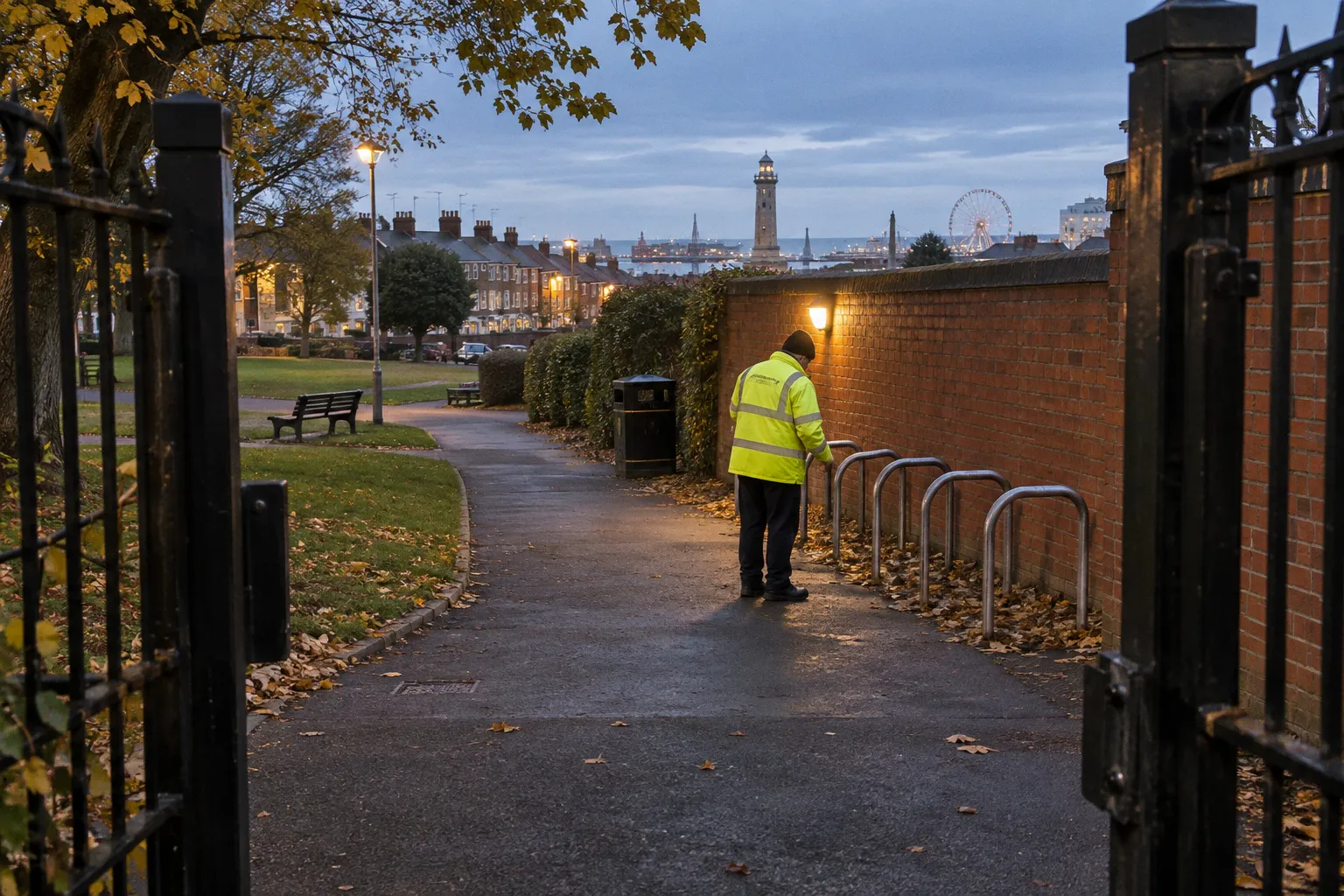
Larger crime-prevention funds can reach £25,000, but the same question eventually arrives in Grimsby, Cleethorpes and Immingham: what happens when the grant period ends?
For local safety groups, community grant sustainability planning is not an administrative exercise to be completed after the project has begun. It is part of the project itself. A neighbourhood initiative is more likely to endure when its organisers know which costs will continue, which partners can carry them, what evidence will support the next application, and how the work belongs to the community rather than to one temporary funding pot.
This matters particularly now. Community Safety Partnerships in England and Wales no longer receive central government funding in the form of permanent annual budgets, leaving many local safety efforts dependent on one-off grants, partner contributions and support from Police and Crime Commissioners. That does not make grassroots action impossible. It means a good idea needs a stronger structure around it.
The shift from seed funding to structural stability
The first grant is often the easiest money to understand. It pays for a defined period, a set of activities and a visible outcome. A local group may receive funding to run detached youth work, improve a community venue, support victims of antisocial behaviour, or organise activity in a place where residents have felt unsafe.
The difficulty begins when the funded period becomes part of the neighbourhood’s normal expectations.
A weekly session that helped young people spend Friday evenings safely may now be relied upon by families. A residents’ group that began with a short-term community wallet allocation may have developed trusted links with the police, housing officers, schools and voluntary organisations. A neglected green space may have become more welcoming because volunteers reclaimed it through regular maintenance and community events. Once that progress is visible, closing the project can feel like losing ground.
The answer is not to treat every grant-funded activity as permanent. Some projects should end when their purpose has been achieved. A time-limited diversion programme may reduce tensions during a particular period; a one-off environmental improvement may resolve a problem that does not need a second round of spending. Sustainability does not mean preserving every activity indefinitely. It means understanding what should continue, what can be handed over, and what evidence would justify a new phase.
A practical sustainability plan asks four straightforward questions:
- Which outcomes must continue after the grant expires?
- Which costs are essential to those outcomes, and which were simply convenient during the pilot?
- Who has a legitimate role in carrying the work forward?
- What will the group do if the next grant application is unsuccessful?
The last question deserves more attention than it usually receives. A project that can only continue if one particular funder says yes is not financially resilient, even if its first year is well managed.
For a small voluntary group, the aim may not be to build a large permanent organisation. It may be to establish a repeatable partnership: a youth club providing the venue, a school sharing space, a housing provider contributing practical support, and residents shaping the programme. In that arrangement, the grant pays for development and coordination while the wider partnership gradually absorbs parts of the work.
A grant can launch a neighbourhood project, but only local ownership gives it a chance of lasting beyond the award letter.
Grant constraints are part of the design
Funding rules can shape a project just as much as the community need does. Local safety grant schemes often set limits connected to the applicant’s annual income. In some UK applications, a group may be restricted to requesting no more than 25% of its annual income shown in signed accounts. A modest organisation therefore cannot assume that a compelling idea will automatically justify a large award.
This is not necessarily a barrier. It can encourage a more proportionate project, provided the group does not hide the real cost of delivery.
Suppose a residents’ association wants to establish a regular evening presence near a troubling hotspot. The budget might include volunteer training, coordination time, safeguarding procedures, refreshments, insurance, publicity, travel and evaluation. If the grant pays only for visible activity but not for the people organising it, the project may appear affordable while quietly placing an unsustainable burden on volunteers.
A better application separates costs into three categories:
1. Launch costs — publicity, equipment, training, venue preparation and initial engagement.
2. Delivery costs — the regular staffing, materials, transport and coordination needed to run the project safely.
3. Continuation costs — the minimum resources required once the grant has ended.
That third category should be calculated before the project starts. It may reveal that the initiative is not expensive to maintain, but it may also show that one annual grant is being asked to carry a permanent service.
The distinction is especially useful when applying to different funding streams. A Community Wallet allocation may be suitable for a locally chosen improvement or a small piece of community activity. A Safer Streets fund may support a wider prevention programme with clearer links to antisocial behaviour, public reassurance or the design of safer shared spaces. A voluntary sector grant may help with community engagement, while a Police and Crime Commissioner fund may favour prevention, victim support or harm reduction.
These labels are not interchangeable, and neither are their reporting requirements. A project should not be reshaped merely to fit a fashionable funding term. The strongest applications begin with a clear local problem, then identify the fund that genuinely matches the proposed response.
Build a budget that can survive a smaller award
Many groups prepare one budget: the amount they hope to receive. Sustainable groups prepare at least three.
| Budget view | What it shows | Why it matters |
|---|---|---|
| Full delivery budget | The complete cost of achieving the project’s intended scale | Prevents underfunding from being mistaken for efficiency |
| Minimum viable budget | The smallest safe and credible version of the activity | Gives the group a realistic fallback if the award is reduced |
| Continuation budget | The cost of maintaining the most valuable elements after the grant | Starts the post-grant conversation before the project ends |
This approach also helps when discussing support with partners. A housing provider may not be able to fund an entire project but could cover room hire. A school may provide access to a hall. A local business might contribute printing or refreshments. None of these contributions should be treated as automatic, and in-kind support should be recorded carefully, but a realistic partnership offer can reduce pressure on the next grant application.
The group should also check whether the fund permits reserves, equipment purchases, staff time, match funding or multi-year commitments. Where those details are unclear, the safest route is to ask the funder directly rather than build a business plan around an assumption.
Make partnerships operational, not ceremonial
A project becomes more durable when every partner knows what it is actually responsible for. A meeting attended by several agencies may demonstrate goodwill, but goodwill alone does not provide a venue on a wet winter evening, cover a safeguarding duty or ensure that concerns are passed to the right service.
Community Safety Forums can give local organisations a regular structure for sharing intelligence, identifying gaps and agreeing practical roles. A Service Level Agreement or Memorandum of Understanding can then set out who will do what, when and with which resources. These documents do not need to be overcomplicated. Their value lies in removing uncertainty.
For a community-led safety project in East Marsh, for example, a useful agreement might clarify:
- who coordinates volunteers and maintains the rota;
- which organisation holds responsibility for safeguarding;
- how incidents are recorded and referred;
- which partner provides the meeting space;
- how residents’ concerns reach the relevant council, police or housing contact;
- what information can be shared and under what conditions;
- how progress will be reviewed after three, six and twelve months.
The project should not be built around the hope that one particularly committed individual will keep everything moving. People change jobs, volunteers become unavailable and organisations face their own financial pressures. A written partnership gives the initiative a collective memory.
This is also where local knowledge matters. Residents often know which alleyway feels unsafe after dark, which route children use to reach school, where young people actually gather and which venue people trust enough to enter. Professional agencies bring other forms of knowledge: incident patterns, safeguarding expertise, environmental design, support services and enforcement powers. Neither perspective is sufficient on its own.
A strong partnership does not ask residents to imitate a statutory body. Nor does it expect public services to hand over responsibilities they are legally or professionally required to retain. It creates a clear boundary around what the community can lead, what agencies can support and where specialist intervention remains necessary.
The wider public funding picture reinforces the need for this clarity. The government announced up to £798 million in additional funding for police forces across England and Wales, bringing total police funding to £19.5 billion for the 2026/27 financial year, including £746 million for local forces tackling antisocial behaviour and knife crime. That investment may strengthen the environment for local prevention, but it does not mean every neighbourhood project will receive a direct or permanent allocation. Community groups still need to show how their work connects with local priorities and how its benefits can be sustained.
Diversifying revenue without losing the project’s purpose
Financial independence for neighbourhood safety groups is a useful ambition, but the phrase can mislead if it suggests that every voluntary project should become commercially self-sufficient. Some safety work has no sensible earned-income model. Victim support, youth diversion and community reassurance should not be forced into a sales strategy simply because a grant has ended.
Revenue diversification is better understood as reducing dependence on a single source.
A local group might combine:
- small community grants for activity and equipment;
- Police and Crime Commissioner funding for prevention or victim support;
- local authority or council-led grant schemes;
- contributions from housing associations or other place-based partners;
- donations from residents and local businesses;
- room hire or modest earned income from unrelated community activity;
- charitable trusts whose priorities match the project’s outcomes;
- Proceeds of Crime Act funding where the proposal meets the relevant criteria.
In 2026, POCA funding schemes are prioritising primary crime prevention, trauma-informed victim support and the reduction of antisocial behaviour. Those priorities may offer a route for projects that can demonstrate a clear connection between their activity and prevention outcomes. They should not, however, be treated as a general replacement for every community grant. The application still needs a credible purpose, suitable governance and an explanation of how the project will be delivered safely.
A group should also distinguish restricted and unrestricted income. Money awarded for a particular youth programme cannot necessarily be redirected to rent, administration or another activity. Unrestricted donations, membership contributions or general fundraising may be smaller, but they give an organisation room to respond when a grant ends or an unexpected cost appears.
The most resilient plan often starts with modest commitments:
1. Secure the basics first. Establish a bank account, appropriate policies, clear signatories and a simple system for recording income and expenditure.
2. Keep a live funding calendar. Note opening dates, eligibility rules, decision times and reporting deadlines rather than searching for money only when the current grant is nearly spent.
3. Create a small unrestricted base. Regular donations, community fundraising or partner contributions can cover practical costs that restricted grants will not.
4. Package the project into fundable components. A full initiative may include youth engagement, environmental improvement, training and evaluation; each element may suit a different supporter.
5. Show the cost of continuation openly. Funders are more likely to trust a group that explains what will happen after the award than one that implies the project will continue without resources.
Diversification also protects the character of the work. If one funder’s priorities change, the project does not have to abandon its purpose overnight. The group can adjust its mix of support while retaining the relationships and local knowledge that make the activity effective.
Embed asset-based development into safety work
Asset-based community development begins with what a neighbourhood already has: trusted people, practical skills, local venues, existing groups, informal networks and places that can be improved rather than written off. For safety projects, this is more than a positive way of describing the community. It can reduce costs and make the work more credible.
A youth club may already have relationships with the young people a new project hopes to reach. A faith group may have a warm, accessible room that is empty on certain evenings. A residents’ association may have volunteers who know how to communicate with neighbours in several languages. A local sports organisation may be able to provide a consistent activity that gives young people somewhere purposeful to go.
Using those assets does not mean asking people to provide endless unpaid labour. Grassroots resilience is not the same as volunteer exhaustion. The project should identify where people can contribute safely and where paid coordination, training or professional support is needed.
The same principle applies to the physical environment. A safety project might focus on improving how a public space is used, not only on adding security measures. Regular activity, better maintenance, community gardening, youth provision and visible stewardship can all influence whether residents feel a place belongs to them. These measures will not replace policing where crime has occurred, and they should never be presented as a cure for serious offending. They can, however, form part of a wider prevention approach.
Evaluation should capture these wider changes. Counting activities is useful, but it is only the beginning. A group can record:
- how many residents took part and whether participation broadened over time;
- whether partner organisations continued meeting after the grant period;
- whether the project reached people who had previously been disengaged;
- what residents reported about confidence, belonging and use of local spaces;
- which referrals or support connections were made;
- what practical assets remained in the neighbourhood after the funding ended.
The evidence does not need to be elaborate. Short resident surveys, attendance records, referral logs, photographs of environmental improvements and structured conversations with partners can build a persuasive account. The crucial point is consistency: gather a baseline at the beginning, review progress during delivery and record what remains at the end.
That evidence then supports the next decision. Perhaps the activity should continue at the same scale. Perhaps it should be reduced and integrated into an existing service. Perhaps a different organisation is better placed to lead it. Sustainability planning is not a promise that nothing will change. It is a disciplined way to make sure the change is guided by local results rather than by the expiry date printed on a grant agreement.
What local groups should do before the final quarter
The final months of a grant are often filled with delivery and reporting, leaving little time for the next stage. A project team should begin its continuation conversation much earlier, ideally when the first half of the funding period has passed.
By that point, the group should be able to explain what is working, what is costing more than expected and which partners are genuinely involved. It can then hold a practical review with residents and stakeholders rather than presenting continuation as an assumption.
A useful discussion might cover:
- the two or three outcomes residents value most;
- activities that can be delivered through existing organisations;
- costs that cannot be removed without weakening safety or safeguarding;
- partners willing to make a written contribution;
- funding opportunities whose criteria fit the evidence;
- a fallback plan if no further grant is secured.
For groups in North East Lincolnshire, this conversation should remain grounded in the particular place. Grimsby is not Cleethorpes, and the needs of a neighbourhood in Immingham will not always resemble those of an estate or coastal community elsewhere in the borough. A broad funding label may be national, but the case for support has to be local: a named setting, a clear group of residents, a practical intervention and a credible account of what will change.
The most convincing continuation plan is not the one with the longest list of possible funders; it is the one that shows who will still be involved when the original funder has stepped away.
Community grant sustainability planning for local safety groups is therefore a matter of relationships as much as money. A balanced budget cannot rescue a project that has no trusted route into the community. Equally, passionate volunteers cannot safely carry a programme that has no provision for coordination, safeguarding or evaluation.
The strongest local initiatives tend to share a recognisable pattern. They begin with a specific concern, use grant funding to build practical capacity, involve residents in decisions, document what changes and gradually distribute responsibility across a partnership. They do not claim that one award has solved a long-standing problem. They make the case for steady, collective effort.
For any neighbourhood considering its next application, the first step is simple: write down what the project must still be doing twelve months after the current grant ends, then identify the people and organisations who can help make that possible. That conversation may reveal a new funding route. More importantly, it can turn a temporary project into part of the community’s own resilience.