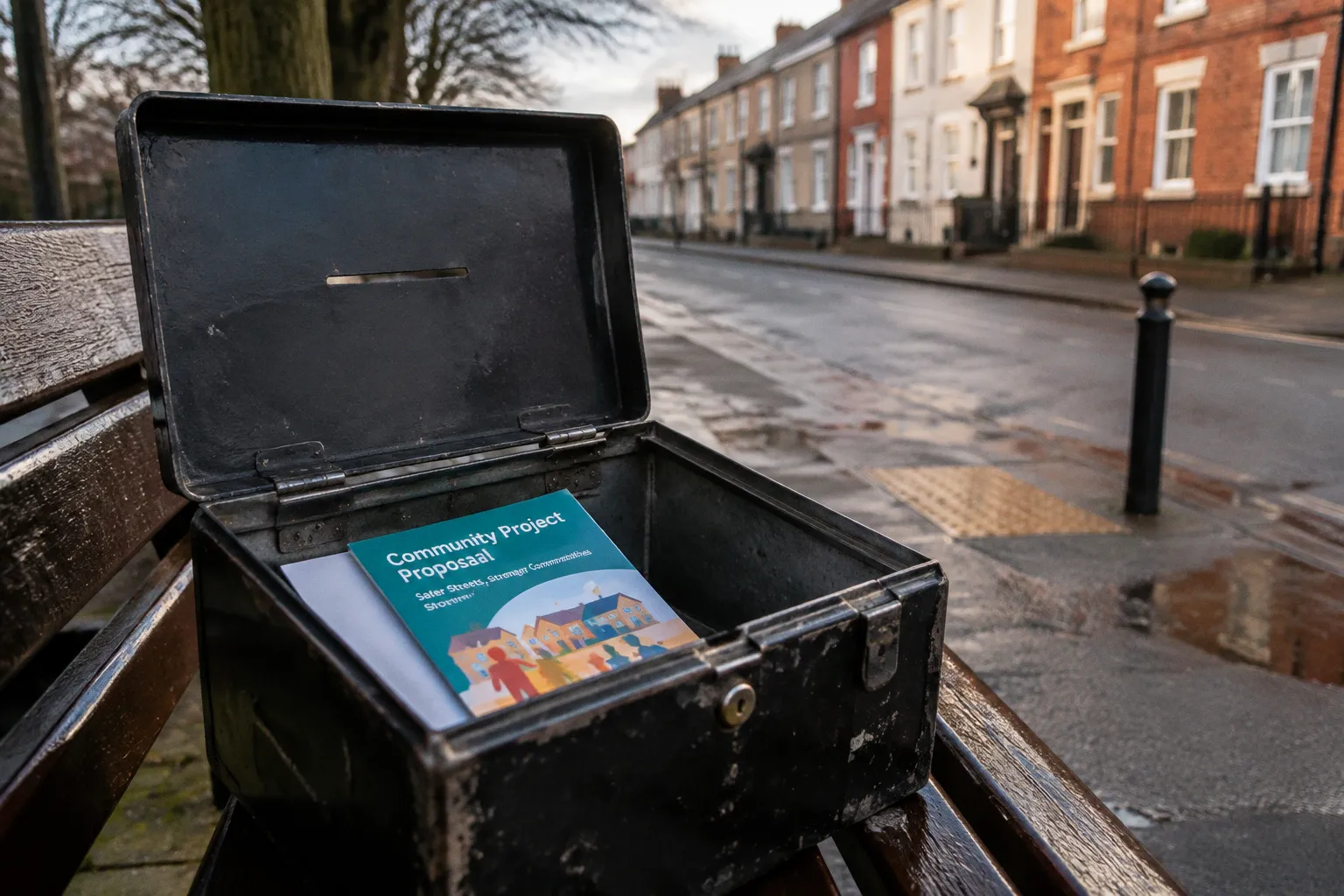
The Community Wallet model ties decisions to defined neighbourhoods, crime-prevention objectives and a formal assessment process. The money is local, but it is not loose change for any worthwhile project.
That distinction matters. A proposal may be popular, well intentioned and useful in a general sense, yet still fall outside the geography, eligibility rules or safety purpose of a particular funding round. The community wallet safety grant allocation in NEL is built around targeted intervention. It is meant to address particular risks in particular places, with residents and local organisations contributing evidence about what will make a difference.
The scheme is administered by Voluntary Action North East Lincolnshire, known as VANEL, on behalf of the North East Lincolnshire Community Safety Partnership and the Police and Crime Commissioner for Humberside. That arrangement places VANEL between the public, voluntary organisations and the bodies responsible for community safety. It also creates a responsibility that should not be brushed aside: applicants and residents deserve straight answers about who decides, what is being scored and why one idea is funded while another is not.
The governance structure: who holds the purse and who sets the purpose
Community Wallet funding is not a single pot with one permanent rulebook. It sits within a wider local safety framework involving the Community Safety Partnership, the Police and Crime Commissioner and North East Lincolnshire Council. Different wallet rounds can be aimed at different areas and can carry different financial limits.
VANEL’s role is practical as well as administrative. It manages the grant process on behalf of the commissioning safety bodies, receives applications and supports the process by which proposals are considered. That does not mean VANEL alone defines local policing priorities or decides what counts as a crime-prevention need. The wider governance structure matters because the funding is intended to connect community knowledge with formal safety priorities.
This is where the phrase community empowerment funding governance stops being a policy expression and becomes a test of the system. A resident should be able to see:
- which organisation is administering the round;
- which public bodies are behind the funding;
- what neighbourhood or statistical area is covered;
- what type of organisation can apply;
- how proposals will be scored;
- whether community evaluation forms part of the decision;
- and what happens after an award is made.
Without that information, a grant scheme can become difficult to distinguish from a closed allocation process. People may hear that funding is available but remain unsure whether their street, club, residents’ group or voluntary organisation has any realistic route into the decision.
The known Community Wallet arrangements in North East Lincolnshire point to a more targeted model. Funding decisions rely on panel scoring and community evaluation criteria, with an emphasis on specific statistical geographies and targeted crime prevention. In plain terms, the question is not simply whether a project sounds positive. It is whether the proposal responds to a defined local problem and whether the people assessing it can see a credible route from activity to safer streets.
Local funding should feel local to residents, but it still needs rules strong enough to show where the money goes and why.
The involvement of the Police and Crime Commissioner is also significant. The office, working with North East Lincolnshire Council, previously secured £432,000 from the Home Office Safer Streets 2 fund for West Marsh during the 2021–2022 scheme. Community Wallet funding is not identical to that larger Safer Streets allocation, but the two sit within the same broad conversation: preventing crime by combining formal enforcement with environmental improvements, community activity and local intelligence.
That combination is easily misunderstood. A grant for a youth project, a neighbourhood improvement or an anti-burglary initiative is not a substitute for policing. Nor should a grant scheme be used to give the impression that residents must solve problems that properly belong to public authorities. The sensible position is more balanced. Police visibility, responsive council services and enforcement remain necessary. Community funding can strengthen the work around them, particularly where local groups can reach people and places that formal services do not reach easily.
The boundary is not a footnote: why LSOA geography controls eligibility
One of the clearest features of the Community Wallet model is the use of Lower Super Output Areas, or LSOAs. These are statistical geographies used to organise population and other local data. They do not always match the neighbourhood names people use in daily conversation, and that is where confusion starts.
For the West Marsh Community Wallet, eligibility was tied strictly to LSOA E01013221. The covered streets included Earl Street, Lord Street, Boulevard Avenue and Macaulay Street. A group working close to that boundary might reasonably see itself as part of West Marsh. But if the project location or beneficiary area sits outside the specified LSOA, the application may not meet the conditions of that particular round.
That can feel bureaucratic. It is also how targeted funding avoids becoming a general-purpose pot. If the money has been allocated to address safety needs identified in one defined area, opening eligibility to every nearby organisation would dilute the purpose and make the original allocation difficult to defend.
The problem is not the use of statistical boundaries itself. The problem is poor communication about them. A map, a list of included streets and a plain explanation of how eligibility is determined are more useful than a grant notice that assumes applicants already understand LSOA codes.
For residents and groups considering a future application, the geography should be treated as an early question, not something to sort out after writing a detailed proposal. The following points usually need to be clear before any serious work begins:
1. Where will the project take place? A group’s registered address may not be the same as the location benefiting from the project.
2. Who will benefit? A proposal aimed at residents in a named area needs to show that those residents fall within the eligible geography.
3. Does the round specify an LSOA? If it does, the code is more authoritative than an informal neighbourhood description.
4. Are the activities tied to the target area? A project may be run by a local organisation but still be too broad if its delivery is mainly outside the funding boundary.
5. Can the administrator confirm the position? If the boundary is unclear, applicants should seek a direct answer before submitting.
This is also relevant to the way success is measured. A targeted grant should not be judged only by how many people attend an event or how much equipment is purchased. The assessment needs to return to the problem in the target area. Has the project improved reporting? Has it made a location more usable and observed? Has it supported people at risk of becoming victims or perpetrators? Has it helped residents share community intelligence with the right service?
Those questions are more demanding than counting activity. They are also more honest.
East Marsh and West Marsh: two financial models, different expectations
The East Marsh and West Marsh Community Wallet schemes show why applicants should never assume that one round’s financial rules apply to the next. Both are connected to local safety work, but their allocations and grant ceilings were structured differently.
| Feature | East Marsh Safety Wallet | West Marsh Community Wallet |
|---|---|---|
| Total scheme allocation | £50,000 | £20,000 |
| Maximum individual grant | Up to £7,500 | Up to £20,000 |
| Geographic approach | Targeted East Marsh safety priorities | Strictly tied to LSOA E01013221 |
| Eligible focus | Voluntary and non-profit safety projects | Local safety and anti-burglary initiatives |
| Wider context | Community-led safety activity | Connected to a West Marsh Safer Streets 2 investment |
The East Marsh scheme offered a total allocation of £50,000, with individual awards of up to £7,500 for eligible voluntary and non-profit organisations. Its scale suggests a model that could support several smaller projects rather than one dominant intervention. That matters in an area where practical knowledge may be distributed among residents’ groups, youth organisations, local charities and other voluntary bodies.
The recorded deadlines for the first two East Marsh rounds were November 28, 2022, and March 31, 2023. Those dates describe past rounds, not a standing promise that the same timetable or criteria will return. Funding programmes change. A future notice may use a different application window, alter the scoring process or target another part of North East Lincolnshire.
The West Marsh model was more concentrated. The total allocation was £20,000, while the maximum individual grant was also set at £20,000 for local safety and anti-burglary initiatives. In principle, that allowed the entire pot to support one substantial project. It also raised the standard an applicant would need to meet. A larger request needs a clear delivery plan, a defined safety problem and convincing evidence that the investment is proportionate to the expected benefit.
The two models illustrate a point that is often lost in announcements about funding: the headline total does not tell residents how the money will affect the ground. A £50,000 scheme split across several awards can produce a network of modest interventions. A £20,000 scheme with a single-award ceiling can back one more concentrated response. Neither approach is automatically better. The right question is whether the financial design matches the problem.
A youth club needing safer evening provision may require a different form of support from a residents’ group seeking alley-gate improvements or an anti-burglary project. The grant ceiling should not dictate the idea. It should provide enough room to deliver the idea properly, without encouraging applicants to inflate their budgets simply because money is available.
How the panel process translates an idea into a funding decision
The exact individual vote breakdowns from previous panel rounds are not publicly established in the available material. Nor is it confirmed whether future 2026/2027 rounds will use open public voting, panel-only scoring or a combination of methods. That uncertainty should be acknowledged rather than filled with assumptions.
What is clear is that decisions rely on panel scoring and community evaluation criteria. This is different from a popularity contest, even when community views are part of the process. A proposal can attract support and still need to demonstrate that it is eligible, deliverable and relevant to crime prevention.
For applicants, the practical task is to connect five elements without overcomplicating the case.
1. Define the local problem
The strongest proposal starts with a specific problem rather than a broad statement that the area needs improvement. That might involve repeated concern about burglary, poor use of a public space, limited safe activity for young people or weak communication between residents and services.
The application does not need to turn into a crime report. It does need to show that the problem has a local basis. Residents’ reports, existing community intelligence, local service knowledge and information from partner organisations can all help establish the case. The point is to move from a general fear of crime to a problem that can be addressed.
2. Explain the intervention in ordinary language
A panel should not have to decode the project. If the proposal is for a youth activity programme, say what will happen, when, who will deliver it and how it connects to safety. If it is an anti-burglary initiative, explain the practical measures and the residents who will be reached.
Plain language is not a sign of a small idea. It is a sign that the applicant understands the work. Overly academic language can hide a weak plan just as easily as it can dress up a strong one.
3. Show why the organisation can deliver
Eligibility is only the first gate. A voluntary or non-profit organisation also needs to show that it can manage the award responsibly. That includes having suitable people, a realistic timetable and a way to account for spending and outcomes.
A proposal built around partners should identify what each partner will actually do. A police or council reference may support the case, but it does not replace the need for the community organisation to explain its own role. The system works better when responsibilities are visible from the start.
4. Link spending to the safety outcome
The budget should tell the same story as the proposal. If most of the money is going on equipment, the application should explain why that equipment is needed and how it will be used. If the project relies on staff or sessional workers, the cost should be connected to the activity and the people it will reach.
Community Wallet funds should not be treated as unrestricted general overheads. The available evidence does not establish that the money can be used for broad organisational running costs, and applicants should avoid presenting it that way. A targeted grant needs targeted spending.
5. Make evaluation part of the design
Community evaluation is not a box to tick at the end. It should shape the project from the beginning. That could involve residents recording changes in how safe they feel using a space, participants reporting whether they know where to seek help, or partner organisations tracking whether a new intervention improves communication and reporting.
The most credible measures are usually modest and specific. A project does not need to promise that crime will disappear. It needs to explain what improvement can reasonably be expected within the grant period and how that improvement will be observed.
A panel cannot fund a vague promise to make an area safer. It can fund a defined intervention with a visible route from money to action.
This is where participatory budgeting for community safety in Grimsby and nearby areas can become meaningful. Participation is not simply asking residents to endorse a finished idea. It is giving them a useful role in identifying the problem, shaping the response and judging whether the result has helped.
Community support is evidence, not decoration
There is a temptation in local grant applications to add a few lines about community support and move on. That is rarely enough for a serious safety project. A panel needs to understand who has been consulted, what they said and how their views changed the proposal.
Community support can take several forms:
- residents identifying a recurring problem in a particular location;
- a youth group describing barriers to safe activities;
- local organisations agreeing to share outreach or delivery responsibilities;
- businesses or landlords contributing practical knowledge about a hotspot;
- volunteers offering time, local contacts or specialist skills;
- residents helping to review whether the intervention is working.
None of this means the loudest voices should automatically determine the outcome. Local debate can be uneven. Some residents attend meetings; others work irregular hours, have caring responsibilities or do not feel comfortable speaking in public. A responsible project should consider how it gathers views and whether the same small group is being treated as the whole community.
The role of community intelligence is especially important. Police data can show patterns, but residents often know the detail behind them: which route feels unsafe after dark, which doorway attracts nuisance behaviour, where lighting fails or which families are not being reached by existing services. That knowledge should be handled carefully and passed through appropriate channels. It should not become a licence for rumour or public accusation.
The bridge between authorities and residents has to work in both directions. Police and public bodies should explain what they can act on. Residents and organisations should provide information that is specific enough to use. A grant-funded project can help create that bridge, but it cannot survive on suspicion and anecdote alone.
Beyond cash: volunteer time and in-kind support
One of the more useful features of this funding environment is the recognition that contribution does not only mean cash. Volunteer and in-kind support can form part of the project’s value. That might include donated meeting space, volunteer coordination, local outreach, equipment already held by a partner or professional time offered without charge.
This matters for smaller organisations. A group may have strong local reach but limited reserves. If cash match funding were treated as the only proof of commitment, many capable organisations would be ruled out before the merits of their proposal were considered.
At the same time, in-kind support should be described carefully. Volunteer hours are not an endless free resource, and donated space still has practical limits. An application is stronger when it explains what contribution is available, who will provide it and whether it is dependable for the full delivery period.
A sensible budget can distinguish between:
- the direct costs requested from the Community Wallet;
- volunteer or donated contributions;
- support from partners;
- and any other confirmed funding.
That separation gives the panel a clearer view of the real cost of the project without pretending that every contribution is a cash payment. It also protects volunteers from being treated as an invisible substitute for proper staffing.
What accountability should look like after an award
The public interest does not end when a grant is approved. Residents should be able to understand, at a reasonable level, what was funded and what happened next. That does not require publishing sensitive personal information or turning a community project into a public relations exercise. It does require a basic account of delivery.
For each funded project, accountability should answer practical questions:
- Was the activity delivered as proposed?
- Did it reach the intended area and participants?
- What changed as a result?
- Were there obstacles or delays?
- Was the budget used for the stated purpose?
- What should be continued, amended or stopped?
This is particularly important when funding is targeted at places with longstanding concerns. People living in East Marsh, West Marsh, Grimsby, Cleethorpes or Immingham have heard plenty of promises over the years. They are entitled to be cautious. A new grant announcement is not the same as a visible presence, a safer route home or a response to repeated reports.
The answer is not to dismiss small projects because they cannot transform a neighbourhood alone. A community grant may provide a youth session, support resident coordination, improve a vulnerable location or help people report problems more effectively. Those are legitimate outcomes. The mistake is claiming more than the project can deliver.
Good governance keeps the claim proportionate to the work. A small project can be valuable without being presented as a cure for crime.
What applicants should take from the model
The Community Wallet process rewards specificity. A strong application is not necessarily the longest one, and it is not the one with the grandest language. It is the one that makes the decision easier to defend.
Applicants should be ready to explain:
- the exact target area and whether it falls within the relevant LSOA;
- the safety issue the project is addressing;
- the people who will benefit;
- the activities and delivery timetable;
- the organisation’s capacity to manage the award;
- the requested amount and how each significant cost supports the work;
- the community input behind the proposal;
- the volunteer and in-kind contributions available;
- and the evidence that will be collected after delivery.
They should also read each new round on its own terms. The East Marsh and West Marsh examples demonstrate that total allocations, maximum awards, geographical restrictions and eligible activities can vary. Past deadlines, including the two East Marsh dates in 2022 and 2023, should not be treated as evidence of a current or future timetable.
For residents who are not applying, the responsibility is simpler but no less important. Ask who received funding, where it will be delivered and what outcome is expected. If a project is announced as a safety intervention, residents should be able to see how it connects with the problem they raised. That is not hostility towards the police, the council or VANEL. It is ordinary public accountability.
A local fund is only as credible as its answers
The Community Wallet model has a sound principle at its centre: local safety problems should not always be met with decisions made at a distance. Residents, voluntary organisations and community groups often understand the practical barriers better than anyone reading a spreadsheet at a regional level.
But local control does not remove the need for discipline. Targeted geography, panel scoring, clear eligibility and honest evaluation are what prevent community funding from becoming a series of well-liked but weakly connected projects. The scheme must remain open enough for capable groups to participate and firm enough to show that money is following evidence and purpose.
For the authorities and administrators, that means publishing straight answers about boundaries, scoring and outcomes. For applicants, it means making the case in precise, grounded terms. For residents, it means using community intelligence responsibly and reporting concerns through the proper channels rather than allowing frustration to harden into rumour.
A visible presence on the beat still matters. So does a resident who knows how to report a problem, a youth worker who can reach people early and a local group willing to stay involved after the grant money is spent. Community Wallet funding cannot replace the basics of public safety. It can help make those basics work better at street level—provided the process remains transparent enough for people to see what was promised, what was delivered and what still needs an answer.