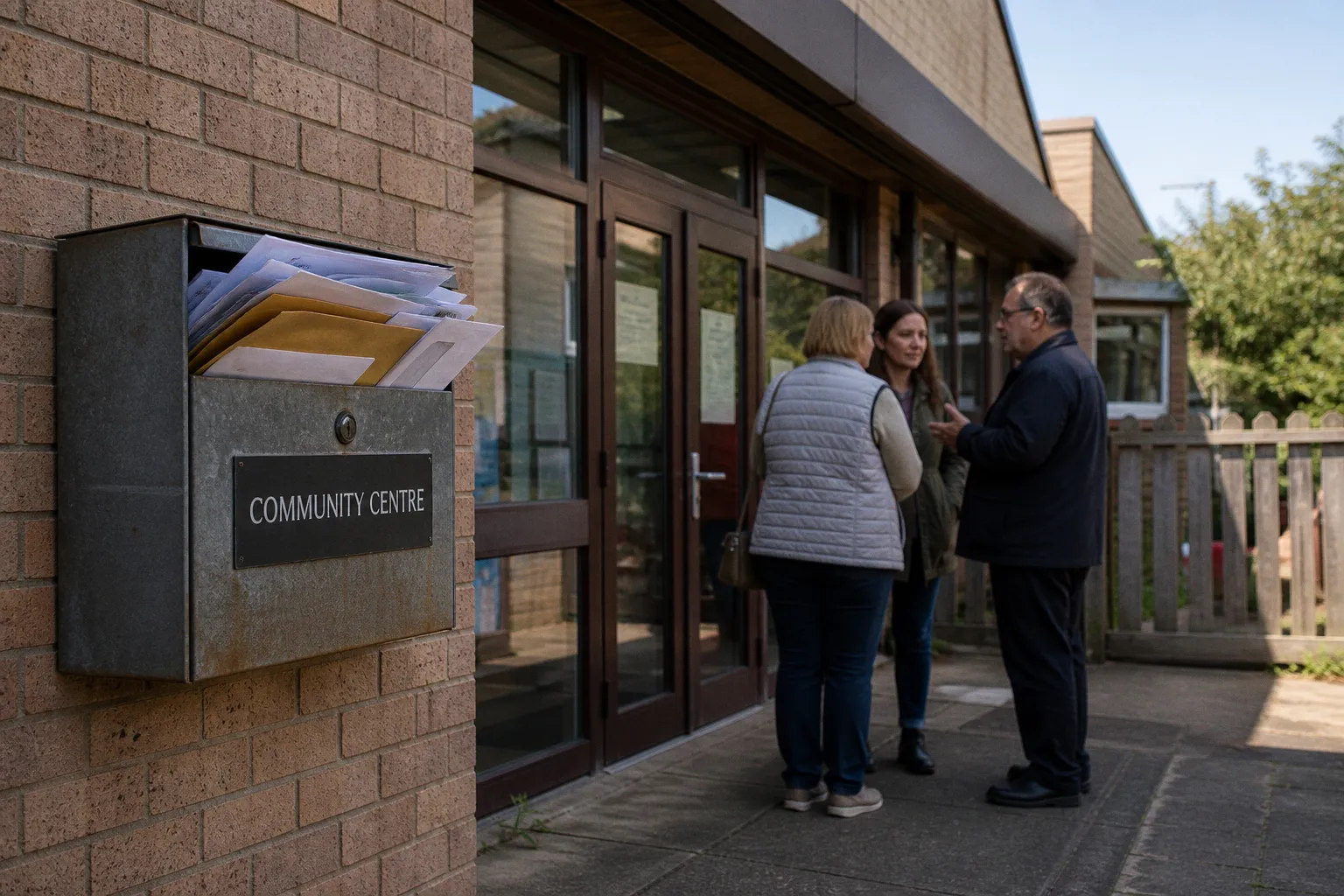
You have gathered your neighbours, mapped the broken lighting on your ginnel or identified an antisocial behaviour hotspot near the local shops, and you are ready to act. Then you read the eligibility criteria, and the language shifts from “community-led” to “constituted organisation with a bank account in the group’s name”.
For the informal resident groups working across Grimsby, Cleethorpes and Immingham, that single requirement can feel like a door slamming shut. The group may be active, trusted and capable of delivering a project, but it may not have a constitution, trustees or a bank account separate from the people who started it.
The good news is that the door has not necessarily shut — it may simply open through a different entrance. Unconstituted neighbourhood groups can, depending on the funding round and its rules, access time-limited safety grants in North East Lincolnshire without first becoming a registered charity or creating a formal committee. The route usually involves working with an established organisation that can receive and manage the funding.
That distinction matters. Informal groups are not automatically eligible for every scheme, and a fiscal host does not remove the need to meet the funder’s geographic, financial and project requirements. But it can solve the specific problem of how public money is held and accounted for. Understanding that arrangement — and checking the boundaries before writing a bid — is often the difference between a project that moves forward and one that stalls at the application stage.
The Financial Barrier: Why Personal Accounts Do Not Work
The most common stumbling block for informal groups is the simplest one: where does the money go?
When a residents’ group is just that — a handful of people who have come together over a shared concern about local safety — there is typically no separate bank account, no treasurer formally appointed through a constitution and no legal entity standing behind the collective. The natural instinct is to nominate the most trusted person in the group, pay the grant into their account and get on with the work.
That instinct is understandable. It is also unlikely to satisfy a public funder.
Community Wallet funding rounds in North East Lincolnshire are administered by Voluntary Action North East Lincolnshire — VANEL — on behalf of the North East Lincolnshire Community Safety Partnership and the Police and Crime Commissioner for Humberside. Public funding comes with accountability requirements. The funder needs to know who is responsible for the money, how spending will be authorised and what records will be available when the project is reported on.
A personal current account cannot provide the same separation as an organisational account or a formal host arrangement. It may contain wages, rent payments, household bills and everyday spending alongside the grant. Even if the person managing it is completely trustworthy, the paper trail becomes difficult to distinguish from their personal finances. That creates a problem for the applicant, the funder and the wider group.
A neighbours’ group full of energy and ideas may be exactly the kind of collective a community grant is intended to support; the funding route simply needs to match the reality of how grassroots work happens.
This is not bureaucracy for its own sake. A clear financial structure protects the group as well as the funder. It reduces the risk that one individual becomes personally responsible for every payment, makes it easier for several residents to oversee the budget and gives the group a defensible record if questions arise later.
It also prevents a common misunderstanding: being “community-led” does not necessarily mean that a grant can be paid to an individual. A funder may welcome an informal group’s idea while still requiring the application to sit under an eligible organisation. Those are two separate questions:
- Who has developed and will deliver the project? This can be an informal residents’ group.
- Who can legally receive, hold and account for the grant? This may need to be a constituted organisation or fiscal host.
The second requirement is where many groups need support. It does not mean residents must abandon the project or immediately create a charity. It means finding an accountable structure that allows the project to operate within the funder’s rules.
Navigating the Community Wallet: The Role of VANEL and Local Partnerships
Understanding who administers the funding helps demystify the process. The Community Wallet is not necessarily one permanent pot with one universal set of rules. It operates through targeted rounds, each of which may have its own purpose, geography, deadline, eligible applicants and maximum award.
The standard NEL Community Wallet rounds offer awards of up to £20,000 per project for non-profit community organisations. More localised allocations, such as the East Marsh Community Wallet scheme, have provided up to £7,500 per project from a dedicated £50,000 fund, typically concentrated in a particular financial year.
Those figures should be treated as features of the relevant funding round, not as a promise that every informal group can apply for the same amount. A new round may use different limits or priorities. Before preparing a detailed budget, check the current guidance and confirm whether the project’s location and delivery model fit the opportunity being considered.
VANEL’s role as administrator is significant because it sits within the voluntary and community sector across North East Lincolnshire. The organisation is familiar with the local landscape: established groups with years of experience, newer resident-led collectives and projects that have grown out of a specific neighbourhood concern. That local understanding can be particularly useful when a group has the right idea but does not yet have the administrative structure expected by a grant programme.
A conversation with VANEL should not be treated as a substitute for reading the guidance. It is better used to clarify the points that are easy to misunderstand:
- whether the relevant round accepts applications from unconstituted groups;
- whether the group must apply through a host organisation;
- which LSOAs or named neighbourhoods are covered;
- whether the activity must take place inside a particular boundary;
- what evidence of resident support is expected;
- how match funding, in-kind support or partnership contributions are treated; and
- what monitoring and reporting will be required after an award.
The wider safety-funding picture also explains why several different routes may appear in the same local conversation. East Marsh received £749,500 under Safer Streets Round 4. West Marsh was allocated £432,000 under Safer Streets Round 2. Grimsby Town Centre saw £300,000 under Safer Streets Round 5. These are substantial investments, but they are not interchangeable pots of money. Each programme has its own scope and conditions, and a project that fits one neighbourhood initiative may not fit another.
For an informal group, the practical lesson is straightforward: start with the project and the area, then identify the funding route. Do not assume that a grant mentioned at a residents’ meeting, in a local newsletter or on social media has the same eligibility rules as every other safety grant in North East Lincolnshire.
The Fiscal Host Solution: Partnering for Grant Eligibility
This is where the practical answer usually lies for an unconstituted group.
A fiscal host — sometimes called a fiscal sponsor — is an established organisation that agrees to receive and manage grant funds on behalf of a group that does not yet have its own legal status or organisational bank account. The host provides the accountability structure required by the funder. The resident group retains responsibility for the idea, the local relationships and, subject to the agreement, the delivery of the project.
The arrangement can take different forms. The host may hold the grant in a restricted project budget, approve payments against an agreed plan, help with procurement and submit or support financial reports. The precise responsibilities should be written down before the application is submitted. A host is not simply a name placed on a form; it takes on real obligations.
For a group considering this route, the questions to settle early include:
- Who will be the named applicant?
- Who will approve spending?
- Can the group make purchases directly, or must the host pay suppliers?
- How will invoices, receipts and mileage or sessional-cost records be collected?
- Will the host charge an administration fee?
- Who owns equipment bought with the grant?
- What happens if the project underspends or needs to change?
- Who will communicate with the funder during delivery?
- What reporting evidence must residents provide?
Some UK fiscal host services can onboard unconstituted groups in under two weeks, although timing depends on the organisation, the complexity of the project and the checks required. The point is not that every group can be made eligible instantly. It is that a fiscal host can be considerably more practical for a time-limited project than creating a charity from scratch.
The typical route looks something like this:
1. Identify a suitable host. Look for an established community organisation in North East Lincolnshire with experience managing external grant funding. A group working in neighbourhood improvement, youth provision or community safety may be better placed than an organisation with no connection to the proposed activity.
2. Test the fit before committing. The host will need to understand the project and confirm that it sits within its own charitable or community purposes. It should also be satisfied that the group has the capacity to deliver what it is proposing.
3. Agree the financial and practical terms. Set out how money will be held, who can authorise spending, what evidence will be retained and how reporting will work. Do this before the application deadline rather than treating it as an administrative detail for later.
4. Apply under the agreed structure. The application may be submitted by the host, jointly with the group or in another format specified by the funder. The current programme guidance should decide the process.
5. Deliver and report. The residents’ group carries out the activity and records what happened. The host provides the financial oversight and reports to the funder in the agreed format.
A fiscal host is not a loophole. It is a bridge between grassroots energy and the financial accountability that public funding demands.
The relationship requires trust in both directions. Residents need to be comfortable with another organisation managing the grant. The host needs confidence that the group is organised enough to deliver, communicate problems and keep basic records. A written agreement protects both sides and helps prevent disputes over purchases, publicity, equipment or unspent money.
There is also a longer-term decision to make. If the group expects to run repeated projects, receive several grants or employ people, formalising may eventually be worthwhile. A constitution and organisational bank account can provide greater independence. But that does not mean every short-term neighbourhood project needs to begin with charity registration, trustees and a permanent administrative structure. The right arrangement depends on the scale and lifespan of the work.
Geographical Constraints: Understanding LSOA Boundary Requirements
A fiscal host solves the banking and accountability problem. It does not solve an eligibility problem caused by geography.
Community Wallet eligibility in North East Lincolnshire can be tied to specific statistical zones known as Lower Super Output Areas, or LSOAs. These are standardised areas used for government statistics and programme targeting. They do not always match the neighbourhood boundaries residents use in everyday conversation.
That is why a project can feel local and still fall outside a particular funding round. A residents’ group may describe its area as East Marsh, West Marsh or a particular estate, while the grant guidance uses an LSOA code or a defined list of eligible zones. A road, park or parade of shops that feels like the centre of a neighbourhood may sit close to — or across — an administrative boundary.
In practice, the group needs to establish three things:
1. Where is the activity taking place? A project to improve a footpath, run youth sessions or organise a neighbourhood safety event should have a clearly defined delivery location.
2. Who is expected to benefit? Some schemes focus on residents living within the target area; others may allow activity that serves a wider community if the main impact remains within the eligible geography.
3. Does the relevant round cover that location? The answer must come from the current guidance, not from the name residents use for the neighbourhood.
A project centred on West Marsh, for example, would need to confirm that its delivery area sits within the LSOA or other boundary specified for the West Marsh funding round. If the group operates near the edge of a boundary, it should check before spending time on a full application. The same applies where the problem itself crosses two adjacent areas. The group may need to explain the split, narrow the project’s delivery area or identify a different funding route.
This targeting is not necessarily about excluding neighbouring residents arbitrarily. LSOA-based funding allows resources to be directed towards the areas identified by the programme as having particular needs. The East Marsh allocation of £749,500 under Safer Streets Round 4, for example, was directed at that area as part of a place-based safety initiative. The geography is part of the programme design: it concentrates money, activity and evaluation within a defined area.
For an informal group, the boundary check should happen near the beginning, alongside the fiscal-host conversation. Keep a simple record of how the area was checked and which guidance was used. If the application later needs to explain why a footpath, community venue or outreach location is eligible, that early work will make the answer clearer.
It is also worth distinguishing between a group’s membership and its project geography. Residents from outside the target LSOA may be involved in organising an activity, particularly where streets or facilities sit close together. That does not automatically make the project ineligible. What matters is how the particular scheme defines beneficiaries, delivery and impact.
Building Your Bid: Strategic Planning for Grassroots Groups
Once the structural questions are resolved — the host arrangement is agreed and the geography checks out — the quality of the application becomes decisive. A formal legal structure cannot rescue a vague proposal. Conversely, an informal group can present a strong bid if it can show a clear problem, a credible response and sensible stewardship of the money.
Describe the safety problem in local terms
Avoid describing the issue only as “crime in the area” or “concerns about antisocial behaviour”. Explain what residents are experiencing and where the proposed intervention fits.
Useful detail might include:
- the specific path, green space, parade of shops or communal area involved;
- when the problem is most visible;
- how residents currently use — or avoid — the space;
- whether lighting, visibility, isolation, noise or lack of positive activity contributes to the concern;
- what residents have already tried; and
- what would change if the project succeeded.
The application does not need to exaggerate the problem. A precise account is more credible than a dramatic one. If the group has spoken with residents, collected informal observations or worked with a local partner, explain what those conversations showed without presenting anecdotal evidence as a complete crime assessment.
Connect the activity to the outcome
A grant application should make the chain of reasoning easy to follow. If the proposal is for environmental improvements, explain how the changes are expected to improve visibility, use of space or residents’ confidence. If it involves youth engagement, explain what the sessions will offer, who will lead them and how the activity relates to the local safety concern.
The project should not promise that one small intervention will eliminate crime. It can promise a defined contribution: more positive use of a space, stronger links between residents, better reporting routes, improved visibility or a structured alternative for young people.
Make resident involvement visible
Informal groups often have a genuine strength here. They are close to the issue and can show that the proposal has grown from local knowledge rather than being imposed by an outside organisation.
That does not mean simply stating that “the community supports the project”. Show how support has been established:
- notes from a residents’ meeting;
- a short record of conversations or a local survey;
- written support from a school, tenants’ group, community venue or other partner;
- a list of residents involved in planning;
- photographs or descriptions of existing community activity; or
- a clear explanation of how residents will help deliver and review the work.
Be careful with personal data. The group does not need to overwhelm a funder with names and contact details. It needs to demonstrate genuine involvement in a proportionate way and follow any data-protection expectations attached to the application.
Budget for delivery, not aspiration
An award of up to £20,000 can support a meaningful project, but the budget needs to show exactly what the money will do. Break costs into understandable lines and connect each one to an activity.
Depending on the scheme and project, that might include materials for an environmental improvement, venue hire, sessional delivery, equipment, volunteer expenses, communications or safeguarding-related costs. Each item should have a reason for being there.
A strong budget also acknowledges practical constraints:
- whether quotes are available or still need to be obtained;
- who will buy and store equipment;
- whether permissions are needed for work in a public space;
- whether insurance is required;
- whether the host will manage payments;
- how volunteer time will be recorded; and
- what happens if a supplier or venue becomes unavailable.
Do not inflate the budget simply because the award ceiling is high. A smaller, well-supported project is more persuasive than a larger plan that has not addressed delivery.
Plan evidence from the beginning
Reporting should not be an afterthought. Decide how the group will know whether the project has made a difference. The evidence may include attendance records, photographs of improvements, feedback from residents, partner observations, records of sessions delivered or a simple before-and-after account of how a space is being used.
The right evidence depends on the project. A lighting or environmental intervention may need photographs and completion records. A community activity may need attendance and feedback. A partnership-building project may need a record of meetings, referrals or follow-up activity.
The group should also be realistic about what it can measure. It may be able to show that residents feel more confident using a space or that a programme delivered the planned sessions. It may not be able to prove that a complex pattern of crime changed solely because of one grant. Honest evaluation is stronger than a claim the evidence cannot support.
Show what remains after the grant
The best projects leave something behind after the funded activity ends. That might be a maintained green space, a stronger relationship between neighbours and local services, a regular youth activity or a residents’ group with the experience to seek future support.
Sustainability does not always mean finding another grant. It can mean identifying who will maintain the equipment, how volunteers will stay involved, which partner will continue the activity or what the group has learned that can be used elsewhere. Explain the realistic next step rather than promising that the project will continue indefinitely.
Many funded projects begin with local residents identifying a problem and deciding that a practical response is worth pursuing. The grant does not create that local knowledge; it can give residents the structure and resources to act on it.
The Bigger Picture: Community Safety as Collective Effort
The question of whether informal groups can access safety funding is not only a technical question about bank accounts and eligibility criteria. It is also a question of whether the people closest to a problem are able to participate in the response.
Across North East Lincolnshire, the Community Wallet, Safer Streets programmes and partnerships involving local authorities, the Police and Crime Commissioner and organisations such as VANEL provide routes for community-led work. Those routes are not identical, and none removes the need for a properly designed project. But they show that a group does not have to become a large charity before its local knowledge can be taken seriously.
For an informal residents’ group, the order of work matters:
1. Define the safety problem and the change the group wants to make.
2. Check the current funding guidance rather than relying on an older announcement.
3. Confirm the project’s LSOA or other geographic eligibility.
4. Speak with VANEL or the relevant programme contact about the application route.
5. Find a suitable fiscal host if the group cannot receive the funding directly.
6. Agree financial responsibilities before submitting the bid.
7. Build a budget and evidence plan that match the group’s actual capacity.
8. Keep the project focused on a deliverable local outcome.
That could mean better lighting around a dark footpath, a youth diversion activity, a more active community space or a neighbourhood safety project that develops beyond a WhatsApp group. The important point is to turn a general concern into a defined piece of work, with a responsible host, an eligible location and a clear account of what the funding will achieve.
The money may be available, but it will not remove the need for local organisation. What an informal group brings is precisely what a distant programme cannot manufacture: knowledge of the place, awareness of how residents use it and the relationships needed to make a small intervention work. The fiscal host and funding process provide the framework. The purpose, credibility and staying power still have to come from the people who live there.